Former Israeli hostage Elkana Bohbot shares of his struggles with trauma from Gaza captivity




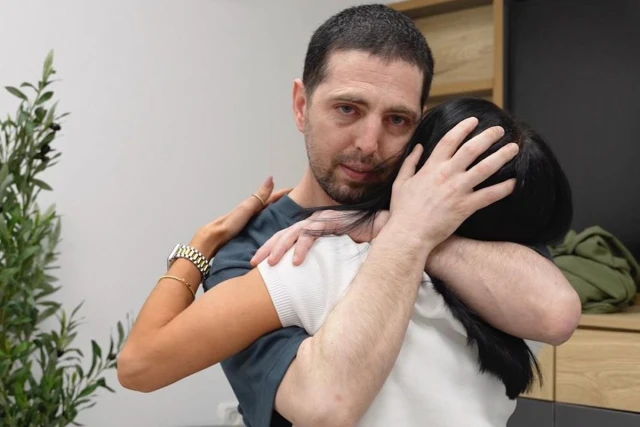
Former Israeli hostage Elkana Bohbot was kidnapped during the Hamas Oct. 7, 2023, attack and survived for 738 days in Gaza captivity. He was among the last 20 living Israeli hostages who were released during the American-brokered ceasefire in October.
In an interview with Ynet News, Bohbot spoke about his trauma resulting from the difficult captivity and the struggle to rehabilitate his family and himself.
“These were two years of suffering and uncertainty,” Bohbot recalled. He suffered from hunger, beatings, darkness in the Hamas tunnels and fear that every day could be his last.
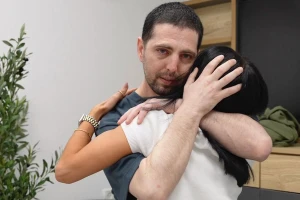
“Every day that began, I had no idea whether I would live or die. I was cut off from everything, and especially from Rivka and Reem,” he explained, referring to his wife and son, who was almost three years old at the time of his kidnapping.
“All the time, thoughts. What’s happening to them? Where are they? What did they tell the child? How is he coping? It drives you crazy. That was the hardest part,” Bohbot said.
Working professionally as a music entrepreneur, he played a leading role in organizing the Nova music festival together with twin brothers Osher and Michael Vaknin, his childhood friends who were murdered by Hamas terrorists on Oct. 7.
“People lay down on the ground in panic, and then the chaos started,” he recalled. “A manhunt. A massacre. Bodies. Things happened very fast. Suddenly, about 70 terrorists arrived. They moved through with weapons, smashed car windows, and carried out executions. They shot people who were already dead."
Bohbot survived the Nova festival massacre and recounted the moment he was kidnapped.
“They loaded us onto a pickup truck and drove us to Gaza,” he explained.
“I happened to be lying on top of other people, so I absorbed all the blows. Every three minutes, someone would lift my head and beat me. Another would fire his weapon and then press the hot barrel against my leg, again and again. In Gaza, they thought I might have a bullet in my leg, because it was open to the bone from the burns caused by the heated weapon. They started digging into it. I refused. I told them that from my perspective, they could amputate it, just not touch it,” he said.
Bohbot explained that the torture began the moment he arrived in Gaza.
“The first thing they did to us in Gaza was put us in that room and beat us,” Bohbot recalled. “My head was filled with insane thoughts. I talked to God. I told him, ‘Release me from this suffering. Give me a bullet in the head.’ Just let me die, as long as I don’t get lynched. I thought only about Reem growing up knowing his father was murdered in a Hamas lynching,” he continued.
Bohbot admitted that on multiple occasions he believed he would not survive captivity in Gaza.
“Another hour, another day, another evening, another night, and that’s it, you can’t anymore. Many times I said I couldn’t go on. I reached states of dissociation and shutdown. I had already understood as a soldier that if I were taken captive, I would be physically abused. But mentally, I was less prepared. That destroyed me,” he explained.
Bohbot revealed that Hamas propaganda included attempts to film simulated suicide videos.
“They dictated what we had to say, but the screaming was real,” he said. “With the video that never came out, they went the furthest. They drew blood from our hands. They beat us because they wanted us injured for the filming. They wanted to simulate suicide scenes.”
He recalled one specific traumatic encounter with a Hamas terrorist.
“One time, a terrorist came with a box cutter,” Bohbot said. “He told us, ‘Choose who I cut a finger off.’ We screamed, begged, pleaded. It didn’t interest him. He said, ‘I need to return to my commander with a finger, with blood. Do you want him to come, or should I choose one of you?’ In the end, he said, ‘Fine, next time.’”
He stressed that his return to freedom in Israel was the single most important event since the birth of his son Reem.
“Yes, after Reem's birth. Walking out of that place on my own feet is a miracle. To come out alive after all the death I saw in those two years? I still can’t process it.”
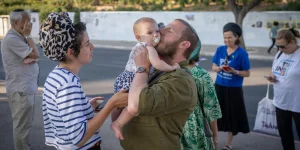
Despite all the trauma, he is determined to recover and live a normal life with his family.
“Seeing Rivka and Reem next to me every day. I’m also in therapy. This rehabilitation is not simple. Reconnecting with Reem after two years without a father figure is a process, and it will be long. My mother is also ill, and that’s another battle. It doesn’t make things easier. We’re fighting on many fronts,” he explained. Looking ahead, Bohbot said he hopes he and Rivka will have more children.
“My dream is to give Reem a brother or sister as soon as possible, and for them to have a home here in Israel to sleep in. That’s what I want. We need that. Rivka and I, and the whole family, are in therapy and dealing with so much. We’re not managing to return to routine. And that’s all we want.”
You might also like to read this: