On the way to Gaza


On the way to the Gaza border yesterday my friend asked how many times I had been there since the October 7, 2023 Hamas attack and massacre. I had to think about it. I remember the first trip vividly. Several other trips were outstanding whether visiting soldiers and bringing supplies or preparing and providing food, one on one like the time with my friend Marziyeh (Marzi) Amirizadeh and seeing the devastation through the eyes of a woman who suffered the evil hatred of radical Islam growing up and living in Iran and identifying the evil we faced with the evil that she lived under for most of her life, or planning for and implementing our incredible Root & Branch program bringing Christian volunteers to harvest olives in Israel and along the Gaza border.
There were other trips with friends & donors, as well as relatives, media and more. In the car I estimated that I’ve visited the Gaza border at least 30 times. In retrospect it’s probably more. Surely averaging once a month. Considering my travels that’s a lot.
Some trips blur together. Some are memorable for different reasons. All are emotionally draining. Yesterday was no different. It had been a while since the last time.
Along the roads from Routes 34, 232, 25 and more, I noticed the increased number of memorials along the side of the road. From piles of stones with flags and photographs these have been “developed” to permanent and thoughtful memorials. In America and other countries, you see similar things where people have died in car accidents. The roads have been repaved and show no signs of what happened that day anymore. But I remember the countless points where one would drive and see large dark spots on the road with a slight bump as you drove over them, burn marks from the high temperature flames where cars were set on fire. Torched with people inside.
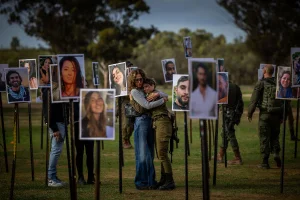
The roads no longer have the scars but the memorials along the side of the roads show the points where hundreds of people were shot and burned to death, their bodies and their cars littering the roads.
I looked at the piles of the shot up and burnt remains of the vehicles from that day. More than 1000 cars, many of which became death traps for their passengers. As we visited the site that also has been built up as a permanent memorial, first I noticed dozens of tour buses. Most were for Israelis for whom the site has become a pilgrimage. People wanting to see, understand, bear witness to the horrors of that day.
There are few tourists in Israel now so most of the guides and survivors telling stories of what happened that day were speaking Hebrew. What broke my heart, other than the memorial itself, was the prevalence of young people. It’s terrible that we must educate our children about this all and it’s part of the legacy we leave them. It’s not new but its still sad. Many high school students. Some of whom got to pray their English in a spontaneous conversation with Marzi about her life and imprisonment in Iran. She connected the dots of the Islamic Republic and Hamas as the same evil. That we have the same enemy. That the Iranian people are not the regime that hijacked Iran 47 years ago and that the people support Israel.
Three years ago, they were early adolescence and three years from now they will all be serving in the army defending from enemies like these that we continue to face. I wondered if in seven or 10 or 15 years, my own grandson’s will be part of this pilgrimage.
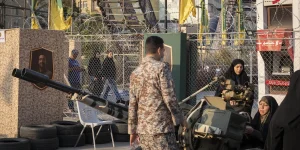
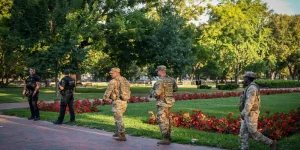
I saw a group of soldiers, Three years earlier they were the age of the high school students we encountered. They stood there with weapons over their shoulders, against the backdrop of piles of dozens of burnt remains of just some of the cars. Their weapons are used to defend us against the evil that perpetrated the crimes that we witnessed with the cars just as one reminder, listening to things they surely remember from three years ago when they were just students and Israel was at its most vulnerable.
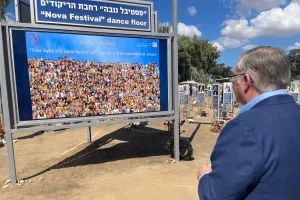
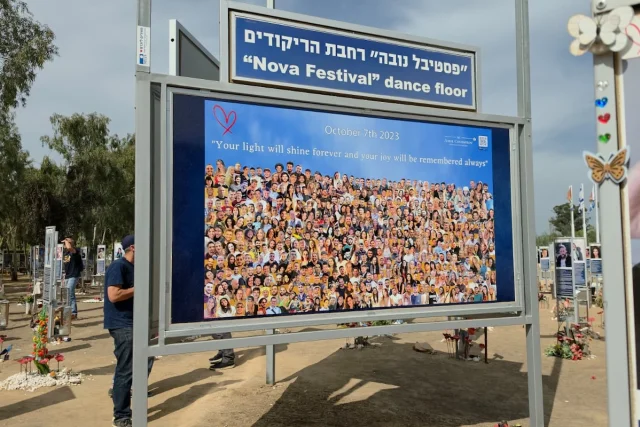
At the site of the Nova Music Festival where some 25% of the 1200 people killed that day were slaughtered, the memorials have become uniform and standardized, albeit with personal touches from the loved ones of those who were killed and mutilated there that day. I always describe it as a cross between Woodstock and Auschwitz. We spent nearly an hour there, but what’s really needed to understand the enormity and the scope of the loss is much more, even if you’ve been there multiple times before as I have.
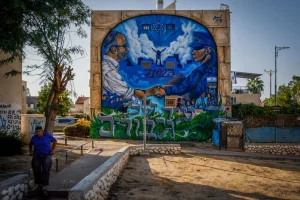
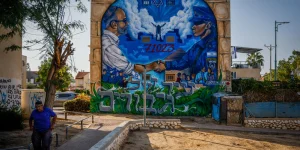
In Sderot we visited the powerful memorial at the site of the former police station in which all the police on duty that morning were killed and many others on the street. As hard as it is to think, amid the slaughter there was incredible heroism and it was a miracle that more people were not killed there that day. Of course, that’s no comfort for the survivors whose loved ones are no longer with us.
I told the story of the Suisas, the young parents who were killed, and whose two young daughters became orphans in one of the most gripping stories from there that day. It always must be noted that the person who tried to save the family was a Bedouin Arab. His story is not unique as many Israeli Arabs were killed that day, including a police officer inside the police station, but is important to recount as it points to the reality of life in Israel, where loyal Israeli Arab citizens exist, and unfortunately also die alongside Jewish Israelis.
On an uplifting moment, we visited a remarkable program for at risk youth, who come from homes where their parents are unable to provide for or protect them sufficiently. We heard stories of just two children, whose recollections from that day will carry emotional scars and trauma for the rest of their lives.
But it’s uplifting all the same to know that by providing resources as we have, they are able to help the children with a variety of therapeutic treatments and hot meals and warm hugs that make them feel safe and hopefully set them on a path for overcoming the circumstances which they were born into. Please contact me if you would like to be part of buying Hanukkah presents for these children who will almost certainly not receive anything from their families.
As the sunset, we made our way to one of the lookout points from which Gaza is visible. Despite international claims otherwise, even with the naked eye one can see entire cities still standing. And even three years and a week after the inhuman Hamas attack and massacre, there was a jarring audible punctuation of the reality as we heard significant gunfire, taking place at that moment inside Gaza, indicating that the terrorists are still standing, and if not fought and pushed back, they will rise and try to attack us again and again.
The numbers alone do not sufficiently represent the enormity of the day. Each of the 1200 people, including Jewish and Arab Moslem and Druze Israelis, as well as many foreigners including Christians, is the loss of an entire universe for them and their loved ones. But there’s a national story as well, timeless in the sense that it’s an unfortunate part of the reality of Jewish history and the foreseeable future.
However, many times I have gone to visit these sites, each time thinking that there’s nothing particularly new in doing so other than bringing people who have not yet witnessed it, I am sadly shocked at how there’s still so much to absorb and how such experiences are necessary.
You might also like to read this: