I wish you knew what Israel's Memorial Day really was, I wish we didn’t have to

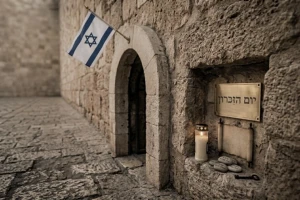
It took the jarring two-minute siren sounded across the country a few minutes ago for the epiphany that I needed to share about the unique commemoration of victims of war and terror that’s taking place today, as we do every year as we observe Memorial Day in Israel. It’s an important thing to understand in a country that has never lived a day of 78 years in peace, and coming out a 40-day operation against the Islamic Republic, and ongoing war against Hezbollah in Lebanon, Hamas in Gaza, and other Islamic terror groups, with the threat of war and terror looming. It’s important to understand the paradox of living under this threat from day one through today, and to note our resilience. Its one of the most remarkable aspects of Israeli society that I wish you understood overseas, and I wish we didn’t have to understand ourselves.
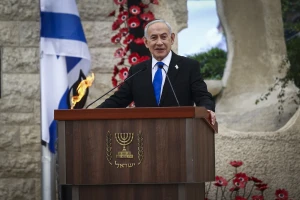
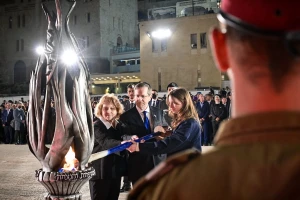
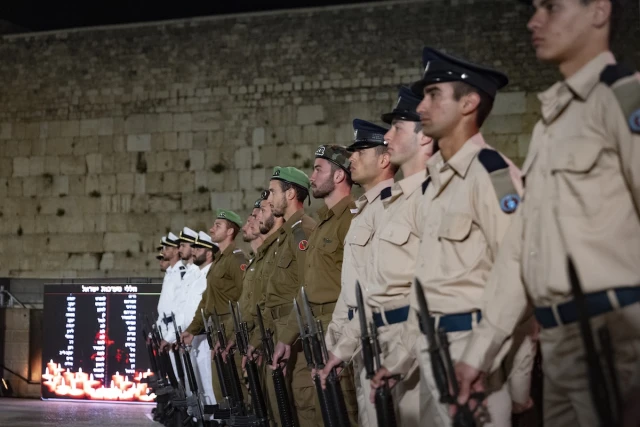
Last night I attended one of hundreds of events that began the solemn observance of Memorial Day across the country. Some are local community events, some are national and televised. The event was powerful but more on that in a moment.
No less powerful was getting to the event outside the walls of Jerusalem’s Old City. I started in Tel Aviv in the afternoon as things began shutting down in preparation for the commemoration. Businesses, shops, cafes and restaurants all closed. People scurrying to get where they were going to begin the solemn observance.
The event itself in Jerusalem’s Sultan’s Pool was a mix of inspiring recollection of the lives of any number of victims of war and terror to which Israel has been subject. Jews and Arabs, Israelis and non-Israelis. Stories would be shared often with the deceased person’s loved ones, followed by a song that encapsulated the person’s life. It felt that these songs were written especially to commemorate the person being memorialized. But decades of war and terror lead to popular music reflecting our sad reality that are personal to us all.
At one point, a woman spoke about her husband who had been killed in battle. She referred to the prayer that’s a central part of the Passover seder, sung as a way to glorify God for having saved us then, as slaves in Egypt, and still today. Accompanied by a pianist and singer with the lyrics projected on the screen for us all to sing, she picked up a violin and played along, commemorating her husband and all those who have been lost. The final words of the song changed from praising God for saving us, to affirming that he will continue to do so. Something we believe, but need to be reminded at these mournful times.
What struck me this morning, as the two-minute siren sounded was that the elementary school outside my office window had assembled all the students on the soccer field for their own ceremony. Imagine this being repeated thousands of times all across the country as every school, all the students stopping in silent prayer and reflection honoring those who have been killed.
At that moment I realized that it’s not just national but very personal. It’s hard to find any Israeli – Arab or Jew – who has not been impacted directly or indirectly by decades of war or terror. It’s come close to our family too many times. Last night, my son-in-law asked to borrow my car to take my oldest grandson to the ceremony at his school. He’s seven. His father has spent hundreds of days in reserves since the Hamas massacre of October 7, 2023.
Whether our children are old enough to know details of the war and acts of terror (this year everyone knows something having spent many hours in their bomb shelters over the past two months), all know that we have sacrifices to be here, to continue to maintain our sovereignty in the Land that God gave us, to which He brought us when we were freed from slavery in Egypt, just as the song reminds us.
These realities are part of the national DNA in Israel. They are inherited from generation to generation. I wish it weren’t that way. I wish that we could live as detached as those in America for whom Memorial Day is a holiday, where people wish one another “Happy Memorial Day,” (think about it) or use it as an excuse for Memorial Day sales. It’s not part of a holiday weekend, going to the beach, or the beginning of summer vacation. Nor is it the occasion for radio stations to the “top 500 songs of all time.” In fact, in Israel, all frivolous TV and radio programs are suspended. It’s a day to mourn what and who we have lost in order to remember and appreciate what we have.
As I stood in silence, I contemplated that hopefully soon in a free Iran, there will be a Memorial Day like ours, where tens of millions of Iranians who have suffered the brutality of the Islamic Republic for half a century, will have an experience to remember those they’ve lost, and come away stronger, more committed to maintaining and cherishing their freedom. I pray this day will come soon.
I pray that Syria and Lebanon will also be freed from the Islamic radicals that have hijacked their countries and are responsible for countless deaths and suffering there. There’s talk of peace. Maybe that’s a little too bold for right now. Let them become free, and also have their days of commemoration as well, as independent peaceful neighbors.
The same with the Palestinian Arabs, living under the heels of Hamas, Islamic Jihad and the PLO who have only brought suffering on themselves and on us. There’s a trend to hijack our Memorial Day and have joint memorials with Palestinian Arabs. I reject that. Let us have ours and them have theirs. But let them first rise up and shed the Islamic extremism that has led to so much suffering for so many decades, and not frame their narrative with the singular goal to annihilate Israel and the Jewish people.
We are stronger than all their evil. How we do Memorial Day depicts that in a way that few can comprehend. I wish you knew what Memorial Day really was, and I wish we didn’t have to.
You might also like to read this: