Hamas disarmament deal – good or bad? It’s a matter of interpretation



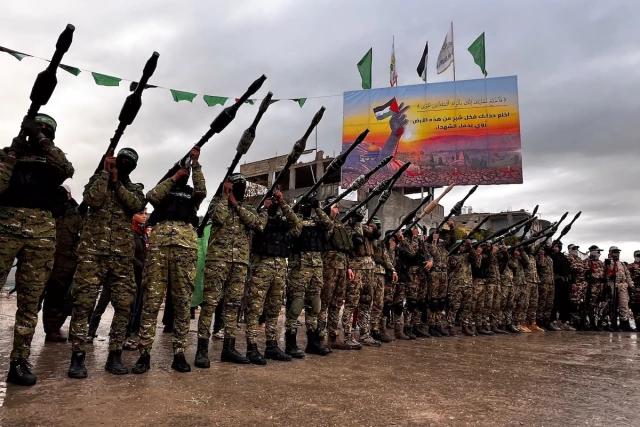
Language is a funny thing. It’s not only based on words but also on the interpretation and meaning of those words. In the case of the newly forged Hamas disarmament deal, brokered with the help of Egypt, Turkey and Qatar, deciding on whether it’s good or bad largely depends on whom you ask.
On Fox News, Brian Kilmeade, filling in on Jesse Watters Primetime, reported the following:
“The president has begun choking off one of Iran’s favorite proxies – Hamas. Last night, his Board of Peace reached a historic agreement in the Middle East. The terror proxy agreed to disarm and remove their weapons from Gaza. The Strip will be demilitarized, in theory. In return, Israel is supposed to withdraw all the troops out of Gaza. The deal will also allow a new Palestinian government to form to serve the people, backed by a fresh police force and an international stabilization to keep the peace. Trump called this a critical step towards lasting peace and security in the Middle East.”
Trump, in the belief that his nightly attacks on Iran are responsible for this development said, “It’s a great breakthrough. Nobody ever thought that it would be possible to disarm Hamas. That shows you how much success we are having with Israel, because four or five months ago, a deal like that would have been impossible, so it’s a big step for the Middle East and people are really impressed and surprised by it.”
Secretary of State Marco Rubio concurred, saying, “This disarmament deal that you brought with Steve and Jared’s work on Hamas is another big step as well. It’s something a lot of people thought would never happen. The fact that they even agreed to it is a real achievement.”
Kilmeade went on to say “There’s still a lot of work to be done. The U.S. and the Board of Peace have to establish a complete accounting of their weapons. Hamas says they are willing to put their guns in storage or, as they put it, on ice. That’s the term they used. So, we are making progress, and once that’s complete, the terrorists say they will hand over power to the Board.
“This is all part Trump’s 20-point plan, and remember, that’s how we got the hostages out. But giving up a government seat isn’t the same as giving up control. Israel is warning Hamas could still run things right through to Hezbollah in the north. The Israelis are major players in the deal and they’re skeptical. Who can blame them for saying they can’t leave Gaza without assurances of their security.”
While that sounds like cautious optimism, the Israeli evening news tells a completely different story.
On Friday evening’s N12 news, three prominent Middle East experts gave their assessment. The first was Israeli investigative journalist Dr. Ronen Bergman, senior political and military analyst for the Hebrew newspaper Yedioth Ahronoth.
He said, “Israel is not being asked to sign off on this agreement as they already approved the agreement of October. But the conditions set forth in this agreement are opposite from that one. They have demanded that, within two weeks from this past Sunday, Israel will no longer be able to target Hamas operatives. This is not disarmament. It’s storage of weapons in Gazan warehouses. Hamas will not be required to leave Gaza. They will have complete immunity. Israel will be expected to retreat and eventually leave Gaza as weapons are given up. Heavy weapons are not defined in the agreement. The ball is in Bibi’s court. Will he see this as a great accomplishment or will he risk a conflict with the U.S.?”
The second to opine was Israeli publicist and journalist, Amnon Abramovich who said, “The 20-point agreement of October actually facilitated Hamas to regroup. It’s based on Israel leaving Gaza. Far-right members of Netanyahu’s coalition opposed the agreement but remained in the government. What does it mean to disarm them from light weapons? They have 60,000 Kalashnikovs. Will they give them up? Nothing is clear. Who will be responsible for all of this? Not moderate Arab countries. It’s Turkey and Qatar, so it’s a failure.”
The third to speak was the distinguished retired Major General Israel Ziv who said the following: “Why did this sit for 10 months and suddenly come up now? During those 10 months of relative quiet, it gave Hamas time to regroup. There are three problematic issues:
Disarmament turns into storage of weapons;
An international force will tie Israel’s hands, because preventing them from being able to freely act militarily;
All the bureaucratic wrappings can’t hide the fact that it’s a “Hudna,” (the Arabic word for a temporary truce, armistice or ceasefire for a fixed duration, rather than a final end to hostilities) for Hamas until they recover and feel strong enough to return to the game.”
And there you have it! Two completely different outlooks on the same agreement. Which one seems to be more believable and realistic? Rule of thumb is to go with those who are the most experienced and intimately familiar with the mindset, culture and behavior of the enemy. In this case, that would be Israel, hands down.
No one in this geographical area is shocked or surprised that mutually agreed upon terms end up being misread or altered, just a day later – sometimes even sooner. No one is bewildered that the weeks’-long back and forth was just an exercise to buy more time. And no one is disturbed by the revelation that everything they believed to be trustworthy promises were only lies.
That is because Western values are not part of the way people operate in these parts. The sanctity of one’s word isn’t the preferred code of ethics, employed by an enemy whose religion allows for deceit and trickery.
And most important of all, when the peace which is sought is only one-sided, the enemy will continue its goal of total conquest and whatever it takes to achieve its end.
This is what is missed by negotiators whose background is in real estate and business transactions. For them, it just comes down to the right figures and terms, whereas with terrorists, such as Hamas, no deal is good, because their end game is the total destruction of the only Jewish state in the Middle East.
You might also like to read this: