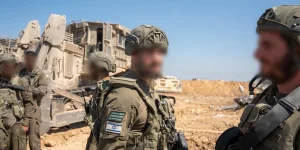
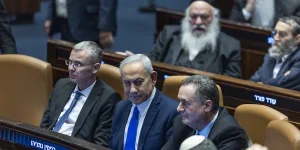
What about the other 30% of Gaza controlled by Hamas?


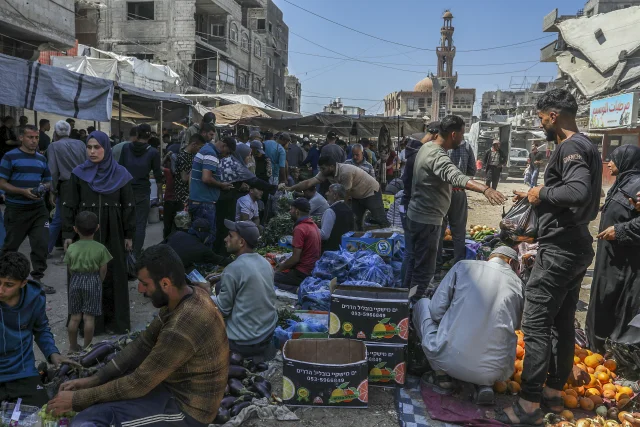
There’s good news and bad news. The good news is that, according to a recent Jerusalem Post article entitled, “Next step in Gaza begins with the international force,” Israel actually controls up to 70% of Gaza. The bad news is that the remaining 30% is controlled by Hamas.
For Gazan residents, who have the misfortune of living in that 30% area, they find themselves like the hostages - helpless, unable to leave and no longer in charge of their destiny.
Consequently, one would think it’s a bit premature to bring in an international stabilization force to implement the vision of the Board of Peace, established by President Donald Trump in January 2026, for the purpose of managing and overseeing Gaza.
But, given the fact that Hamas, which promised to relinquish all governance, recently elected a new leader, Khalil al-Hayya, why does anyone think that they will not seek to expand their control into the 70% under the authority of the IDF?
As the successor of Yahya Sinwar, the 65-year-old Khalil al-Hayya has made a name for himself, as a lecturer, member of the Association of Palestinian Scholars and academician who served as dean of Student Affairs for Islamic University of Gaza.
No less radical than Sinwar, he has advocated for close ties to Iran and refers to Hamas as part of the Islamic resistance movement. Describing October 7 as a “a necessary act to put the Palestinian issue back on the table,” he has no intention of overseeing Gazan’s everyday needs, such as water, electricity and other basics, but rather focusing all of his energies on “the Palestinian cause.”
That does not seem to be a winning formula for the homeless and hungry of Gaza or an effort to rebuild the ruins by creating a livable and vibrant society for the people who foolishly trusted their political leaders to provide them with hope and a good future.
If anything, it sounds like more of the same – strategizing with Hamas survivors to find a new way to attack Israeli communities and the continuation of claiming victimhood while pointing to Israel as the aggressor.
Of course, they’ll need a new plan to procure weapons, finances, building supplies for new tunnels, as opposed to schools, hospitals and housing and, most importantly, the recruitment of boys to replace the thousands of terrorists who were eliminated.
How does an international force intend to confront that reality? It’s like plugging up the holes in a boat at the same time that someone else is carving out new ones to let in the water that will eventually sink the boat.
As long as Hamas remains intact, controlling 30% of Gaza, all attempts at revitalizing Gaza will fail, since the terror group is wholly committed to undermining any progress that would be made. Consequently, this next premature phase is doomed even before it gets off the ground.
As humanitarian aid, equipment and building materials begin to enter Gaza, financed through a conglomerate of nation states and organizations, for the purpose of rebuilding, who will stop Hamas from forcibly seizing what has been sent for the Gazan people?
Will the terror group, in need of militants, allow young boys to get an education so that they can abandon the aspiration of becoming a shahid (martyr) before the age of 20? Or will they take them at gunpoint, giving them no choice but to be trained for the next massacre that will “call attention to the Palestinian cause?”
What about the construction of a new Gazan police force which has been thrown around as a necessary means of maintaining order and peace? Will Hamas members manage to integrate into such a body of law enforcement, enabling them to kill at will? Who will prevent such individuals from infiltrating a police force?
All of these very complex issues must be resolved well before an international force can be an effective body in the reshaping of Gaza. Perhaps, chief on the list of things to confront would be the refusal of Hamas to disarm, per phase two of the Gaza peace plan, brokered in October, 2025.
Up until now, no one has been successful at getting them to honor the agreement so that the next phase can move forward. Phase two of the Gaza peace plan specifically involves “demilitarization, technocratic governance, and reconstruction, shifting the territory from a basic ceasefire toward long-term stabilization.”
Since that never happened, Gaza has turned into a quagmire, from which nothing good can emerge. Seeing their weapons as “central to its identity as a resistance movement,” Hamas will never cooperate with an international plan whose goal is to rebuild and restore.
If anything, they will fight every effort made to turn it into a peace-loving, law-abiding territory which has a chance to reject the poverty and misery brought on by unending conflict. Because, by their way of thinking, a peaceful Gaza is not helpful to their goal of defeating Israel.
Since Al-Hayya wasn’t democratically elected, but rather appointed by a general council, that already tells you everything you need to know about the fact that Gazans have no say in their government nor the ability to democratically decide their fate.
This is why the 30% control, still maintained by Hamas, is so crucial to crush. Because until then, Gaza will be hijacked by the same terrorists who are responsible for all of the devastation and havoc wreaked upon their people as well as the constant threat they pose to all of Israel, especially the neighboring kibbutz communities they already brutally attacked.
Any international governing force must recognize, ahead of time, that their efforts will be in vain if the remaining 30% of Gaza is not freed from the monsters who refuse to give it up.
To disregard that is to throw good money after bad, to expect positive results from an already negative deadlocked impasse and to foolishly anticipate a good outcome. At some point, lessons must be learned if we are ever to eradicate the horrors of terrorism.
Shouldn’t that be internalized before wasting everyone’s time? Until 100% of Gaza is controlled by those committed to peace, no one should make the mistake of skipping the vital steps of phase two! Because no healing process can begin until the cancer of Hamas is completely excised.
You might also like to read this: