Israeli surgeons perform first complete rib cage replacement with 3D-printed implant





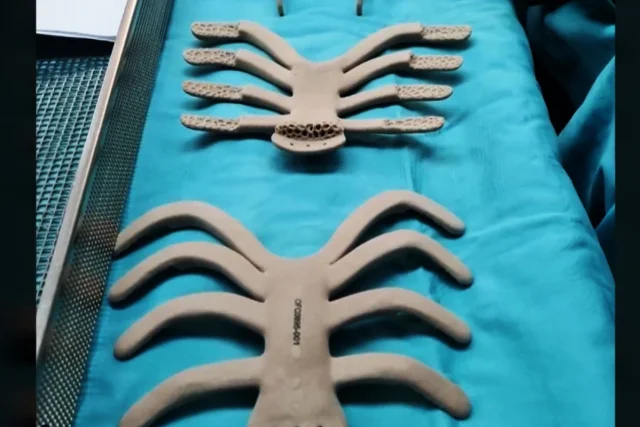
Israeli surgeons have successfully replaced an entire rib cage with a customized 3D-printed implant for the first time, performing the groundbreaking procedure on a woman in her 20s with an exceptionally rare form of cancer.
Doctors at Clalit-Beilinson Hospital said the operation required removing both the patient's sternum and portions of her ribs before reconstructing her chest with a custom-made implant, demonstrating how advances in 3D-printing technology are expanding treatment options for some of the world's rarest and most complex cancers.
The patient, identified only as Hadas, was diagnosed with an exceptionally rare type of sarcoma that has been reported in only about 20 cases worldwide, according to the medical literature.
"Rare cases require creative solutions," Head of Thoracic Surgery at Clalit-Beilinson Hospital Dr. Yury Peysakhovich said. He added that such a solution would not have been possible just a few years ago.
Surgeons had to remove not only Hadas' sternum but also portions of the ribs attached to it in order to eliminate the cancer. Peysakhovich explained that the surgeons replaced what "is essentially the anchor of the entire chest."
"If reconstruction is not precise, both respiratory mechanics and protection of the heart and lungs can be compromised," he said. "Every breath, cough, or physical movement places significant stress on this area, making it one of the most complex reconstructions in thoracic surgery."
Instead of using traditional reconstruction materials such as synthetic mesh, titanium plates or bone cement, the surgical team selected a custom 3D-printed implant made from polyether ketone ketone (PEKK), a high-performance carbon fiber-reinforced polymer.
According to the Head of Orthopedic Oncology at Clalit-Beilinson Hospital Dr. Israel Weiss, PEKK combines strength with flexibility in a way that closely resembles natural bone, making it particularly well suited for reconstructing the constantly moving chest wall.
He added that the material also allows surrounding tissue to gradually integrate with the implant over time.
The surgery lasted about two hours. Hadas has since been discharged from the hospital and is recovering at home.
"Rare cases require creative solutions. The combination of advanced 3D-printing technology and close collaboration between multiple surgical specialties allowed us to offer this patient a solution that simply wasn't available only a few years ago," Peysakhovich said.
The operation is the latest example of Israel's growing role in developing medical applications for 3D-printing technology.
In April, researchers at Haifa's Rambam Medical Center announced advances in 3D bioprinting for organ transplants, including lungs, a development they said could have a significant impact on future healthcare.
"It's amazing. Skin is already yesterday's news. The lung is the new thing," said Dr. Arbel Artzy-Schnirman, head of Rambam's Center for Medical Application Technologies.
"I love lungs. You have to see this," the senior researcher continued. "Right now, in our incubator, we have a small vessel containing lung tissue that is functional. There are cells that secrete mucus and cells with hair-like structures that clear dirt and bacteria from the air, just like in a human lung," Artzy-Schnirman explained.
In December 2025, Aryeh Batt, co-founder and CEO of Israeli biotech company Precise Bio, said in an interview with Christian journalist Paul Calvert that his team was using 3D bioprinting to restore sight by treating corneal blindness.
You might also like to read this: