Warsaw District Court renovations uncover Holocaust-era murals



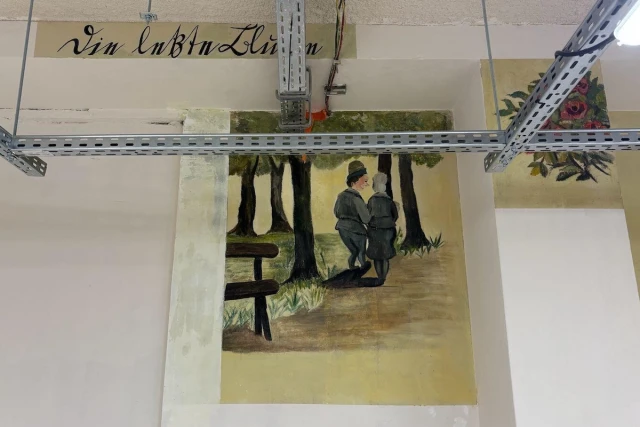
Renovations of the Warsaw District Court led to the discovery of Holocaust-era murals in the building’s basement. The mural was found by chance in a secret passage linking the Jewish Warsaw Ghetto to the “Aryan” side of the Polish capital during the Second World War. The passage was used to smuggle goods and to rescue Jewish children from the ghetto.
Meir Bulka, a scholar specialized in Polish Jewry, responded to the discovery of the Holocaust-era mural and the secret passage.
“The entry into the basement is especially moving,” Bulka stated. The scholar argued that the passage between life and death symbolized the wider Jewish story of survival against all odds throughout history.
“To walk through the dark spaces where children were saved, where fate shifted from darkness to light, is a story that repeats itself throughout Jewish history. Even though the site has undergone renovation and preservation for the future, the public will not be able to see these findings, and I am deeply moved to have been given the chance to witness them,” Bulka explained.
The scholar also chairs J-nerations, an organization that focuses on preserving Jewish history in Poland and across Europe.
The Polish capital was severely bombed during the Second World War. Bulka noted that the district court building was one of few structures that had survived and was not bombed during the war.
Scholars currently do not know the identity of the artists behind the mural.
“The most plausible explanation is that the paintings were likely created in three different periods,” Bulka explained.
“The first was when the space served as a hospital, to make the stay of the children there more pleasant. In some images you can see ambulances bringing patients to the other side of the city. The second period was when it became an officers’ club, which explains the more provocative paintings. The third was the idea of turning the place into a café, according to the building’s original plans. The character of the paintings supports this assumption: in one area they are decorative, and in another they resemble a kind of comic strip,” he said.

Antek Zuckerman, one of the leaders of the Warsaw Ghetto Uprising, mentioned the passage in his book “Seven Years.”
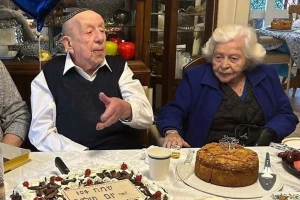
Earlier this year, the 104-year-old Warsaw Ghetto survivor Berysz Aurbach who resides in Australia, recalled his brother’s fight in the Warsaw Uprising against the Nazis.
“I can talk for six months and I wouldn’t tell you everything I want to tell you,” Auberbach said. He is one of some 35,000 Holocaust survivors who moved to Australia after the war.
“My elder brother Mordechai, together with other ghetto leaders, went to rich people in Warsaw to obtain money for arms. Rich people gave him and other leaders money after my brother convinced them to fund resistance in the ghetto,” he recalled. His brother was later executed by Gestapo after being betrayed by Polish collaborators.
“I don’t know where he is buried,” Aurbach said.
You might also like to read this: