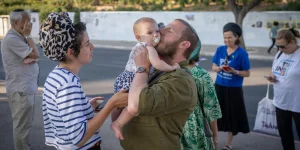
Hospital therapy dogs help rehabilitate traumatized patients in Israel



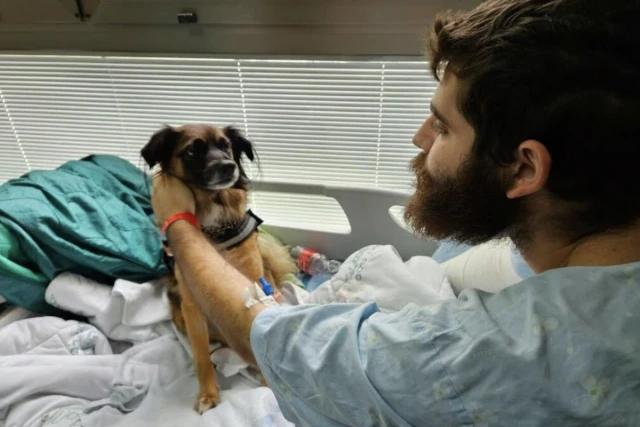
The idea of clowns in hospitals to raise spirits and improve the well-being of patients and caretakers is well known, but dogs? Over the past few years, senior nurse Keren Matry has been bringing specially trained dogs into wards at Rabin Medical Center (RMC) in Israel, with remarkable results.
The initiative has been operating for six years in total, according to a report on The Media Line by Maayan Hoffman, and now the results of the therapy are being observed and measured by a team of clinicians.
Matry has been taking her dogs, Teddy and Yuli, into the medical center for the last four years and says the help they provide is beyond simply bringing joy, but that the breakthroughs from dog therapy can even be “better than a drug from a doctor or a nurse.”
While hygiene might seem like a concern, Matry takes extensive precautions to maintain the highest standards of cleanliness – ensuring the dogs are thoroughly bathed, using antibacterial cleansers on patients before and after each visit, and placing a clean sheet over bed coverings when a dog joins a patient on the bed.
And the results are worth the effort. Research has shown that therapy dogs can reduce stress, depression, and anxiety, according to News Medical Net.
In addition, animal-assisted therapy results in measurably improved motor and physical ability gains and improvements in mental and behavioral health in patients with neurological diseases, according to a study published in the International Journal of Environmental Research and Public Health. Another, published in the journal Neurology, found an average decrease of 43% in the frequency of seizures among those who were paired with a seizure-alert dog.
Now, further research is underway in RMC’s neurology department, led by Matry alongside physiotherapists Shlomi Shochat and Yuval Levinsky, in collaboration with senior physician Dr. Yonatan Naftali. The study is examining the measurable benefits of medical dog therapy combined with structured physiotherapy sessions and its impact on rehabilitation.
The cute canines have brought significant breakthroughs in the lives of several patients, helping a soldier so traumatized by the violence that left him blind in one eye after witnessing the death of his friend that he wouldn’t speak, finally starting to talk again… to little Teddy, one of the therapy dogs. Matry told The Media Line that “something shifted,” and the soldier opened up, began to cry and also began speaking to the dog.
She gave other examples of how therapy dogs have helped to bring unresponsive patients back into action, and others with mental blocks and fears, including Nova survivors, find breakthroughs.
The positive developments give hope to the families of patients, as well, and the dog’s presence helps people to open up. “He does not judge them,” Matry said.
Interaction with therapy dogs has been found to increase oxytocin while decreasing levels of stress hormones, beneficial to patients with mental health disorders and post-traumatic stress, but are also used in intensive care, with geriatrics and in neurology departments, according to The Media Line.
Senior neurologist and head of the Neuroimmunology Clinic at RMC, Dr. Mark Hellmann, told The Media Line that therapy dogs can help patients react and interact. “There’s certainly lots of research that has been done in the field of autism and (the) use of animals with people with autism, where the connection is much easier with an animal than it is with a human being.”
“Animals have sensors that we don’t have,” Hellmann explained. “So there are all sorts of diseases like epilepsy and others where there are subtle things that happen to a patient and a dog, through their senses, can detect things that we wouldn’t be able to detect. …Animals can cause stimulation of areas that human beings wouldn’t be able to reach and therefore improve rehabilitation and speed up rehabilitation.”
Moreover, interacting with dogs can help prevent post-traumatic stress disorder from developing.
“After a traumatic event, a soldier could be in acute stress, and doctors or nurses may not be able to read him. Somehow, when the dog is there, you ask the soldier not to speak to the nurse or doctors, but speak to the dog,” Hellmann said. “Just looking into the dog’s eyes, there’s something in the chemistry that happens between a human and a dog that can break that threshold and let things come out.”
With the team at RMC fully convinced of the benefits of dog therapy, the treatment has been incorporated into the care offered by the hospital.
“Every department needs to have a dog like this,” said Matry.
Want to help more people find our reporting from Israel? Leave a quick Google review of our website HERE .
You might also like to read this: