Trump: US is ‘only semi-negotiating’ with Iran currently; regime is in ‘very bad shape’
US president weighs declaring victory and walking away without final deal, WSJ reports





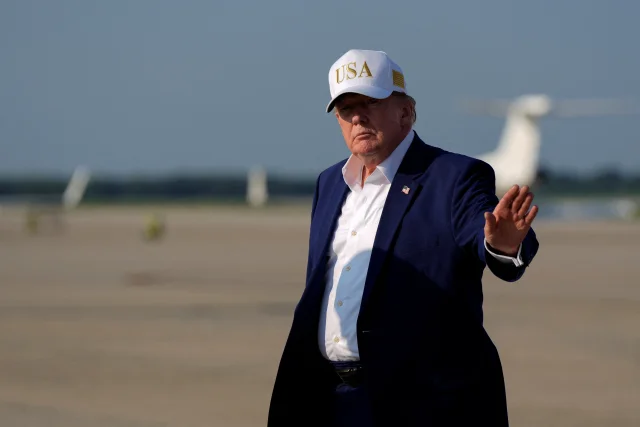
President Donald Trump hinted on Sunday that the United States currently intends to wait out the Iranian regime, allowing the naval blockade to increase economic pressure rather than launching a new military operation.
Trump told the Axios news outlet that the U.S. is “low-keying” negotiations with Iran at the moment.
“We are only semi-negotiating with them. We are just watching Iran with its huge inflation and the fact they have no money,” he said, saying that the country is “in very bad shape” and lacks money to pay its military.
On the other hand, Trump stressed that the situation for U.S. consumers had improved as oil prices decreased to around $75 a barrel. “It will work out. It always works out. It's like a chess game,” Trump said without issuing new threats or referring to potential strikes, as he had repeatedly done in the preceding days.
“These comments by President Trump suggests the U.S. is aiming for a middle course for now: holding off on military escalation and avoiding rushing into a bad deal, while letting the U.S. blockade continue to add pressure on Iran's regime,” according to Jason Brodsky, policy director at the United Against Nuclear Iran think tank.
“This limbo will become the new normal for some time,” Brodsky warned in a post on 𝕏.
The talks are currently focusing on an agreement between Iran and Oman to coordinate the traffic in the Strait of Hormuz.
On Sunday, the Wall Street Journal reported that Trump has privately floated the idea of declaring victory once Tehran fully reopens the key waterway, allowing the United States to walk away without a final agreement or nuclear deal, according to U.S. officials.
Qatari and Pakistani mediators reportedly sought to announce an Iran-Oman agreement by Wednesday, although prospects for a deal appeared to weaken over the weekend.
On Saturday, United Arab Emirates officials said that a state-owned vessel was attacked by Iranian missiles in the strait, without reporting casualties.
U.S. Sailors stand watch on the bridge of USS Ross (DDG 71). Ross is one of over 20 U.S. warships deployed to the Middle East supporting military missions, including strict enforcement of the U.S. blockade against Iran. As of Aug. 9, CENTCOM has redirected 55 commercial vessels,… pic.twitter.com/B5NCpX7Nxw
— U.S. Central Command (@CENTCOM) August 9, 2026
Then, the head of Iran's Supreme National Security Council, Mohammad Bagher Zolghadr, presented a new list of extreme demands for an agreement.
These included U.S. commitments to never “threaten nor insult Iran in any language,” permanently end “the war against Iran and Iran's allies in Lebanon, Gaza, Yemen, and Iraq,” and completely withdraw U.S. military forces from areas surrounding Iran.
In addition, Zolghadr, who resigned the next day, demanded that the U.S. pay full compensation for war damages, lift all sanctions and unfreeze any frozen funds.
A diplomat from one of the mediating countries told Axios that the demands highlighted the degree of political infighting within the regime, with IRGC chief Ahmad Vahidi reportedly pushing a hardline stance.
A White House official told the WSJ that the U.S. considers its military objectives achieved and that Trump is now focused on keeping the Strait of Hormuz open.
Officials told the newspaper that if U.S. intelligence can continue monitoring Iran’s nuclear program and shipping traffic resumes through the Hormuz, the president could maintain the current situation for an extended period. They added that the naval blockade could also be lifted once the strait is fully reopened.
Israel has viewed Trump’s back-and-forth positions on the negotiations with concern.
A former senior Mossad official strongly criticized the U.S. president in a radio interview on Sunday.
“The American conduct is outrageous,” said Oded Eilam, former head of the Mossad’s Terrorism Division and a researcher at the Jerusalem Institute for Foreign Affairs and Security.
“The Americans failed to turn the military achievements into strategic achievements,” he said.
He warned, “The thing Israel must insist on and under no circumstances give up is the ability to act to thwart any attempt by Iran to rebuild its nuclear infrastructure,” even at the cost “of a crisis” with the United States.
You might also like to read this: