Trump administration reportedly preparing sweeping sanctions against ICC


The Trump administration is reportedly preparing sweeping economic sanctions against the International Criminal Court that could restrict the Hague-based tribunal’s access to the U.S. financial system and prohibit most transactions with the court, according to a Wall Street Journal report published Sunday.
The reported measures would target the ICC as an institution rather than individual judges and prosecutors and would take effect after a six- to seven-month grace period, potentially cutting the court off from transactions conducted in U.S. dollars and making it more difficult to access the global financial system.
The report cited U.S. officials and documents reviewed by the Journal. Reuters said it could not independently verify the report.
The administration could finalize or announce the measures as early as this week during the United Nations General Assembly in New York or shortly afterward, according to the Journal.
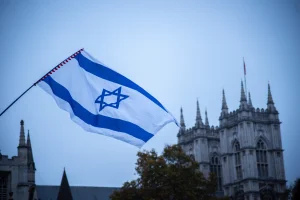
The reported move would represent an escalation of the Trump administration’s campaign against the ICC, which intensified after the court issued arrest warrants in November 2024 for Israeli Prime Minister Benjamin Netanyahu and former Defense Minister Yoav Gallant.
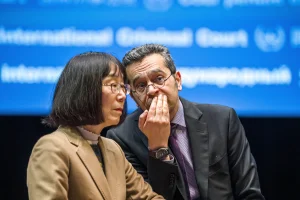
The administration has already imposed sanctions on several ICC officials. In August, the Treasury Department sanctioned ICC President Tomoko Akane and Senior Trial Lawyer Abdoulaye Seye. The U.S. had previously sanctioned former ICC chief prosecutor Karim Khan and other court officials.
Khan was removed as prosecutor by ICC member states in July following allegations of sexual misconduct. Khan has denied the allegations.
U.S. Secretary of State Marco Rubio has repeatedly criticized the court. In August, he declared that “The Trump Administration has been clear: the International Criminal Court (ICC) is a corrupt and fatally politicized supranational court that has maliciously abused its authority and exceeded its mandate. We will not tolerate its assault on state sovereignty.”
The Trump administration has argued that the ICC has exceeded its authority by pursuing officials from countries, including the United States and Israel, that are not parties to the court.
Neither Israel nor the United States is a party to the ICC, and both have rejected the court’s jurisdiction over their nationals.
The issue has also emerged in the context of Netanyahu’s planned visit to New York this week to address the UN General Assembly.
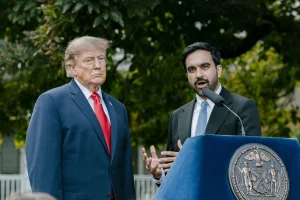
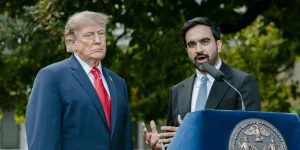
New York City Mayor Zohran Mamdani has repeatedly said that he believes the ICC’s arrest warrant for Netanyahu should be honored when the Israeli prime minister visits the city. Mamdani reiterated that position after meeting with President Donald Trump at Gracie Mansion on Monday.
Mamdani told CNN, “When it comes to Benjamin Netanyahu, I have described him as I believe him to be — a war criminal and an architect of a horrific genocide of the Palestinian people.”
Regarding the International Criminal Court’s arrest warrant for Netanyahu, Mamdani added, “I do believe that that is something that should be honored, because what we want to see, and we’ve been talking about this today, is a faith in our politics, a faith in accountability. If the International Criminal Court deems someone worthy of an arrest because of a violation of those laws, then who are we to say that anyone should be above that? And I think very clearly that everyone should be held accountable to it.”
Mamdani has acknowledged that, as mayor, he does not have the authority to arrest Netanyahu.
Trump did not address the ICC or Netanyahu’s arrest warrant in his remarks following Monday’s meeting with Mamdani. The president has previously ruled out the possibility of Netanyahu being arrested on U.S. soil.
The ICC was established in 2002 under the Rome Statute and investigates and prosecutes individuals accused of genocide, war crimes, crimes against humanity and the crime of aggression. The court describes itself as a court of last resort that complements rather than replaces national judicial systems.
You might also like to read this: