Thousands stranded, millions lost: Surprise employee strike cripples Ben Gurion Airport, triggers political fights
1-hour walkout reportedly cost Israel approximately $10 million





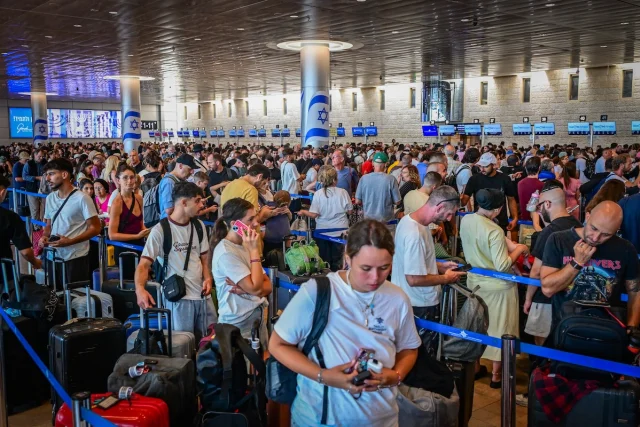
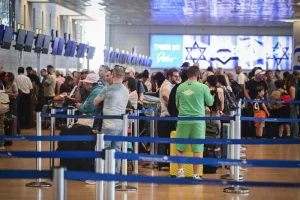
A surprise strike on Thursday threw Ben Gurion International Airport – Israel’s only real gate to the rest of the world – into complete chaos.
The strike by airport staff cost millions of shekels, triggered massive delays that continued into Friday morning, and caused several additional flights to be canceled due to the incoming Sabbath, stranding Israelis overseas for days.
The incident completely dominated local headlines for some 24 hours, coming smack in the middle of what Israeli media described as the busiest travel period of the year, as tens of thousands of Israelis take advantage of the school break to go on vacations abroad.
On Thursday, 107,000 passengers were set to pass through the airport on over 600 scheduled takeoffs and landings.
By Friday morning, Ben Gurion had topped the list of airports with the most severe disruptions worldwide, according to aviation activity monitoring website Flightradar24.
Chaos and unusually heavy congestion at Ben Gurion Airport, as the workers’ union chose to launch a surprise strike on one of the busiest days of the year.
— Amit Segal (@AmitSegal) August 20, 2026
It’s time to dismantle this corrupt union, which today targeted a hundred thousand innocent Israelis who did nothing to it. pic.twitter.com/x6uoKokB8y
The massive impact of the strike quickly broadened into the political arena, with government officials scrambling to threaten harsh consequences if the strike were to continue. At the same time, opposition leaders argued that the chaos represented the government’s failures in managing the country.
Around 3 p.m. on Thursday, dozens of airport staff walked away from their counters, citing long-standing concerns that staffing levels were insufficient to handle the large summer influx of passengers. Just over an hour later, the workers returned to their posts, although the damage was already done.
It remains unclear whether this was a strike organized and planned by the Israeli workers’ union Histadrut, which denied any involvement, or a wildcat strike organized by the workers themselves.
The union stated, “The attempt to present the chaos at Ben Gurion Airport as the result of a ‘surprise strike’ misses the truth and diverts attention from the real failure: the grave personnel crisis and lack of sufficient preparation for the summer.”
Channel 12 News reported that Pinhas Idan, chairman of the Israel Airports Authority workers’ committee and prominent member of the Likud party, instructed the workers to return to their posts after an hour, indicating he might have instigated the strike.
🇮🇱✈️ 🚫BEN GURION AIRPORT SHUTDOWN: NO FLIGHTS FOR YOU
— dana (@dana916) August 20, 2026
Scenes from Ben Gurion International Airport, where check-in staff are currently striking and refusing to process passengers.
The strike is taking place on one of Israel's busiest travel days, when approximately 100,000… pic.twitter.com/OopGV38b2K
Prime Minister Benjamin Netanyahu, the chairman of Likud, later expelled Idan from the party, which said the decision was made because of “the wild and illegal strike at the airport.”
Party sources told Ynet News that Idan appeared to have ordered the strike out of petty party politics, in an effort to harm Transportation Minister Miri Regev and Netanyahu, who has angered many party members by seeking to secure reserved slots on the election list.
“No labor dispute was declared,” said one senior party official. “There were no threats, preliminary steps, that would have given early indication of a dramatic strike like this… So what happened, after all? A clear attempt to harm Regev, and – indirectly – also Netanyahu.”
The prime minister, who typically refrains from commenting immediately even on major developments, released a statement within an hour of the strike, threatening to fire anyone who “stands in the way” of regular operations. “Ben Gurion Airport will continue to be open and operate as usual,” he vowed.
According to the Finance Ministry, lost fees and charges due to canceled flights, reduced economic activity due to disrupted vacation plans, and delays in air cargo shipments – as well as other factors – cost the country about NIS 30 million ($US10 million), Kan News reported.
בלגן בנתב"ג. אלפים תקועים שם כבר שעות ארוכות לפני או אחרי טיסות, המזוודות נעלמות ופנחס עידן חוגג אבל אל דאגה. ברגע שהשרה רגב חוזרת ממרוקו ודקה אחרי שהיו"ר יפתח רון טל מסיים פאנל לקקני בערוץ המשטר, הם יטפלו במשבר. סמכו עליהם. pic.twitter.com/VJRnMrH1kQ
— יוסי מזרחי Yossi Mizrachi (@yosimiz1) August 20, 2026
Tourism Ministry Dir.-Gen. Michael Izhakov also noted the reputational damage to the country, emphasizing that tourism numbers have only recently begun to show an improvement, with about 5,000 tourists currently arriving in Israel each day.
“This creates a terrible image for the State of Israel,” Izhakov told Kan. “There is no need to explain how badly tourism has been hurt over the past three years.” He added that the strike disrupted the lives of more than 100,000 Israelis.
Opposition leaders quickly seized the opportunity to pillory the government over the chaos.
“Together” party leader Naftali Bennett reportedly drove to the airport with Keren Turner, a former director-general of both the Transportation Ministry and the Finance Ministry and a candidate for the party.
“Ben Gurion is in chaos because of a government of chaos. What you see here – these very difficult images – they’re not the result of a natural disaster; they’re the result of a government that is a disaster,” Bennett told reporters.
והשרה בכלל בחופשה במרוקו.
— Gadi Eisenkot - גדי איזנקוט (@gadi_eisenkot) August 20, 2026
בקרוב נקים ממשלה שאינה כישלון גמור בכל תחום. pic.twitter.com/mUjjqKiFL2
Turner appealed to those affected, saying that “everyone currently stuck at Ben Gurion, or in a traffic jam, or waiting hours for a bus that hasn’t come – it’s important to me that you know the situation doesn’t have to be this way. They’ve gotten us accustomed to a government that normalizes the idea that it can’t solve anything, but soon things will be different.”
Yashar party chairman Gadi Eisenkot noted that Regev was overseas during the chaos but shared footage of her and Netanyahu touring the airport just a day earlier.
“A responsible Minister of Transportation would now be on her way to Ben Gurion Airport and convening an emergency discussion to provide an immediate response to all the tens of thousands stuck at Ben Gurion Airport. But it's only natural that the failed Minister of Transportation, as usual, is not in the country… Israeli citizens deserve leadership that takes responsibility, stands up to the challenges, and knows how to address systems from the ground up,” he wrote on 𝕏.
The incident “is a reflection of the failed management culture of the Netanyahu government – chaos and disorder, lack of management and lack of accountability. The Israeli government's lack of interest in the lives of its citizens and, above all, lack of leadership,” Eisenkot charged.
You might also like to read this: