Second Temple-era ritual purification complex uncovered near Temple Mount in time for Sukkot




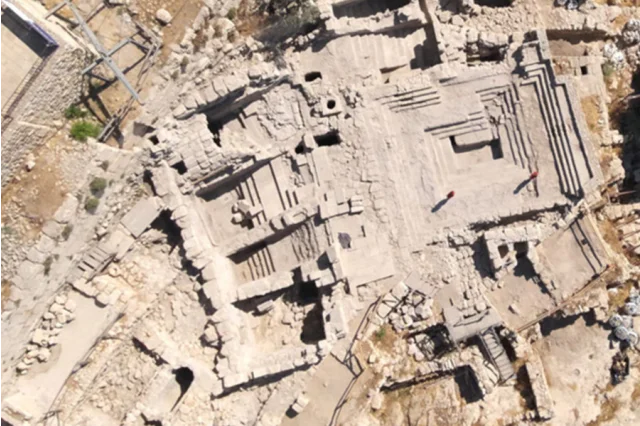
Just in time for the Feast of Tabernacles, archaeologists have uncovered a remarkably well-preserved ritual purification complex dating to the late Second Temple period at the foot of the Temple Mount in Jerusalem’s Old City.
The complex, discovered near the Triple Gate, the easternmost of the Huldah Gates, was excavated as part of a large-scale archaeological project in the Ophel, the area immediately south of the Temple Mount. The excavation is being directed by Prof. Uzi Leibner and Prof. Orit Peleg-Barkat of the Hebrew University of Jerusalem’s Institute of Archaeology.
The archaeologists believe Jewish pilgrims used the complex when they came to Jerusalem for the biblical festivals and underwent ritual purification before entering the Temple.
Its location near one of the Temple Mount’s gates and its monumental scale suggest that it played an important role in accommodating the large numbers of pilgrims visiting Jerusalem during the Second Temple period.
The complex was built in the early first century CE, meaning it could have been under construction during Jesus' lifetime and would have remained in use during His earthly ministry.
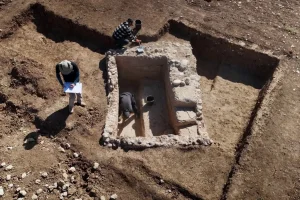
Among the complex’s best-preserved features is a large central pool measuring approximately 12 by 9.5 meters (39.4 × 31.2 feet), with steps descending into it from all four sides. The complex covers approximately 280 square meters (3,014 square feet) and also contains an ashlar structure with four rooms, three of which were identified as large public mikvaot, or Jewish ritual baths.
One of the ritual baths is preserved almost to its full height of 4.2 meters (13.8 feet), including its vaulted stone ceiling and a shaft used to supply it with water. Such extensive preservation of a Second Temple-period structure from floor to ceiling is extremely rare in Jerusalem, particularly in a location that has experienced centuries of construction, destruction and natural disasters.
Two of the ritual baths feature carefully constructed ashlar steps.
“The discovery of a monumental ashlar structure devoted entirely to purification, located at the foot of the Temple Mount and close to one of its gates, is unprecedented,” Leibner and Peleg-Barkat said.
“The character of the complex goes directly to the heart of our research into the archaeology of pilgrimage during the Second Temple period and the questions we are examining: How was the area surrounding the Temple Mount designed to regulate the many pilgrims arriving at the Temple Mount compound in Jerusalem, and what activities and rituals took place near its gates?” they continued.
The complex also contains an extensive drainage system that allowed large quantities of water to flow into and out of the pools. The system carried water toward the Kidron Valley, while the excavation team has theorized that the complex may have received water from a permanent source, possibly a branch of the aqueduct that supplied the Temple during the Second Temple period.
The complex appears to have remained in use until the Roman destruction of Jerusalem in 70 CE. Dozens of coins dating to the First Jewish Revolt were found on the complex's floors and in the destruction debris, providing evidence of its final period of use.
The excavation also revealed that the site had been used for ritual purification even before the construction of the monumental complex. Beneath it, archaeologists found remains of an earlier public purification complex that included a large ritual bath and likely dates to the first century BCE.
The discovery is part of the excavation’s fifth season in the Ophel. The project is being conducted under the auspices of the Hebrew University’s Institute of Archaeology in cooperation with the Armstrong Institute of Biblical Archaeology and is funded by the Israel Science Foundation, the Armstrong Institute and the Hertog Center for the Archaeological Study of Jerusalem.
Visitors to Jerusalem who wish to see the archaeological work may do so at the Jerusalem Walls National Park, managed by the East Jerusalem Development Company.
You might also like to read this: