2,000-year-old mikveh points to previously unknown Jewish settlement in Israel

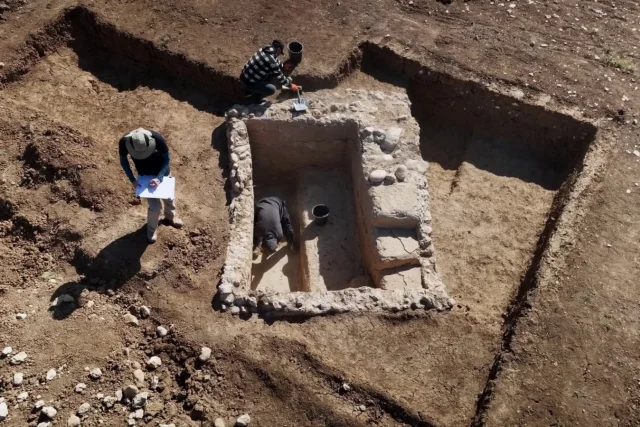
Archaeologists have uncovered a 2,000-year-old mikveh, or Jewish ritual bath, in Kiryat Gat’s Carmei Gat neighborhood, providing evidence of a previously unknown Jewish settlement in the area during the Second Temple period.
The Israel Antiquities Authority announced the discovery following an excavation funded by the Israel Land Authority at a cost of approximately NIS 28 million ($9.2 million). The mikveh indicates that a Jewish community was established at the site during the period when Jesus lived and ministered, with the community developed enough to construct a large stone ritual bath weighing approximately 25 tons.
The mikveh was recently relocated to the Israel Antiquities Authority’s National Treasures Department in Jerusalem for further study. It is expected to return to Carmei Gat after nearby construction projects are completed, where it will be displayed for residents and visitors.
Moving the ancient structure required a complex engineering and conservation operation. Archaeologists and conservators first excavated around the mikveh to fully expose it, then drilled through the ground beneath it and inserted steel beams to support the structure during the lift.
The mikveh was then wrapped in gauze and reinforced with foam to protect it from jolts and vibrations during transportation. A 300-ton crane lifted the approximately 25-ton structure onto a wide-body truck, with special traffic arrangements made for the journey to Jerusalem.
“Once you lift up a structure like this, there is no going back,” says Eyal Kaho, Senior Conservator at the Israel Antiquities Authority, who led the operation. “If it falls apart – we've lost the mikveh. Therefore, every detail must be considered in advance. The day before an operation like this, you don't sleep. You're under pressure, because the responsibility is yours and there’s simply no price that can compensate for mistakes. Even after 36 years at the Israel Antiquities Authority, every time, the adrenaline rises anew.”
The discovery is significant because archaeologists had not previously identified a Jewish settlement in this particular area between the Judean Lowlands and the northern Negev.
According to the Minister of Heritage, Rabbi Amichai Eliyahu, “The ritual bath uncovered in Kiryat Gat adds an important dimension to our understanding of Jewish settlement in the Land of Israel during the Second Temple period."
He went on to explain that the complex operation led by the Israel Antiquities Authority to relocate it intact "reflects our commitment as a nation to preserving our heritage assets, even amid rapid development. Its future incorporation into the neighborhood’s public space will enable residents and visitors to encounter tangible evidence of Jewish life from 2,000 years ago as part of their daily lives.”
The mikveh was not the only evidence of Jewish life uncovered at the site. The IAA said archaeologists also found “stone measuring vessels, which according to Jewish law do not become ritually impure, and which were therefore widely used among Jews during the Second Temple period.”
According to Elena Kogan-Zahavi, Maayan Margulis and Shira Lifshitz, Excavation Directors on behalf of the Israel Antiquities Authority, “The Jewish settlement we discovered here is the first and the only known one in this area. In the Judean Lowlands, many Jewish settlements from the Roman period are known, but in the seam between the Judean Lowlands and the northern Negev – no Jewish settlement was known until now.”
Additional archaeological evidence suggests that the settlement “was apparently abandoned during the Bar Kokhba Revolt in the second century CE. Only about 500 years later, during the Byzantine period, it revived, but this time with an entirely different population composition.”
You might also like to read this: