Kamala Harris eyes 2028? First stop: taking aim at Israel

If you were wondering whether Kamala Harris was going to run again for president in 2028, this week provided a pretty solid clue: she’s going after Israel. In today’s Democratic Party, that’s political gold.
Harris took direct aim at Israel’s military campaign in Gaza. And she’s not limiting her criticism to President Donald Trump. She’s also going after the Biden administration, where she served as vice president for four years.
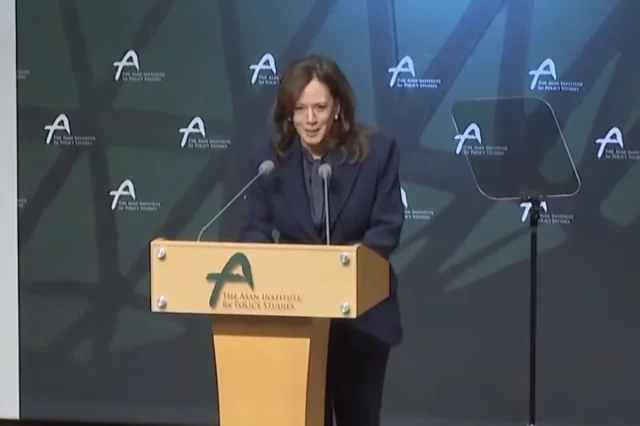
Speaking Wednesday at the Asan Institute for Policy Studies in Seoul, South Korea, Harris accused the Israeli government of what she called “horrific conduct” during the war against Hamas.
But it wasn’t just Israel that came under fire. Harris said the United States had failed to live up to its “moral obligation to human rights and international law” by not doing enough to restrain the Israeli government.
Then came this pointed criticism of both the current and previous administrations.
“Most recently, the failure to use our leverage to curtail the Israeli government’s horrific conduct in the war in Gaza, both under the current administration, which offers [Israeli Prime Minister Benjamin] Netanyahu a blank check, and our administration before, where we should have acted sooner and more forcefully,” Harris said.
In short, the former vice president isn’t simply just saying Israel made mistakes during its war against Hamas. She’s accusing two American administrations, including her own, of failing to use American influence to stop Israeli military actions. That sort of statement is pretty provocative coming from someone who served alongside President Joe Biden for four years.
Harris framed her comments around the principle that America should hold its allies accountable, arguing that even friendly governments should be challenged when their actions raise human rights concerns.
To be clear, she did not explicitly accuse Israel of genocide in the remarks reported Wednesday, but her language was unmistakably critical. Read into that what you may.
Harris maintained during her 2024 presidential campaign that Israel had a right to defend itself but now, unshackled from her past, she’s now making her disagreements with the Biden administration’s approach much more explicit.
The Republican Jewish Coalition certainly wasn’t impressed. The organization called her remarks “unsurprising,” pointing to what it described as a longstanding pattern of positions critical of Israel.
The RJC cited Harris’s decision to skip Netanyahu’s 2024 address to Congress and her opposition to legislation targeting the anti-Israel boycott, divestment and sanctions movement. The group also criticized her earlier opposition to Israel’s military operation in Rafah, where Israeli forces subsequently rescued hostages.
While criticism from the RJC was expected, comments from Warren Kinsella, an attorney and author who worked on Harris’s 2024 presidential campaign, were surprising and particularly stinging. Kinsella said he was “ashamed to have worked with her.”
Not exactly the kind of reaction Harris would welcome from a former campaign ally.
On the other side, as expected, The Jewish Democratic Council of America has defended Harris’s record of support for Israel in the past and has pushed back against efforts to make disagreements over Israel a dividing line within the Democratic Party.
Meanwhile, other Jewish Democrats have become increasingly vocal about Netanyahu’s conduct of the Gaza war while continuing to support Israel’s security and right to exist.
Kamala Harris’s comments are unfolding against a much bigger political backdrop. The reality is that for any democrat thinking about running for president in 2028, the numbers tell a remarkable story.
According to a February 2026 Gallup survey, 65% of Democrats sympathize more with Palestinians, compared with just 17% who sympathize more with Israelis. What a difference four years makes.
Back then, supporting Israel was still a relatively comfortable position for much of the Democratic establishment. Not now. Currently, candidates face growing pressure from progressive voters who want Washington to take a much tougher approach toward Netanyahu’s government and Israel in general.
Harris isn’t the only possible 2028 contender changing the conversation. Look at California Gov. Gavin Newsom. Earlier this year, Newsom generated controversy by discussing whether Israel could be described as an apartheid state. He later clarified that he wasn’t labeling Israel that way in its current condition, but warning about the consequences of possible West Bank annexation.
Later, in September, Newsom went further in criticizing Netanyahu and the political influence of the American Israel Public Affairs Committee, better known as AIPAC. Newsom said Democratic opposition to Israel’s current government was overwhelming and described rejecting AIPAC campaign money as an increasingly mainstream position within his party.
Illinois Gov. JB Pritzker, a Jewish man mulling a presidential run, previously supported AIPAC but has since criticized the organization’s political spending after its involvement in Illinois congressional primaries. He accused AIPAC of moving away from its traditional bipartisan mission.
Other potential candidates are also making the anti-Israel shift. Some have been more subtle than others but whatever the case, the emerging political dynamic is difficult to ignore.
You might also like to read this: