








Israel’s students fall to 43rd spot in global education rankings
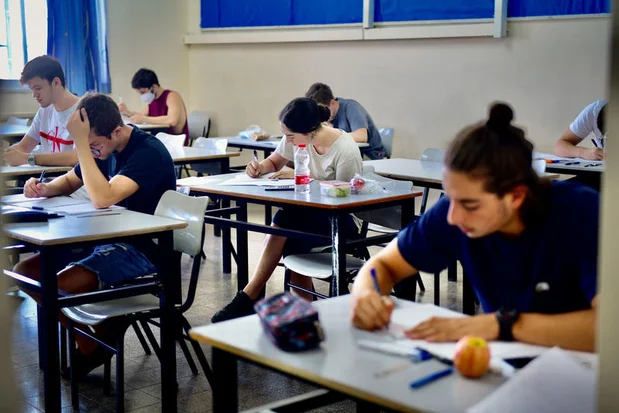
Israeli 15-year-olds have fallen sharply in international rankings for mathematics, science and reading, posting Israel’s poorest showing since the country began participating in the Programme for International Student Assessment (PISA) in 2000, according to a report released by the Organisation for Economic Co-operation and Development (OECD) on Tuesday.
Israel’s overall ranking dropped to 43rd in the world, down from 38th in the previous round of testing in 2022. The country also fell from 31st to 33rd among OECD countries. The latest results showed declines in all three traditional PISA subjects, as well as in computational problem-solving, a category included in the tests for the first time in 2025.
The results have prompted alarm among Israeli teachers, parents and students just one week into the new school year, while also becoming an election-year political issue.
Education officials have pointed to the disruption caused by the COVID-19 pandemic and the war that began following the Oct. 7, 2023, Hamas attacks, while educators and others have raised broader concerns about the state of Israel’s education system.
The OECD administers PISA tests every three years to provide governments, education systems, teachers, and parents with data they can use to evaluate and improve educational outcomes. Israel began participating in the program in 2000.
Israel’s sharpest decline was in reading, where students scored 436, down from 474 in 2022. Science scores fell from 465 in 2022 to 442 in 2025, while mathematics scores declined from 458 to 433. Israeli students scored 444 in computational problem-solving.
The OECD averages in those four categories were 461, 482, 463 and 500, respectively.
The particularly low score in computational problem-solving was a bitter pill for Israeli educators, who expressed surprise and alarm given the country’s reputation as a global technology hub and its thriving hi-tech sector.
The report also prompted sharp criticism from politicians, who have made the education system an election-year issue.
Yesh Atid MK Meirav Cohen posted a statement on 𝕏 saying that the report was “a serious indictment against the education system and the person who heads it.”
Education Minister Yoav Kisch defended himself against the criticism in a post of his own on 𝕏, saying that the results were grim, but much better than they could have been given the fact that they were administered during a time when Israel was “at the height of war” with “teachers and parents doing rounds of reserve duty” in the armed forces, along with “night after night of air raid sirens.”
He added that despite all this, the Israeli civilian population and education system has demonstrated “amazing resilience during a time of war and I am proud of you, dear students and education staff.”
Kisch also posted a letter he had received from OECD director for education and skills Andreas Schleicher, in which Schleicher acknowledged that test results have been declining in many other countries in recent years and that outcomes “need to be considered alongside the conditions in which students learn… particularly in contexts affected by uncertainty and conflict.”
“The recent security situation has placed extraordinary pressure on students, families and schools, which needs to be considered in interpreting results as well, although these effects are harder to quantify,” he added.
Parents’ and teachers’ groups have issued statements expressing appreciation for educators and sympathy for the difficult conditions in which they are working. At the same time, internal Israeli testing has also shown steep declines in scholastic achievement in recent years, raising broader questions about the long-term strength of the country’s economy and even the IDF’s ability to field effective fighting forces.
Elisheva M., a Jerusalem-area high school teacher who began her 19th year of teaching this past week, told ALL ISRAEL NEWS that students entering her classroom in recent years have had their lives and education severely disrupted, first by the COVID-19 pandemic from 2020-2022 and then by the war Israel has been fighting since the Oct. 7, 2023 Hamas attacks.
But she said those disruptions do not explain everything she is seeing in the classroom. In particular, she has noticed a change in how students view education and academic achievement.
“When I first started teaching, the kids believed me when I told them that they needed to study and work hard so they could get into a good university and get a good job after that,” she said. “Now, when I try to tell them that, they tell me about their favorite YouTuber influencers who brag about getting rich despite having dropped out of school.”
She said students are also increasingly disengaged from reading, and are spending more of their free time on their phones. She added that the problem is not unique to Israel.
“It’s not just in Israel either. My sister teaches school in New York, at a private school with really expensive tuition, and she tells me she’s dealing with the same issues.”
At the same time, Elisheva said the changing economy raises a more fundamental question about whether the education system is preparing students for the future.
“The worst part is, the kids might be right,” Elisheva concluded. “The economy certainly is changing and a lot of the things in the curriculum we have now are already obsolete, so it’s a waste of everyone’s time to try and tell these kids to try harder to learn about them.”
She said she believes significant changes are coming to education: “Big changes are coming, one way or the other and I have no idea how it’s going to turn out.”
Popular article:
interview Easter message of resurrection hope amid war at Jerusalem's Garden Tomb

biblical commentary Let my people go: a Passover message for today
4 IDF soldiers killed, 2 wounded in fighting in southern Lebanon, as Israel eliminates dozens of Hezbollah terrorists

Receive latest news & updates
A message from All Israel News
Help us educate Christians on a daily basis about what is happening in Israel & the Middle East and why it matters.
For as little as $10, you can support ALL ISRAEL NEWS, a non-profit media organization that is supported by readers like you.
Latest articles:

North American Jewish organizations to recruit 100 professionals to combat antisemitism
‘No need’ for pre-election Iran strike, IDF chief says as gov’t, opposition trade blame for potential escalation – report
terror attack 2 Israeli soldiers killed, 2 terrorists eliminated in Hebron shooting; IDF says much larger attack was prevented
analysis A people dwelling securely? Israel’s strategic standing, 3 years after Oct 7

Hamas on wheels: What I found in Dearborn reveals a troubling history and a battle over Israel