Israel reportedly freezes aliyah for 2 Jewish activists working with Palestinians in Judea and Samaria
Cases raise concerns about political tests in immigration requests



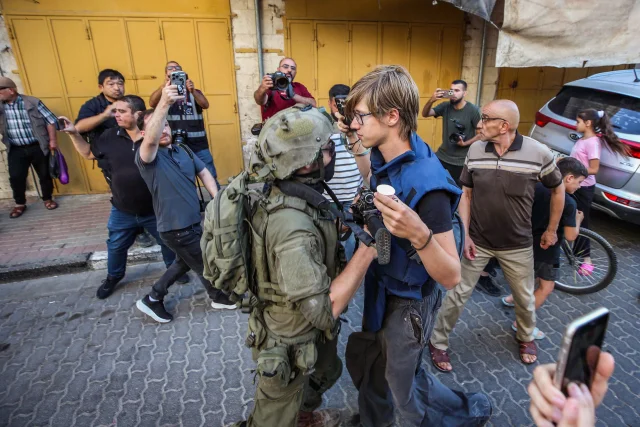
Israel’s Population and Immigration Authority (PIBA) has frozen the immigration (aliyah) of two Jewish activists involved in advocacy to protect Palestinians in Judea and Samaria from attacks by radical settler groups, according to a report published by Israel's Haaretz.
The two activists, who do not know each other personally, had both been approved by the Jewish Agency prior to the suspension of their immigration.
According to Haaretz, the two individuals were not told why their immigration process was halted, but it appears linked to their involvement in protective presence activities, in which activists go to contested locations to prevent attacks by radical settler groups, often associated with the Hilltop Youth movement.
When asked, PIBA officials did not explain the reason, but they also did not deny that the freezing was related to their activism.
The Jewish Agency told Haaretz that PIBA is “examining” the two's eligibility to immigrate to Israel under existing law.
Under Israeli law, any Jew is allowed to apply for aliyah, which is usually only denied in certain circumstances.
Ethnic Jews who have become followers of Jesus are considered by rabbinic Judaism to have ceased being Jews, and are therefore often denied permission to immigrate, even when being able to prove Jewish heritage.
PIBA has also denied immigration to people with a criminal history, as in the case of Meyer Lansky, a member of the National Crime Syndicate, who was denied aliyah in the early 1970s, despite his work against Nazi Party activities in the United States. between 1938 and 1941. Lansky’s criminal history was cited as the reason he was denied aliyah.
The Law of Return grants permission to every Jew, child, or grandchild of a Jew and their spouses at the time of the application, apply for immigration, “unless the Minister of the Interior has reason to believe … the applicant may endanger public health or the security of the State.”
This phrase appears to be the basis for PIBA's decision to freeze the immigration process for the two activists, despite neither having a known criminal history.
One of the activists, Lawrence (Ya'aqov) Shenkin, grew up in an Orthodox family in Golders Green, a London suburb.
He was active in Jewish youth movements and told Haaretz he was raised as a Zionist.
At 18, he came to study in a yeshivah on a student visa and lived in Israel for about five years. In 2023, he joined Bnei Avraham, a religious Jewish organization whose members protect Palestinian communities in Judea and Samaria from radical settler groups.
During protection work in 2025, Shenkin said a settler activist named Gabriel Kalish took a picture of Shenkin’s passport and threatened to detain him.
Six months later, he received an email notifying him that his electronic travel authorization (ETA) to enter Israel had been canceled. He initially believed this was related to his aliyah application. However, after the process stalled, he began corresponding with the Jewish Agency again.
He even tried to restart his immigration process in London, and initially received an email confirming his immigration eligibility. However, just a few weeks later, he received an email that told him, "Based on information received from the Population and Immigration Authority, and in accordance with Section 40 of the Entry into Israel Law, the approval of your eligibility for aliyah is currently under review by the Authority and is temporarily revoked.”
A similar situation happened with a 27-year-old Jewish-American woman, a law student at a U.S. university, who asked Haaretz not to publish her name.
She was detained by IDF soldiers in June 2025 while participating in protective presence activities near the settlement of Neve Daniel. The soldiers photographed her passport, and six months later, her travel authorization was also canceled.
She similarly received a follow-up letter from the Jewish Agency, informing her that PIBA had temporarily revoked her aliyah eligibility, which was under review.
Both activists deny being involved in any violent incidents.
Shenkin denied being anti-Israel, saying his love for Israel is what motivated him to make aliyah.
“Because I'm left-wing, a lot of people don't get that I'm religious. For me, living in Israel is a biblical commandment. Every minute I'm not there hurts,” Shenkin told Haaretz.
He left Israel to visit his parents, saying, “But if it were up to me, I wouldn't leave Israel even for the holidays.”
He said the incident is concerning because it appears to institute a political test for immigration.
“The whole promise of Israel is that any Jew can move there simply because they're Jewish,” Shenkin said. “And now there's this new idea that you have to support a certain agenda, or else we don't want you.”
The Jewish Agency released a statement saying, “The Population and Immigration Authority is the government body responsible for implementing the Law of Return. In light of this, and for reasons of privacy, we cannot comment on the details of the cases.”
When asked by Haaretz, the Population Authority said, "The applications have been received, and each is being examined individually, on its own merits. Once a decision is made, each applicant will be formally notified.”
Meanwhile, the two cases, which come amid increased Israeli enforcement against foreign activists operating in Judea and Samaria, raise questions regarding whether political activism in opposition to the interests of some coalition parties will become a barrier to aliyah.
You might also like to read this: