Is a second strike on Iran inevitable, and what would it change?
.jpg "Maayan Hoffman")




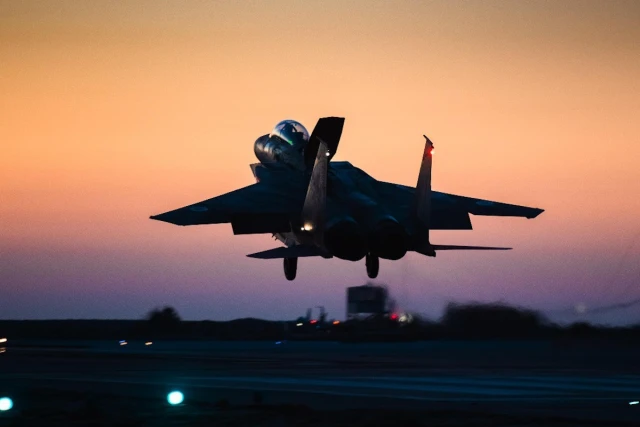
Israel may be heading toward another year defined first by war and then by diplomacy.
In the first half of 2026, Israel is likely to be fighting Hamas, Hezbollah, the Houthis, and Iran. In the second half of the year, those battles could give way to a series of peace agreements, including an expansion of the Abraham Accords.
That is the assessment of Brig.-Gen. (Res.) Amir Avivi, who stressed in an interview with ALL ISRAEL NEWS (AIN) that despite the current ceasefire, the war is far from over.
“There will be a few challenging and difficult months on all fronts,” Avivi said. “The U.S. and Israel are fully coordinated talking about the need to eradicate Hamas, the need to weaken Hezbollah dramatically, and the need to deal with the Houthis.”
Avivi warned that the ceasefire has created a false sense of calm. While many believe the fighting has ended, he said, the strategic objectives have not yet been achieved.
At the top of the agenda, Avivi added, is Iran.
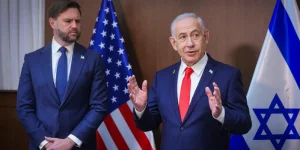
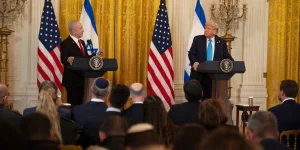
During his meeting this week with Prime Minister Benjamin Netanyahu at Mar-a-Lago, President Donald Trump stressed that “he’ll knock the hell” out of Iran if it attempts to rearm its ballistic or nuclear capabilities. Trump said he would back an Israeli attack and insinuated that the United States might even take part in another strike against the regime.
"The missiles, yes,” Trump said. “The nuclear, fast. Okay. One will be, yes, absolutely. The other was, we'll do it immediately.”
The United States already supported Israel during its 12-day war against Iran over the summer, including the deployment of stealth B-2 bombers to strike key nuclear sites. During those 12 days, 28 Israelis were killed, including 27 civilians, as a result of Iranian ballistic missile attacks. Israeli intelligence now indicates that Iran is once again rearming.
Iranian leaders responded sharply to Trump’s remarks. On Tuesday, Iranian President Masoud Pezeshkian wrote on 𝕏 that the “Answer of Islamic Republic of Iran to any cruel aggression will be harsh and discouraging.”
Two days later, Iranian media reported that banners had been erected across Tehran threatening further attacks against Israel and a U.S. base in Qatar. The phrase “It Will Happen Again” appeared above images of sites targeted during the June war.
Avivi said Iran is planning to attack Israel, which is why Israel will need to strike first.
“It is imminent,” Avivi told AIN. “There will be an attack on Iran.”
Brig.-Gen. (res.) Yossi Kuperwasser, head of the Jerusalem Institute for Strategy and Security (JISS), told AIN that Iran has been rapidly rebuilding its missile systems with Chinese and Russian assistance. At the same time, he said, the Iranian axis has been weakened after two years of fighting through its proxies and the 12-day war with Israel. Israel destroyed much of Iran’s air defense capabilities, making an early strike more feasible.
“The longer [the] action is delayed, the greater the threat will grow,” Kuperwasser wrote in a paper published on the JISS website. “Iran does not conceal that its missiles are directed first and foremost at Israel, and preventive logic dictates that it is therefore preferable to act swiftly to address the threat.”
Israel has been planning for a second strike since the ceasefire between Israel and Iran was announced on June 23 and went into effect the following day. Israeli military officials said at the time that while the war was successful, it was only one phase of what needs to be done to eliminate the Iranian threat.
Avivi said Israel is focused on preventing three significant developments. First, Israel will not allow Iran to rebuild its air defenses. Second, it will not allow Iran to produce ballistic missiles. Iran has said it wants to make 10,000 ballistic missiles, a number that would overwhelm Israel. Finally, Israel will not allow Iran to build new nuclear sites. Much of Iran’s existing nuclear infrastructure was destroyed last summer, and Tehran is now trying to move equipment and materials to other locations.
Kuperwasser warned that as long as China continues to purchase Iranian oil, thus providing the regime with an average annual revenue of $35 billion, Iran will have the resources needed to revive its missile program and assist its proxy organizations. This is the case even as Iran’s economy deteriorates and many citizens lack reliable access to water and electricity.
Iran, Avivi said, understands that Israel is closely monitoring its actions but is moving ahead regardless.
“They are determined to attack Israel,” Avivi said. “They want revenge… They are trying to rebuild all of these capabilities and sending a message that they are not afraid to fight.”
Kuperwasser, however, said the Iranian leadership is divided over how to proceed.
“The pragmatists stress the need for greater flexibility in order to secure the removal of sanctions, or at least their easing, so that the regime can stabilize itself and, in due course, renew its efforts to export the revolution and bring about the destruction of the State of Israel,” Kuperwasser wrote. “The conservatives, whose power base lies in the Islamic Revolutionary Guard Corps, argue instead that any display of flexibility would be interpreted as weakness, threaten the regime’s survival, and prevent the Iranian revolution from fulfilling its mission, namely, the spread of Shiite Islam and the destruction of Israel.”
Although Kuperwasser said he does not believe Israel would need U.S. assistance to complete the work required in Iran, both he and Avivi said it is likely that the United States, and potentially other international players, would provide support if the conflict escalates further.
There is, however, one factor that could delay or even prevent such an attack. That is the growing unrest inside Iran.
Protests have expanded beyond traditional opposition groups to include students, truck drivers, and segments of society that have not typically taken to the streets.
Mark Regev, former Israeli ambassador to the United Kingdom, told ILTV Insider this week that it is possible the protests could lead to a collapse of the Iranian regime before Israel is forced to strike.
“Because of what happened last year in the 12-day war with the Israeli and American attacks on Iran, the regime has been exposed as being weak, and this will give the protest movement a chance, empowering them. If there's regime change in Iran, [it will be] a real game changer across the region for the better.”
Avivi urged caution in assessing the protests, arguing they should be viewed skeptically. He said the demonstrations lack clear leadership and remain far less organized than would be needed to bring about real change.
Trump also made clear during a press conference at Mar-a-Lago that he does not want to discuss regime change in Iran.
“I'm not going to talk about [the] overthrow of a regime,” Trump said. “They've got a lot of problems they are in. They have tremendous inflation. Their economy is bust, their economy is no good. And I know that people aren't so happy.”
Avivi said the key question is whether Israel would limit any future strike to military targets or potentially also target the country’s leadership. Netanyahu has previously said that only the Iranian people can bring down the regime.
“If the regime shoots [at] Israel, it will be easier to decide to take out the leadership of the regime,” Avivi said. “But we have to be careful,” he warned. “The Iranian people are proud, and they don’t want outside intervention. The fact that they don’t like the regime does not mean they want Israel or the U.S. to intervene.”
Avivi added that the United States and Israel are aligned across all fronts, from Hamas in the south and Hezbollah in the north to Iran.
“It is going to happen that Israel will go into Gaza and destroy Hamas,” he told AIN. “Also, attacking Hezbollah is imminent. It will be a very busy time in the coming months.”
According to Avivi, both Washington and Jerusalem want to act decisively and as quickly as possible. The goal, he said, is to move beyond the fighting and advance the next stage of President Donald Trump’s regional vision. That includes expanding the Abraham Accords and forging new alliances that would bring together the West, Israel, and moderate Sunni states, including Azerbaijan and Indonesia.
“The U.S. is building an alliance, and the cornerstone of this alliance is Israel. The connection between the West and the East is Israel. We are a very important part of [Trump’s] vision,” Avivi said. “But we cannot move forward until we win the war.”
Avivi said the timeline is already taking shape. In the coming four to five months, by May, Israel aims to address all active fronts. That would open the door to orchestrating peace agreements by September, ahead of Israel's general elections that are scheduled for October 2026 and the American midterm elections.
If Avivi’s assessment holds, 2026 will unfold in two distinct phases. The year is likely to begin with renewed military action, potentially including another strike on Iran. It could end with a regional realignment, anchored in new alliances and expanded peace agreements.
In that sense, as Avivi explained, the ceasefire that opened the year may prove to be only a pause.
Therefore, the real story of 2026, at least as some see it, is not the end of the war, but the attempt to shape what comes after it.
Want to help more people find our reporting from Israel? Leave a quick Google review of our website HERE .
You might also like to read this: