Iran-US ceasefire still in place after Trump downplays Iranian strikes on US ships as 'trifles'
Israeli officials say exchange has concluded; UAE reports new Iranian attacks





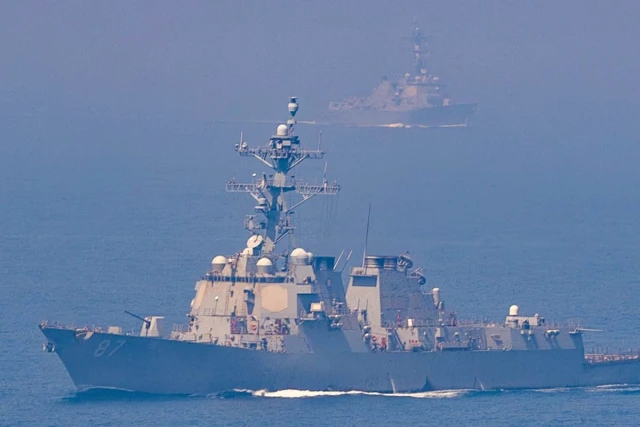
Iranian and American forces exchanged fire in the Strait of Hormuz late Thursday, marking the most serious test yet of the ceasefire that began on April 8. However, Iranian officials and U.S. President Donald Trump quickly affirmed that the ceasefire remained in place and that talks would continue.
In Israel, the defense establishment has been closely monitoring recent developments, fearing that, following several attacks on the United Arab Emirates (UAE), the Iranian regime could resume firing ballistic missiles at Israel next.
On Thursday, officials told Army Radio that the exchange of blows had concluded for now, with one source noting that “both sides were careful to keep the incident limited and with minimal friction.”
Speaking to reporters in Washington, Trump summed up the exchange: “They trifled with us today. We blew them away,” while adding that the ceasefire was still in place.
Iran’s Press TV later reported, “The situation on Iranian islands and coastal cities by the Strait of Hormuz is back to normal now.”
A deal with Iran “might not happen, but it could happen any day. I believe they want the deal more than I do,” Trump said, once again downplaying Iranian strikes in an apparent effort to prevent the resumption of full-scale fighting, which the president reportedly wants to avoid.
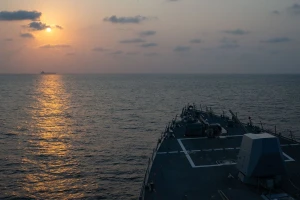
The U.S. president described the exchange on Truth Social: “Three World Class American Destroyers just transited, very successfully, out of the Strait of Hormuz, under fire. There was no damage done to the three Destroyers, but great damage done to the Iranian attackers.”
U.S. Central Command later said it struck Iran's military facilities that were “responsible for attacking US forces,” including “missile and drone launch sites, command and control locations, and intelligence, surveillance, and reconnaissance nodes.”
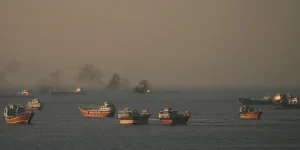
“They were completely destroyed along with numerous small boats, which are being used to take the place of their fully decapitated Navy. These boats went to the bottom of the Sea, quickly and efficiently. Missiles were shot at our Destroyers, and were easily knocked down. Likewise, drones came, and were incinerated while in the air. They dropped ever so beautifully down to the Ocean, very much like a butterfly dropping to its grave!”
Despite assurances that the ceasefire remains in place, Trump blasted the regime’s leadership, writing, “A normal Country would have allowed these Destroyers to pass, but Iran is not a normal Country. They are led by LUNATICS, and if they had the chance to use a Nuclear Weapon, they would do it, without question – But they’ll never have that opportunity.”
The exchange of fire reportedly began when an Iranian tanker attempted to leave an Iranian port and break the American blockade of the Strait of Hormuz and was fired upon by U.S. ships. “Our three Destroyers, with their wonderful Crews, will now rejoin our Naval Blockade, which is truly a ‘Wall of Steel,’” Trump concluded.
Despite assurances that the exchange of fire had ended, the UAE Defense Ministry said that it had worked to engage Iranian missiles and drones on Friday morning.
Earlier this week, Trump announced the suspension of Project Freedom, which had been launched a day earlier to assist vessels departing the Persian Gulf via the Strait of Hormuz.
The UN’s International Maritime Organization (IMO) chief said Friday that “approximately 20,000 crewmen and around 1,500 ships” remain trapped in the Gulf.
“Ten sailors have lost their lives” in over 30 Iranian attacks on vessels, he added.
Meanwhile, the U.S. is still awaiting Iran’s response to its latest proposal to end the war. Ynet News reported that an assessment presented during a recent meeting of the Israeli political-security cabinet suggests that Trump views a return to fighting as a “last resort.”
Given that Washington is insisting on “red lines” that are important to Israel, Israeli officials believe that if an agreement is reached, it would likely resemble the 'phased arrangement' with Hamas last year and include a gradual lifting of Iranian and U.S. blockades while negotiations continue.
A senior Israeli official told the outlet that “it is far from certain there will be an agreement.” “If each side remains in its position and does not make a dramatic change, then on the face of it, there cannot be an agreement, or there will be a two-stage agreement. Trump does not want to renew the fire, but in the end he has to come back with something. The Iranians are not helping him close out this event.”
You might also like to read this: