IAA uncovers sophisticated industrial site from the Middle Ages in central Israel



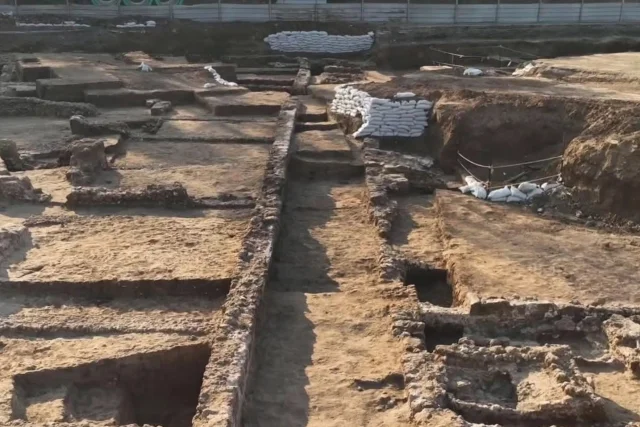
Archaeologists have uncovered a sophisticated industrial and commercial complex dating back about 1,300 years in the heart of modern Ramat Gan, revealing a network of planned streets, shops or warehouses, pottery kilns and other industrial installations.
The Israel Antiquities Authority (IAA) announced the discovery this week following excavations near the city's well-known Winter Stadium. The excavation is being carried out ahead of Netivei Ayalon's planned construction of a new bus terminal.
On Wednesday, Aug. 19, the IAA will open the site to the public, allowing visitors to see the archaeological discoveries firsthand.
The site was built during the Umayyad and Abbasid periods of the Islamic Caliphates, which dominated the Levant during the early Middle Ages. Archaeologists say it appears to have functioned as an organized industrial and commercial center, with facilities for producing pottery, tools and other goods for everyday use.
According to Minister of Heritage Rabbi Amichai Eliyahu, “The discovery of ancient finds in a residential neighborhood in Ramat Gan, adjacent to a well-known, long-standing stadium, once again demonstrates the historical and archaeological wealth of the State of Israel, where windows onto distant periods of the past may open anywhere.”
The complex was apparently constructed during the 7th or 8th century AD and remained in operation for about 150 years. Its abandonment remains unexplained, although archaeologists note that settlements in the pre-industrial world could be abandoned due to drought, disease, earthquakes, other natural disasters, or prolonged warfare.
“Although buildings and artifacts from ancient periods have been discovered in the area in the past, the results of the current excavation exceeded all expectations,” say Dr. Yoav Arbel and Lior Rauchberger, excavation directors on behalf of the Israel Antiquities Authority.
The archaeologists say the scale and organization of the site are particularly striking. “The excavation uncovered an organized, planned complex featuring straight, intersecting streets. Lining these streets were a series of rooms that served as shops or warehouses, plastered industrial facilities, pottery kilns and more.”
The layout suggests that the complex was not built randomly but according to a carefully developed plan. “Clearly, its main phase was planned in advance in detail by engineers and was built with the knowledge of the regional authorities, and perhaps even on their initiative and with their funding.”
The site's location also appears to have been carefully chosen. It was situated near the main road connecting Jaffa, Ramla – then the district capital – and Jerusalem. As the archaeologists explain, “Possibly, it stood on a secondary road branching off from this central route. The area also offered fertile agricultural land and available water sources.”
The site was later repopulated several decades after its initial abandonment, during the early Fatimid Caliphate. New residential areas and industrial facilities were constructed, including several tabuns, or clay baking ovens, which were built on top of the earlier infrastructure.
The people who lived and worked in the region during this period came from a variety of religious and ethnic communities.
According to the IAA, they “included Muslim, Christian, Jewish and Samaritan communities. Ramla, the district capital, had a Muslim community, while the Yarkon region was probably home to many Samaritans, descendants of a large population that flourished in the area during the Byzantine period, which preceded the Muslim conquest in the 7th century AD.”
However, the excavations have not uncovered clear evidence identifying the ethnic or religious identity of the people who lived and worked at the site.
By the late 11th century AD, the site was abandoned again and was never resettled. Over the centuries, it was gradually buried beneath layers of sand until its recent excavation by the IAA.
You might also like to read this: