






German far-right party AfD wins first, crushing victory in state elections but is not certain to lead future gov't
Jewish leaders decry victory of party whose members want to change German culture of remembrance
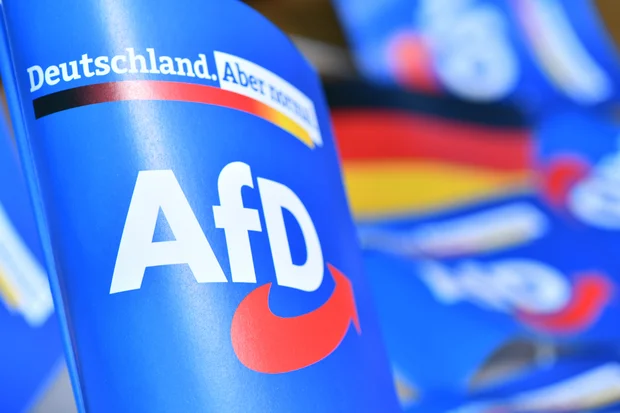
Germany’s far-right Alternative for Germany (AfD) won a first, crushing victory in a state election last Sunday, triggering outrage, fear and consternation across Germany, particularly among the Jewish community.
Most Jewish leaders decried the victory, which is widely being described as the first time a far-right, “radical” or even “extremist” party has won an election in Germany since the Nazis in the 1930s.
However, the victory is, for now, mostly symbolic. It remains far from certain, and even unlikely, that the AfD will in fact head the next government in the northern state of Saxony-Anhalt.
The mostly rural state lies in the center of the former East German territories, and is in the midst of a decades-long economic stagnation. It is roughly the size of Israel, at 20,000 square kilometers (12,400 square miles), but has only one-fifth of Israel’s population, with around 2 million people.
The AfD garnered 43.8% of the vote, more than twice as much as Germany’s ruling Christian Democratic Union (CDU), which received 17.2%, losing more than half of its votes from the previous election.
However, this translates to only 39 of the 83 seats in the state parliament, three short of a majority.
Due to the resolute boycott of most other parties against working with the AfD – dubbed the “firewall” (Brandmauer) – the state is now in a deadlock, with a temporary government being led by the CDU until a new coalition can be formed.
A coalition of all other parties could theoretically reach a majority, but the CDU has historically refused to cooperate with the far-left Left Party, the descendant of the Socialist Unity Party of Germany (SED), which ran the dictatorship that ruled East Germany until 1990.
A recent splinter from the Left Party called BSW has offered to cooperate with the AfD if it leads a minority government but ruled out a full coalition as well.
Josef Schuster, president of the Central Council of Jews in Germany, said he was “personally horrified by this election result,” expressing particular concern about harm to education policy if the AfD came into government.
Charlotte Knobloch, the 93-year-old Holocaust survivor who leads the Jewish Community of Munich, warned that the election victory is “a sign that the foundations of democracy in Germany are no longer functioning.”
She said she could not have imagined such a victory even in her “worst nightmares” and that “on days like this, it is difficult for me to recognize my homeland anymore. And I say quite openly: This frightens me.”
The AfD at first touted a very pro-Israel stance, but in recent years has toned down this rhetoric in favor of generic “anti-war” messages and calls for “both sides” to stop the fighting.
Party co-chair Tino Chrupalla said last year that Israel is committing “crimes” and injustices in the Gaza Strip “when it comes to the provision of basic necessities to civilians, starving children, and the killing of children.”
He added that these crimes would also have to be “punished,” and reiterated the AfD’s opposition to “arms deliveries to crisis and war zones.” Israel would remain “a partner and also a friendly country” for the party, Chrupalla said, but it must be possible to criticize friends “when they are politically wrong.”
Deutschland schaut nach rechts. Es darf auf dem linken Auge nicht blind sein.
— Ambassador Ron Prosor (@Ron_Prosor) September 6, 2026
Die Gefahr von Rechtsextremismus ist offensichtlich. Sie wird diskutiert, benannt und verurteilt. Linksextremer Antisemitismus verdient genau dieselbe Klarheit.
Wenn die Linksjugend an Schüler Sticker…
The Israeli government has maintained a policy of non-engagement with the party, despite recent efforts to reach out to other European right-wing parties like France’s National Rally.
Israel’s ambassador in Germany, Ron Prosor, warned on Sunday that while the “danger of right-wing extremism is obvious,” the country also “mustn’t be blind in its left eye.”
“Left-wing antisemitism deserves exactly the same clarity. When the Left Youth distributes stickers to students featuring a Kalashnikov and the Palestinian flag, that is not ‘activism’ that can be relativized. A firewall against antisemitism must not recognize any political direction. Jewish life and Israel's right to exist are red lines—whether attacked by right-wing extremists, left-wing extremists, or Islamists.”
The warning against left and right antisemitism was underlined by comments from BSW’s co-lead candidate Claudia Wittig on Sunday. Speaking to the far-right magazine Compact, she was asked whether she could rule out support for a prime ministerial candidate who is a “neo-liberal friend of Israel.”
“Yes, absolutely,” she said, laughing. “First of all, it definitely won’t be a Wessi [a person from former West Germany]… our clear red line is that it has to be someone who has a peace policy. It can’t be someone who supports any kind of Zionist projects.”
The AfD, a liberal and traditionally conservative-minded wing, which remains friendly to Israel, is increasingly under internal pressure from a wing that is using lingering anti-American sentiment and ostensible peace slogans that clearly betray a pro-Russian stance, reminiscent of developments among the U.S. right, like Tucker Carlson.
In an interview with Welt ahead of the elections, the party’s number two in Sachsen-Anhalt and author of the election program, Hans-Thomas Tillschneider, presented the AfD’s slogans on its election posters.
They included a mix of “regular” conservative messaging and far-right populism, like “Being able to say what you think again”; “Filling up gas without tears [due to the prices]”; “Living normally again” – a message against progressive sexual education in schools; “Everything is possible”; and “Be proud again.”
Regarding the last one, Tillschneider explained that the goal is “to have an unbiased, open relation to our own history,” highlighting Elon Musk’s call at an AfD event last year saying that “it’s ok to be German.”
Does this mean to speak less about German history, Tillschneider was asked. “No, but not from a perspective of guilt, but from a perspective of historical engagement.”
“Because we don’t have guilt?” – "Of course not, by now, not anymore… by now, not anymore. It’s too long ago… it’s separated by the world historical period of the Cold War, so it’s in the far past now.”
“But it is one of the largest crimes [ever committed]? – “Yes, but it has passed; it passed into history. Everything passes,” Tillschneider asserted.
Popular article:
interview Easter message of resurrection hope amid war at Jerusalem's Garden Tomb

biblical commentary Let my people go: a Passover message for today

4 IDF soldiers killed, 2 wounded in fighting in southern Lebanon, as Israel eliminates dozens of Hezbollah terrorists

Receive latest news & updates
A message from All Israel News
Help us educate Christians on a daily basis about what is happening in Israel & the Middle East and why it matters.
For as little as $10, you can support ALL ISRAEL NEWS, a non-profit media organization that is supported by readers like you.
Latest articles:

North American Jewish organizations to recruit 100 professionals to combat antisemitism

‘No need’ for pre-election Iran strike, IDF chief says as gov’t, opposition trade blame for potential escalation – report

terror attack 2 Israeli soldiers killed, 2 terrorists eliminated in Hebron shooting; IDF says much larger attack was prevented
analysis A people dwelling securely? Israel’s strategic standing, 3 years after Oct 7

Hamas on wheels: What I found in Dearborn reveals a troubling history and a battle over Israel