Why do so many Arab flags look the same?


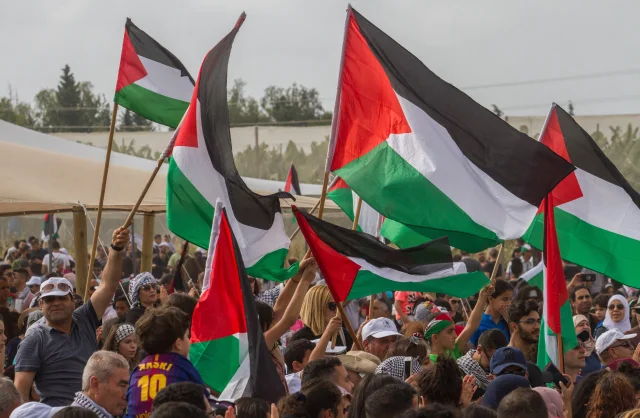
You may have noticed that the flags of many Arab countries in the Middle East follow a similar pattern. Whether it’s the flag of Jordan, Iraq, Kuwait, Libya, Syria, Sudan, the United Arab Emirates, or the Palestinian flag, the recurring colors of red, green, white, and black create a consistent visual theme across the region.
Other countries, such as Lebanon, Morocco, Saudi Arabia and Egypt, Tunisia, Bahrain and Yemen all stay within the limited color scheme, as well.
Why is that?
Carmem Marques Rodrigues, a map historian, explains that many Arab nations adopted a variation of a design created in 1917.
“This iconic symbol was actually designed in England, thanks to the influence of British diplomat Mark Sykes during the period of the Arab Revolt from 1916 to 1918. The Arab Revolt, a significant movement in the fight for Arab independence, had the support of Britain in its struggle against the Ottoman Empire,” said Rodrigues.
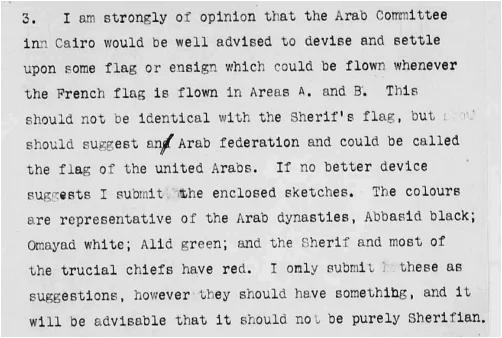
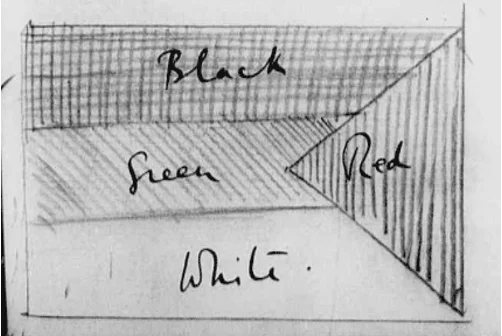
As a representative of the British Crown, Mark Sykes created the design based on four colors and sent it in a letter to Sir Reginald Wingate, High Commissioner for Egypt, in 1917. The four colors represented the four major Arab royal dynasties: black for the Abbasids, white for the Umayyads, green for the Fatimids, and red for the Hashemites.
The flag was designed as a rallying cry to encourage ethnic groups in the region to rise up against the Turkish Empire, which had taken control of the entire area. The British troops and their allies were fighting against the Ottoman Turks not long after the Armenian Genocide and sought to dismantle the caliphate.
Sykes wrote, “I am strongly of opinion that the Arab Committee in Cairo would be well advised to devise and settle upon some flag or ensign which could be flown whenever the French flag is flown in Areas A and B. This should not be identical with the Sherif's flag, but should suggest an Arab federation and could be called the flag of the united Arabs. If no better device suggests I submit the enclosed sketches.”
Sykes and Wingate sought to inspire the different dynasties and people groups to revolt against the Turks and reclaim their sovereignty.
Rodrigues elaborates on the design, “The red triangle at the center of the flag is not just an aesthetic choice but symbolizes Hashemite leadership during the Arab Revolt, unifying the other pan-Arab colors”.
Ultimately, the caliphate was broken up and new states, such as Jordan and Syria, were created in its place. As part of this process, the late Rabbi Sacks described the 1917 Balfour Declaration, which paved the way for a Jewish homeland in Israel, as “an anti-imperialist gesture.”
“After centuries of Christian and Muslim imperialism with no autonomous states, they attempted to return Ottoman ruled lands to the tribes that lived in them. Lloyd George was seeking more justice and wanting an end of the days of Empire, to return the lands to their original inhabitants,” Sacks wrote.
Before 1948, the official flag of British Mandatory Palestine had a red background with the Union Jack in the top left, with a white disc bearing the word “Palestine” on the right. The original area included all of Jordan and part of Syria.
Eventually, a much smaller area, limited to the west of the Jordan River, was divided into two states in the 1947 Partition Plan: one for Arabs and the other as a homeland for the Jewish people.
The new State of Israel soon adopted the blue and white Star of David design, while the Palestinians kept the flag based on Sykes' design.
Rather than being the result of “white settler colonialism,” the creation of Israel – along with many other nations in the Middle East – represented an attempt to dismantle an empire rather than to form one. The flag adopted by multiple Arab nations and the Palestinian cause was designed to inspire a pan-Arab revolt against the Ottoman Empire and re-establishing individual nations.
Images: Letter from Mark Sykes (of Sykes-Pecot) to Reginald Wingate, Feb. 22nd, 1917, showing his own sketches for the flag of the united Arabs (Arab revolt against Ottoman Turks) in WW1 (see: #3 p.59). Ref: FO882/16, https://discovery.nationalarchives.gov.uk/details/r/C1906448