Uncovering layers of biblical history under Tel Beit Shemesh





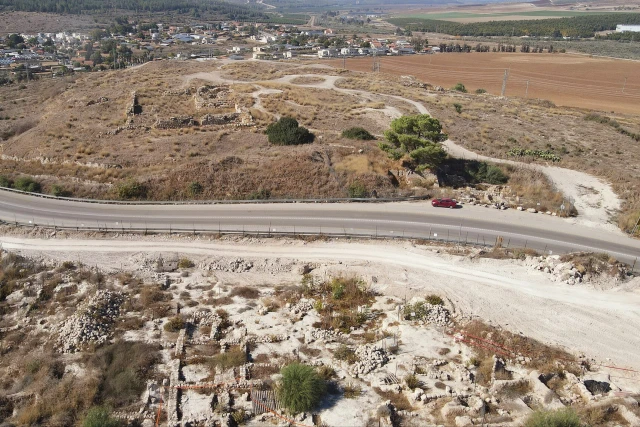
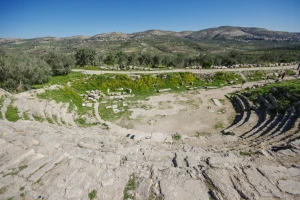
The modern town of Beit Shemesh in the Elah Valley is 30 kilometers (just under 20 miles) west of Jerusalem, but Tel Beit Shemesh, a stacked stash of ancient archaeological wonders, lies on the western outskirts of the town. Israeli tour guide Levi Simon took ALL ISRAEL NEWS correspondent, Oriel Moran, on a tour of the tel and what lies beneath its layers.
A tel is an archaeological term for a large mound formed over generations, each new community building on top of the ruins of the previous settlement, meaning that thousands of years of life and history are packed into that one spot, layer upon layer.
Today, more than 150,000 people live in Beit Shemesh, and it has some important biblical history. The town lies on the border that once divided the ancient Israelites from the Philistines – Israel’s arch enemies.
“The constant battles between the Philistines and the Judeans create great unrest inside of this region with mass destruction, multiple layers of destruction,” Simon told Moran. “Here's one of the layers we can see of the destruction just above this Canaanite temple, dating back to the Bronze Age.”
A battle between the two is described in 1 Samuel chapters 4-6, in which Israel loses and the Philistines capture the Ark of the Covenant, with some shocking consequences.
“The Philistines waged war on Israel at Aphek,” Simon explained. “The war of Ebenezer, where the Jews then lose the Ark of the Covenant to a very harsh battle. The high priest dies, Eli, when he falls back on his chair when he hears it.”
Despite the strict rules God had given about moving the Ark of the Covenant, the Israelites, under the advice of the high priest’s wayward sons, had taken the Ark into battle with them like a lucky charm, hoping it would help them gain victory after being beaten severely by the Philistines.
“And when the people came to the camp, the elders of Israel said, 'Why has the Lord defeated us today before the Philistines? Let us bring the ark of the covenant of the Lord here from Shiloh, that it may come among us and save us from the power of our enemies'" (1 Samuel 4:3).
Moran adds her understanding of why the Israelites lost the battle: “They had failed because they took their God to help them win that war and it didn't happen because there was sin,” she said. “The Ark of the Covenant was now in the hands of their enemies. They paid a really, really heavy price.”
The Bible tells us that the Ark was in the camp of the Philistines for seven months, during which time such terrible things happened in the enemy camp that they decided to return it, on a cart drawn by bulls to the border with the Israelites, at Beit Shemesh.
“The most prized and important article inside of all of the Jewish existence back then was taken back to the Jews. So the Ark of the Covenant makes its way in a straight line, straight towards Beit Shemesh. They didn't go left, it didn't go right, and it makes its way,” Simon relayed. “Two people working from the field of Yoshua then see the Ark of the Covenant. They see it's coming with bulls. The Philistines, they put gifts on top of little mice, five of them representing each town. It comes here, they take the cows, they sacrifice the cows for God, and they place the Ark of the Covenant on a big stone. This happens here where I am.”
Simon explained that "Beit Shemesh" means the house of the sun and that it was connected to worship of the sun god. It is also mentioned as one of the Canaanite towns allotted to Judah in Joshua 15:10.
“It mentions the conquest of Judea and the burning of the cities afterwards,” Simon noted. “If we look over here, we can actually see the layer of destruction of the actual charcoal and it burnt so hot…. archaeologists believed that it burnt for so long because there were storage rooms here with olive oil, which is one of the major exports here inside of Judea,” he said, adding, “the layer of destruction is consistent in the same height on top of this Canaanite temple.”
Some of the ancient store rooms are still visible at the tel, now deep underground. “Just look how big this place is to store the water. They built the city in a way that the water would be brought here,” he said, explaining that rather than just a single storage space, there is a network of smaller rooms. “They wouldn't build it in just one big square room because you needed support, you need support on the walls. So that's why it's built in these different kind of sections.”
The storage area was carved out of the porous rock and coated with plaster to waterproof it. “It was redone every few years. They just have a layer on top of layer on top of layer to make sure that [water] would stay,” Simon explained.
The layers of Tel Beit Shemesh tell stories of everything that’s happened there, stories that still have meaning for us today.
“The Ark of the Covenant was gone for seven months, and by the time it's returned to them, they are so excited and they want to behold God,” Moran suggested, reflecting on God’s presence, associated with the Ark.
“God's wrath was poured out on them because they dared to make profane something that was holy… It really is a lesson to be learned to not take those things lightly,” she added. “The fact that God reigns in us should make us even fear Him even more than before. Every single day, we must live as if we are the carriers of God's presence."
You might also like to read this: