Who cares about Somaliland

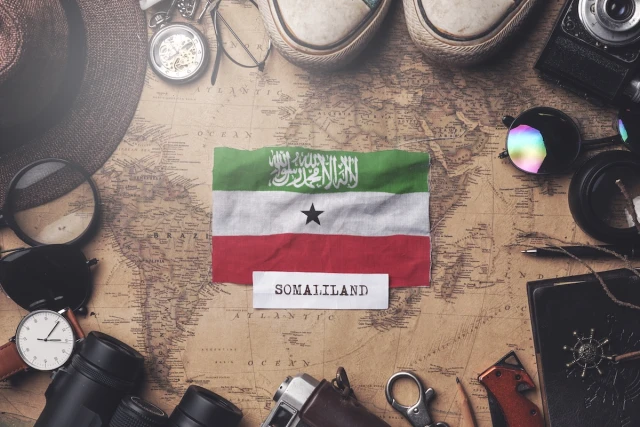
If you’re like me, not only did you never care about Somaliland, you probably never even heard of Somaliland until last week. At best. My initial instinct was that the name sounded like a puzzling cross between Somalia and Never-Neverland. However, after learning about Somaliland, it seems a lot of people do in fact care.
Somaliland is a Muslim nation of several million, on the Horn of Africa. Its immediate neighbors are Somalia to the south, Ethiopia to the west, and Djibouti to the north. To the east, and perhaps most significant, Somaliland juts out into the Gulf of Aden, one of the most important and strategic bodies of water in terms of global shipping.
In recent years, that became more significant as the Houthis, an Islamic terrorist group in Yemen, used their strategic location to threaten, divert, and impact global shipping to the degree that the US and other western nations undertook a campaign to mitigate the Houthis dangerous threats. Sitting opposite Yemen, Somaliland is a welcome, stable, democratic nation that declared independence from Somalia in 1991.
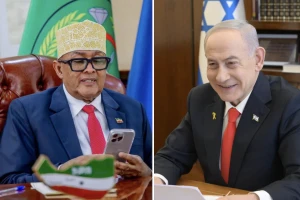
Why did Somaliland leap into the news last week? Because Israel became the first country in the world to recognize Somaliland as an independent state. The reasons for doing so are intuitive on many levels.
If the past two years of war have taught Israel anything is that it needs allies. Somaliland presents an opportunity to have boots on the ground, at least figuratively, in the Horn of Africa. There’s been talk about Israel establishing military base there which makes counteracting threats from Yemen and others that much easier. Minimally it affords Israel greater intelligence gathering opportunities regarding Iran, and the Houthi missile, drone, and other activity.
With the Houthis specifically targeting Israeli and Israeli bound ships, a connection to or presence in Somaliland provides protection for Israeli shipping, and for global shipping alike. It’s estimated that a third of world shipping passes through the Red Sea and the Bab el-Mandab Strait.
It may also be in Israel’s interest to facilitate its ally Ethiopia to access a reliable port through which to operate.
As much as it’s important to strengthen allies in the region, it’s also important to counteract Israel’s adversaries and other bad actors. For some years, Turkey has sought to widen its corrosive Islamist regional influence, not only in neighboring Syria and other middle eastern countries, but in Africa as well. In parallel, Turkey has become an increasing and overt threat to Israel, with its president Erdogan openly stating that he seeks to conquer Jerusalem.
Coincidentally, the same week as Israel recognized Somaliland, Israel also signed a defense pact with Greece and Cyprus, directly challenging Turkish influence in the Mediterranean. Israel has also insisted that Turkey not be part of any international presence in Gaza, nor on President Trump’s “Board of Peace.” Ankara is watching closely.
In addition to Turkey, Iran has long used eastern Africa as a route through which to smuggle weapons, and China has exerted increasing influence through its Belt and Road program to expand its own nefarious influence.
Simply, Israel sees the Red Sea and Horn of Africa as vital to its national security. Mutual recognition to and of an Islamic country is a smart calculation that may have broad dividends as noted above, as well as economically and diplomatically.
But not everyone is so happy with Israel recognizing Somaliland, or Somaliland recognizing Israel. There have been many outright condemnations. Regarding the later, it’s ironic that Turkey is one of the loudest critics of the move, as Muslim country itself that still maintains diplomatic relations (albeit tense and diminished) with Israel, and has done so for decades. As more Arab and Islamic states are lining up to be part of the Abraham Accords, why would this be anything less than celebrated around the world? Why did the United Nations Security Council convene an emergency meeting, three days after Israel’s recognition of Somaliland take place?
The answer lies in the double standard most of the world has relating to Israel. Only their foreign policies are legitimate, but not Israel’s. Why should Israel have any less right to establish diplomatic relations with a country that has existed independently for nearly a quarter of a century, that has its own military, a recognized non-Arab ethnic group, stable elections, currency, and does not threaten its neighbors?
Why should a country that exists like this not be recognized, whereas growing numbers of countries recognize a fictitious Palestinian state whose leaders are at open war with one another, neither of which control the territory they claim as their state, no currency, no elections in two decades, an ethnic group that was only invented in the 1960s, and which overtly threatens its neighbors.
Not only should they not be criticizing Israel, but the world should be celebrating and following suit. The Saudis, Emiratis, and Egyptians should be leading the pack if only to counteract Iranian and Turkish influence in Africa, in Syria, and Gaza.
Perhaps because Somaliland is made up of a non-Arab ethnic minority, and Israel can be viewed as doing something good as compared to being blamed for everything, nobody is looking at this as righteous, or cares about Somaliland. But the moment Israel steps in, it’s a lightning rod for the world to (over re)act as if its done something evil.
There’s another issue that cannot be overlooked when it relates to most anything in Israel as we begin 2026. Whether early elections will be called in the spring or summer, or the current government remains in power until the fall when elections are scheduled, in 2026 Israel will see national elections the first time since the war began in 2023, and all Israeli politicians will be looking at everything they do as another way to win votes, or peel votes away from others.
Do Israelis care so much about Somaliland? Is it likely to become the next hot tourist destination? Probably not. But diplomatic relations with another country, especially a Muslim one located where it is, it’s not a bad thing for which some politicians will also look to take credit.
You might also like to read this: