The failure of the Oslo Accords

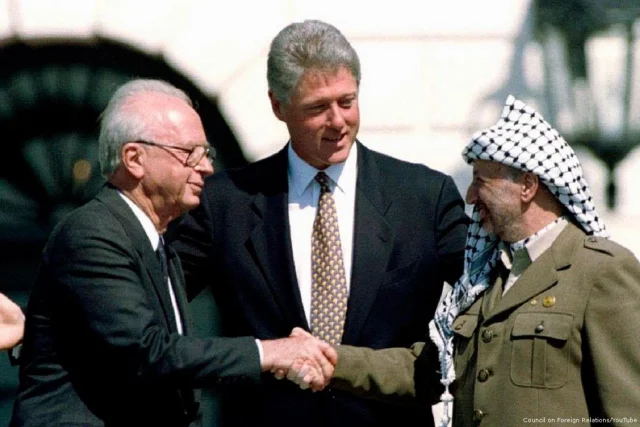
September 2026. Norway, whose capital gave its name to the accords intended to bring peace between Israelis and Palestinians, is now considering criminalizing trade with Israeli settlements in Judea and Samaria. The Norwegian foreign minister has mentioned a bill that could carry up to three years in prison for trade with the settlements and East Jerusalem. After unilaterally recognizing a Palestinian state in May 2024, Oslo is no longer just a mediator. Norway has now chosen to confront Israel.
An Illusion of Peace
Six years after the first Intifada ("war of stones") between Palestinians and Israelis, the Oslo Accords were signed on September 13, 1993. The goal was noble: to bring peace. But this hope rested largely on Israeli territorial concessions, even though Arab and then Palestinian leaders had already rejected several plans for partition or the creation of a Palestinian state alongside Israel. Among the main rejections were the Peel Plan of 1937, the UN partition plan of 1947, the proposals made at Camp David in 2000, Ehud Olmert's offer in 2008, and the American plan of 2020.
The 1993 agreements established an autonomous and interim Palestinian Authority (PA), responsible for administering parts of Gaza and Judea and Samaria. The core issues — Jerusalem, borders, settlements, security, and refugees — were to be resolved later through final status negotiations. The Oslo process and the agreements that extended it led Israel to transfer to the Palestinian Authority the administration of Jericho, Bethlehem, Nablus (Shechem), Ramallah, and most of Hebron, in the hope that these concessions would pave the way for peace. For Gaza, there was a first withdrawal in 1994 as a result of Oslo, followed by the total evacuation of Jewish settlements in 2005. What followed showed that the withdrawal from Gaza produced neither peace nor security... quite the opposite. Far from becoming laboratories of coexistence, several areas that came under Palestinian administration have become hotbeds of incitement, radicalization, and terrorist violence against Israel. What was framed as a peace process ultimately contributed to the "dismemberment" of the land of Israel without any guarantee or recognition of peace.
A Voided Framework
The transitional timetable planned by Oslo has long since expired. Mutual trust has collapsed and the Palestinian camp is no longer subject to a unified political authority. Since 2007, Hamas has controlled Gaza, while the PA only partially administers parts of Judea and Samaria and has not renewed its mandate through national elections for many years. The political framework imagined in 1993 therefore no longer corresponds to reality.
Oslo was based on a simple idea: mutual recognition, progressive autonomy, and territorial concessions were to reduce violence and prepare for coexistence. Israel transferred civil and security powers to the Palestinian Authority and withdrew from several urban centres.
Yet the expected peace has not come. The bloody suicide bombings of the 1990s, the second intifada starting in 2000, the Hamas takeover of Gaza, the waves of rocket fire and, finally, the massacre of October 7, 2023, have ruined the idea that territorial withdrawal would be enough, by itself, to produce peace.
The Political and Moral Failure of Oslo
It is possible to challenge certain Israeli policies without being anti-Semitic. But contemporary anti-Semitism can also take a more insidious form: that of a moral requirement applied almost exclusively to the Jewish state. Its history is denied, its security imperatives are relativized, and its sovereignty is subject to conditions that are not imposed on any other country. When Norway, like other European states, reflects this imbalance in its foreign policy, it helps to legitimize this hostility, even when it claims to be fighting anti-Semitism.
For the believer, the failure of Oslo is also reminiscent of Isaiah 28:15's warning against a "covenant with death" and false political promises. God declares in Leviticus 25:23, "The land is mine." Joel 3:2 also announces the judgment of those who have divided "my land." If the land of Israel is considered a God-given inheritance, giving up portions of it in exchange for promises of peace that are neither kept nor reciprocated is not a mere diplomatic concession: it means risking the sell-off of God's land.
Oslo was supposed to open a path to peace. It became the framework for a dead-end process, then the alibi for international recognition granted to a Palestinian state that has never fulfilled the fundamental conditions for peace: recognition of Israel, renunciation of violence, and an end to the education of hatred.
Today, Oslo looks like a door to the void. Peace cannot be born from a process in which only one side is summoned to give in, while the other continues to contest its very right to exist. Because how do you build peace with those who still refuse to recognize that you have the right to exist?
You might also like to read this: