Beneath a fragile roof, whom do we trust?
As Sukkot begins, the Torah’s warning about hidden power leads to an unexpected promise: God has not left His people without a voice.


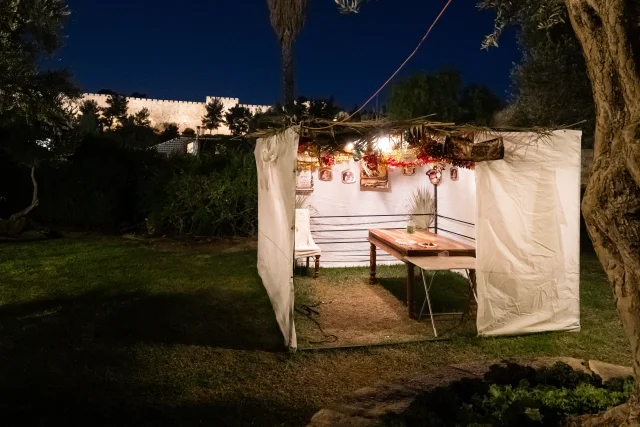
A sukkah lets the sky in.
That is part of its lesson. As Jewish families prepare for Sukkot, beginning at sundown Friday, they build temporary shelters that recall Israel’s years in the wilderness. The walls may be sturdy enough for a meal; the roof reminds everyone beneath it that no human shelter is complete.
Only days after Yom Kippur’s prayers of confession, that fragile roof poses a searching question: Where do we turn when we want forgiveness, protection, and some certainty about what comes next?
The question is ancient. So is the temptation to seek an answer in hidden knowledge: a secret interpretation, a sacred name used as a formula, an object believed to keep harm away. Such things can appeal to sincere people. Fear and longing often travel together.
Scripture does not mock that longing. It tells us where to take it.
After the warning, a promise
In Deuteronomy 18:9–14, Moses forbids Israel to practice divination, consult spirits, or inquire of the dead. God’s people must not seek knowledge and power by those means.
It would be possible to read the prohibition and stop there. But read the next verse. Moses says that the Lord will raise up a prophet from among Israel’s own people, and Israel must listen to him (Deuteronomy 18:15–19).
The order is the heart of the passage. God closes the door to forbidden ways of seeking a voice, then promises that He will speak. Israel is not asked to master a method for reaching Him. Israel is asked to listen.
The first Jewish followers of Yeshua understood that promise to point toward Him. Peter invoked Moses’ words as he urged his fellow Jews in Jerusalem to turn to the Messiah (Acts 3:19–26). His listeners could examine the claim, accept it, or reject it. Nothing about the appeal was concealed. Peter made it in public, from Israel’s own Scriptures.
That is the ground on which a Messianic conversation about spiritual knowledge should stand.
A fair question about Kabbalah
Kabbalah is a varied tradition of Jewish mystical interpretation, not a single ritual and not another name for Judaism. Its influential work, the Zohar, appeared in late thirteenth-century Spain. Its readers and later interpreters have approached questions of Scripture, God, creation, and prayer in different ways.
Followers of Yeshua can disagree with its teachings. We should do so accurately.
Reading a mystical text to understand Jewish history is not the same act as using words or objects in an attempt to command spiritual power. A symbolic interpretation of Scripture is not automatically divination. If a particular practice promises access to otherwise hidden knowledge or control over spiritual beings, Deuteronomy 18 gives us reason to examine it closely. The practice itself must be identified before it can be judged.
The same standard applies beyond Kabbalah. A Christian can turn prayer into an attempted bargain with God. A preacher can promise certainty Scripture has not given. The desire to control the unseen is a human temptation; calling it out only in someone else’s tradition would leave our own hearts unexamined.
Acts 19 describes people in Ephesus who had practiced magic abandoning it after becoming believers (Acts 19:18–20). The account shows the gospel changing what people do. It gives us no warrant to accuse a stranger of secret practices because of what that stranger wears.
The red string and the risk of a false witness
Some red wrist strings have associations with Jewish mystical custom. Their meanings vary, and the fashion has spread well beyond religious circles, as My Jewish Learning notes.
Others point to Genesis 38:27–30, where a midwife ties a crimson thread to a newborn’s hand. Genesis tells us why: she is marking which twin appeared first. It does not tell us what a modern bracelet wearer believes.
A red string is visible. A person’s convictions are not. When we claim to discern a hidden allegiance from an ambiguous object, we risk replacing evidence with suspicion—and bearing false witness in the name of vigilance.
That danger is especially acute when Christians speak about Jewish people. We can test a teaching without treating Judaism as a conspiracy. We can confess Yeshua without asking our Jewish neighbors to defend themselves against allegations we cannot prove. Truth needs no such help.
An invitation spoken aloud
Leviticus 23:42–43 gives the reason Israel dwells in booths: future generations are to remember that God made the people live in shelters when He brought them out of Egypt. The sukkah does not claim to be an instrument of supernatural protection. It recalls the Lord who sustained Israel when permanent shelter was absent.
The Gospel of John places Yeshua at the Festival of Booths. On its great day, He calls the thirsty to come to Him and drink. John says Yeshua is speaking of the Spirit (John 7:2, 37–39).
Consider the setting: a festival that remembers dependence on God, and a Jewish teacher standing where people can hear Him. He offers no guarded formula. His invitation is spoken aloud.
Jeremiah had promised a new covenant with the house of Israel and the house of Judah, marked by God’s instruction written on hearts and sins forgiven. At His final meal, Yeshua spoke of the new covenant in His blood. Followers of Yeshua believe that He fulfills the mercy Jeremiah announced.
Those are substantial claims. They deserve to be weighed from the Scriptures, never advanced by frightening people with unsupported accusations.
This Sukkot, a family will sit beneath a roof through which the sky is still visible. Its openings tell the truth about human limits. But the festival also remembers God’s faithfulness within those limits.
We need not pretend that the roof can save us. We need not claim that an object can reveal another person’s soul. Moses calls us to listen for the voice God provides. And at Sukkot, Yeshua’s invitation still sounds in the open: let the thirsty come.
You might also like to read this: