Tourism Ministry launches 'Biblical Trail' in Judea and Samaria, envisions 'Israel’s Tuscany'

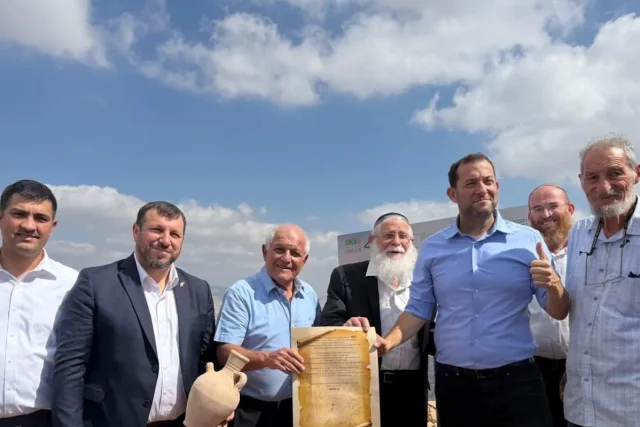
Israel’s Tourism Ministry launched its NIS 3.2 million ($1 million) “Biblical Trail” project on Wednesday, an initiative aimed at promoting tourism in Judea and Samaria (West Bank) by highlighting biblical Jewish sites and comparing the region’s natural scenery to Italy’s Tuscany.
The project includes a promenade and suspension bridge connecting the summit of Mount Kabir Nature Reserve with the Elon Moreh Heritage Center. Elon Moreh is mentioned in Genesis as the place where Abraham received God’s promise that his descendants would inherit the Land of Israel.
Tourism Minister Haim Katz and Heritage Minister Amichai Eliyahu attended the ceremony, along with Tourism Ministry Dir.-Gen. Michael Izhakov and Samaria Regional Council head Yossi Dagan.
“In Samaria, the story is found on the ground, in the places where the events that shaped our history took place,” Katz said. “Developing tourism is part of building the country. Every trail we develop and every site we make accessible connects more people to the area, strengthens settlement and generates growth.”
“Samaria can and should become Israel’s Tuscany. It has landscapes, vineyards, wineries, history and heritage that cannot be found anywhere else,” he added.
Dagan echoed similar sentiments and hailed the new tourist trail as another “moving step in building the country.”
“This place, where the forefathers of the nation walked, will now become accessible and welcoming to large numbers of visitors from across Israel,” Dagan said. “Our response to every challenge is to continue building and continue developing tourism in the heart of the land of the Bible."
Be also thanked Katz, Eliyahu and Finance Minister Bezalel Smotrich for supporting the region, which is home to local Jewish communities.
In August, a steering committee approved a proposal by Finance Minister Bezalel Smotrich to allocate NIS 113 million ($37 million) for the preservation and development of Jewish biblical sites across Judea and Samaria. In July, the Israeli government also approved NIS 27 million ($8.8 million) to develop hotels and other tourism infrastructure in the region, with the stated goal of transforming the area from a “day-trip destination” into a destination where tourists stay overnight.
Judea and Samaria contain numerous sites of Jewish historical and archaeological significance. Some Jewish heritage sites in the area have also been subject to vandalism, particularly in areas under Palestinian Authority (PA) control.
In January, lawmakers in Israel’s governing coalition signaled plans to extend Israeli authority over archaeological sites in Judea and Samaria, including areas under PA control, citing the need to protect and preserve the region’s antiquities and heritage sites.
Under the 1993 Oslo Accords, Judea and Samaria were divided into Areas A, B and C, with varying levels of Palestinian and Israeli civil and security control.
You might also like to read this: