While Iran fumes over Ukrainian strike in Caspian, Netanyahu and Zelenskyy speak for 1st time in 3 years
Ukraine hopeful that common enemies can bring increased cooperation with Israel






The Islamic Republic of Iran weighed an attack on Ukrainian targets, following a strike by the Ukrainian military on a vessel in the Caspian Sea over the weekend.
Ukraine reported that the vessel was carrying military cargo and indicated that it had conducted similar strikes in the past.
Ukrainian President Volodymyr Zelenskyy reported the successful strike on Saturday in a post on 𝕏, writing, “We also achieved very strong results with long‑range strikes in the Caspian Sea – including vessels used in military cargo shipments involving Iran, as well as a warship.”
Speaking to Israel’s Channel 12 News, Ambassador to Israel Yevgen Korniychuk said the vessels contained components for drones and missiles on their way to Iran.
Korniychuk also said the strikes were not the first time Ukraine struck military targets in the Caspian Sea.
“Zelenskyy has attacked an Iranian commercial vessel, killing a sailor,” Iranian Foreign Minister Abbas Araghchi said in a social media post on Sunday.
Araghchi accused Ukraine of carrying out “a blatant UN Charter violation done at Israel's behest to drag Europe into its war.” He also threatened retaliation.
Iran almost carried out that retaliatory strike, an article in The New York Times reported, saying that the Islamic Republic’s leadership ultimately decided against responding militarily.
Ukraine has accused both Iran and Russia of supporting each other’s military operations, pointing to the use of Iranian-developed Shahed drones to attack Ukrainian civilians, while also highlighting Iran's use of Russian-developed technology in a recent drone attack on Cyprus.
However, on Tuesday, following reported discussions with European Union officials, Araghchi spoke with his Ukrainian counterpart, Andrii Sybiha, who he said apologized for the strike and described it as “unintentional.”
Was assured by Ukrainian FM @andrii_sybiha that the attack on an Iranian ship was unintentional and Ukraine seeks no escalation.
— Seyed Abbas Araghchi (@araghchi) July 28, 2026
Iran does not seek escalation either, but made clear any attack on our citizens or interests is unacceptable. There must be restitution for losses.
For his part, Sybiha said that he held a “frank conversation” with Araghchi and conveyed Ukraine’s desire “to avoid unnecessary escalation.”
I called Iran’s Foreign Minister @araghchi for a frank conversation. Diplomacy is about direct conversation, even when it’s difficult. I stressed that our goal is to avoid unnecessary escalation.
— Andrii Sybiha 🇺🇦 (@andrii_sybiha) July 28, 2026
I reiterated that all of Ukraine’s actions are aimed solely at defending our…
Sybiha also said that he stressed “the necessity to refrain from any escalatory steps, as well as to end any support for Russia’s war against Ukraine. This war is illegal and it must end.”
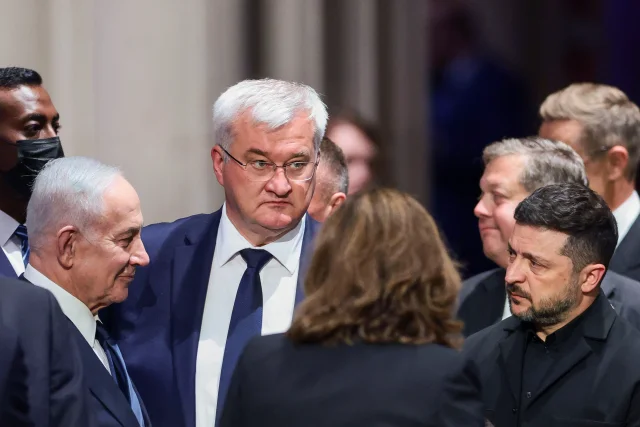
At the same time, Israeli Prime Minister Benjamin Netanyahu and Zelenskyy held their first face-to-face meeting in several years, during an encounter at the funeral of the late Republican Senator Lindsey Graham.
A longtime supporter of Israel, Graham died unexpectedly after returning from a visit to Kyiv, where he went to appraise the political situation, pledging to increase U.S. aid to the country in its fight with Russia.
The two leaders spoke briefly before the funeral service began.
It looks like Ukrainian President Volodymyr Zelenskyy and Israeli PM Benjamin Netanyahu had a cordial and substantive conversation during the commemorative ceremony for the late Sen. Lindsey Graham in Washington, D.C., on July 28, 2026.
— Kateryna Lisunova (@KaterynaLis) July 28, 2026
Earlier that day, Ukrainian Foreign… pic.twitter.com/4FHH27uk1F
The two leaders have not spoken since a phone conversation in January 2025, and their last in-person meeting took place in September 2023, before the outbreak of the Gaza war.
Both leaders met separately with President Donald Trump ahead of Graham's funeral.
Zelenskyy was present on Tuesday as the Senate passed a bill for additional energy sanctions against Russia. Graham sponsored the bill shortly before his death. It will also need to pass the House of Representatives before being sent to the U.S. president for signature into law.
Despite sharing a common enemy in Iran, Israel and Ukraine have maintained tense relations since the Russian invasion in 2022.
Earlier this year, Zelenskyy criticized Netanyahu’s approach to the Russia-Ukraine war, accusing him of maintaining a neutral position in order to avoid angering Russian President Vladimir Putin. Zelenskyy also said that Israel had declined Ukrainian offers of assistance related to countering drone threats from Iran and Hezbollah.
The situation was complicated by Russia’s military presence in Syria, where Moscow supported former Syrian President Bashar al-Assad. Following Assad’s fall, some Ukrainians expressed hope that Israel’s approach toward the Russia-Ukraine war could change.
Hebrew media reports have suggested that Netanyahu has maintained his position despite Zelenskyy’s reported offer to share intelligence regarding alleged Russian collaboration in Iran’s targeting of U.S. and Israeli military sites during ballistic missile attacks conducted during and after the joint aerial campaign in Iran.
Meanwhile, Israeli Foreign Minister Gideon Sa’ar invited Sybiha to visit Israel.
“Israel and Ukraine are friends, and I look forward to further deepening our cooperation, including through the establishment of new education centres in Ukrainian hospitals,” Sa’ar said.
Sybiha accepted the invitation, saying he informed Sa'ar, "about Russia’s escalation of terror against civilian vessels and freedom of navigation in the Black Sea and their implications for global food security, including for Israel as an importer.”
You might also like to read this: