The ‘struggle for Israel’s soul’ – Israeli hospital refuses to treat Gaza child


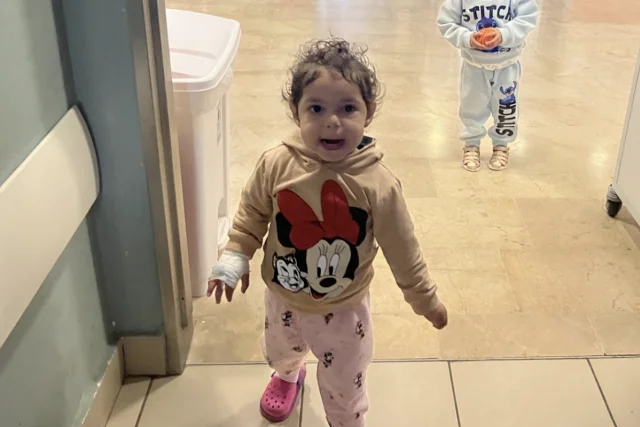
For the first time in its history, a Christian non-profit that brings children from Gaza for life-saving medical treatment says a child has been turned away by an Israeli hospital.
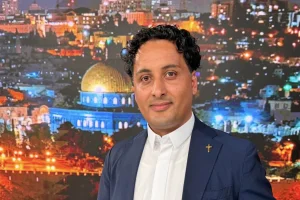
Jonathan Miles, founder of Shevet Achim – an organization that has brought numerous children and their families from “enemy” countries to Israeli hospitals – said that while he doesn’t wish to blame Israel, he is concerned about changes he’s seen since Oct. 7, 2023.
“There's really a struggle for the soul of Israel going on right now,” he said.
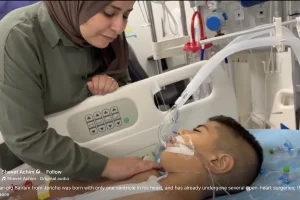
Newborn Hur was among six children from Gaza who got stuck in the hospital in Israel when the war broke out in 2023. After their discharge, they sought shelter at the Shevet Achim community home in Ashdod.
“It was a little tense because it was the first weeks after Oct. 7 and we were living in an entirely Jewish and pretty religious area,” Miles recalled.
They tried to hide the families from neighbors, warning their Gazan guests not to go outside or speak in Arabic loudly but it was not long before they were told that they had to move the families to the West Bank.
Bethlehem has become the “waiting room” for such families, some of whom have now been locked out of Gaza for three years.
Waiting in Bethlehem has come with a silver lining. They live among the sizable community of Christians from Gaza living in Bethlehem since many fled after the assassination of Bible Society manager Rami Ayyad in Gaza City 19 years ago. Shevet Achim’s families were warmly welcomed by the Gazan believers there.
“The Christians supported them, encouraged them, shared life together and had a real impact on them,” Miles said, adding that several among the families had been given the opportunity to read the Bible and experience Christian community.
At first, Hur was given permission to return repeatedly from Bethlehem to the hospital in Israel for the continuation of her treatment.
But when she needed another heart catheterization in November 2025, something had changed. “We put in all the papers… everything was ready, and we just were waiting for the morning – morning until sunset. I kept contacting the authorities, the IDF guy who does the permits… They just wouldn't answer me,” Miles said. “Finally, it dawned on me that they don't want to answer because they don't want to say no. And they can't say yes.”
So Shevet Achim brought Hur, then two years old, into Israel by herself without a family escort, and a team of volunteers stayed with her in the hospital around the clock.
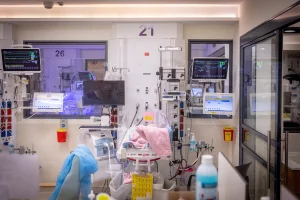
After catheterization failed, doctors determined Hur needed emergency surgery, but now the hospital management also refused to accept her without official government authorization.
“Really, in our 30-plus years, that's the first time that a child was turned away who needed life-saving treatment, and it was because of her origin,” Miles said.
Steve Walz, international spokesperson for Sheba Medical Center, told ALL ISRAEL NEWS that while many Kurdish and Druze children from neighboring countries have been treated in Israel over the years, “Gaza is a political issue that I can’t comment on.”
“But we have taken care of Palestinians from [the] West Bank non-stop since 1967, mostly kids,” he added.
In a statement to ALL ISRAEL NEWS, the military’s Coordination of Government Activities in the Territories (COGAT) said that the Erez Crossing through which Gazan patients used to enter Israel for treatment was completely destroyed on Oct. 7. Since then, Gazans have been barred from entering Israel, except to leave for a third country.
Some 50,000 Gazans with complex medical conditions have been able to travel through Israel for medical treatment in other countries since Oct. 7, 2023, with approximately 6,000 going through the Rafah Crossing to Egypt when it opened in February.
“Israel does not limit the number of patients permitted to depart. On the contrary, Israel encourages countries around the world to submit requests for the medical evacuation of patients from the Gaza Strip and stands ready to facilitate the evacuation process, subject to the receipt of an official request from a receiving country,” COGAT said.
Miles believes, however, that this hardening of government policy is also reflected in public opinion – and needs to be examined.
“It's really a time of crisis, and Israel's friends should realize there are some real problems,” Miles insisted. “There's really a struggle for the soul of Israel going on right now and it's very evident in all that's going on. Many Israelis are deeply distressed and discouraged, leaving the country because they say, ‘This isn't the Jewish state that I believed in. We're not acting righteously.’”
Among the six Gaza families in Bethlehem was a widowed mother, whose son was born with both a heart defect and his abdominal organs in a sac outside his body.
“He lived like that for like eight years, and then finally, the Sheba doctors got a specialist to come in from the U.S. and they put all those organs back in,” Miles said. “They were in the ICU when October 7th happened.”
A month later, the mother received the news that her remaining children were all killed when the IDF hit a residential tower where a terrorist was hiding. It seems no warning was given before the strike.
Miles is concerned that incidents such as these compromise the claim that the Israeli military is the most moral army in the world.
“Over the years, the standards that they set were really very high and moral,” said Miles. “Before the war, for example, they wouldn't take down an apartment building without warning the residents to get out. But after Oct. 7, a lot of that changed.”
“There are still some standards, but they were relaxed and, in practice, on the ground, sometimes totally ignored. Think of the incident where the three hostages got loose in Gaza,” Miles cited as an example. “They were waving white flags, shouting out in Hebrew and they approached the Israeli soldiers and they all got killed and that kind of thing has been happening on the ground.”
Miles described what he sees as a “tug of war” between the “old school” IDF leadership still trying to hold the line of morality and standards versus extremist politicians who have been inflaming hatred.
“This wartime government, for the first time, includes ones who are really anti-Arab,” he continued. “They're constantly agitating, saying we should kill them all, that there are no innocents, or we should be killing 30 or 40 every night in Gaza. This kind of rhetoric...is having an effect on the soldiers in the field.”
In Miles’ opinion, the IDF leadership is losing this tug-of-war.
“They aren’t succeeding in holding the line. The political echelon is tying their hands,” he said, referring to the lack of enforcement against radical settlers who camped outside Palestinian homes in Qusra.
“Refusing to treat children because they were born in Gaza is discriminatory,” said Miles. “We can't love Israel and turn a blind eye when there's unjust discrimination going on.”
Miles added that he does not want to simply criticize these policies but, after grappling with these questions for almost three years, is seeking a thoughtful discussion.
“Maybe instead of asking the authorities, ‘Why would you do that?’ we could ask, ‘When are we going to move on and remember compassion?’” he said.
You might also like to read this: