The Judeo-Christian 'one-two' punch: Evangelicals and Jewish Republicans target the midterms


With control of both the United States Senate and U.S. House hanging in the balance, Republicans are getting help from a powerful political combination: Evangelical Christians at the grassroots level and Jewish Republican organizations supplying money, endorsements and a muscular pro-Israel message. Call it the "one-two" punch of the 2026 midterms.
The two groups are not operating as a formal coalition. There is no evidence they are coordinating their activities. But their political footprints overlap in at least three main Senate races that could determine control of the Senate: Michigan, North Carolina and Ohio.
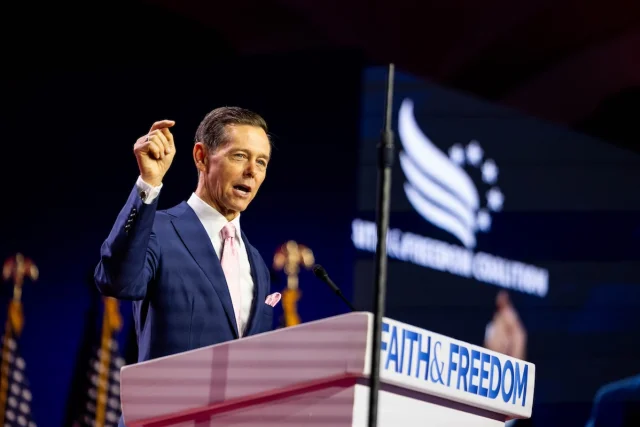
On the evangelical side, the Faith & Freedom Coalition has launched what it calls “Project Vote Chase,” a national campaign focused heavily on churchgoing voters who participated in the 2024 presidential election but might otherwise skip the midterms. The founder and chairman of Faith & Freedom Coalition Ralph Reed tells ALL ISRAEL NEWS, “We are undertaking our largest get out the vote effort in a midterm election in history, knocking on 6 to 7 million doors and blasting out millions of text messages and phone calls in the critical districts and states.”
“We are confident this will boost turnout, change the turnout model & confound the pundits & pollsters who are prematurely predicting the outcome before any ballots have been cast.”
The organization is beginning field operations in six Senate battlegrounds, including Michigan, North Carolina and Ohio. Besides the door knocks and text messages, its plans include approximately 2,000 paid canvassers, 4,000 volunteers and distributing voter guides through more than 190,000 churches. The goal is to directly engage roughly 32 million voters of faith.
That’s the first punch: boots on the ground, knocks on doors and voter guides in churches.
Punch No. 2 comes from the Republican Jewish Coalition (RJC), which has endorsed the Republican Senate nominees in all three states. Through its political action committee and national donor network, the RJC is directing attention and contributions to Mike Rogers in Michigan, Michael Whatley in North Carolina and Sen. Jon Husted in Ohio.
Christians United for Israel and its Action Fund also form part of the broader pro-Israel evangelical ecosystem, educating Christian voters and lobbying on Israel, Iran and antisemitism.
In short, this is all part of a Judeo-Christian 'one-two' punch that is aligned, for the most part, on conservative biblical values, especially support for Israel.
Michigan may be the clearest test of whether this 'one-two' punch can work. Republicans have not won a Michigan Senate election since 1994. Yet Donald Trump carried the state in 2024, while Rogers came within fewer than 20,000 votes of defeating Democrat Elissa Slotkin in the other Senate race back in 2024.
Now Rogers is running for the open seat against Abdul El-Sayed, a Democratic socialist who has been sharply critical of Israel. The race combines nearly every fault line in American politics: Evangelical and Jewish constituencies, the country’s largest concentration of Arab-American voters and a fierce debate over Israel and antisemitism.
The RJC calls Rogers the Republican with “the best opportunity on the map to flip a Senate seat from blue to red.” As for Faith & Freedom, it has evidence that its turnout operation can make a difference there. According to the organization’s post-election analysis, lower-propensity Michigan voters that it targeted in 2024 turned out at a rate 15.4% higher than the comparable figure in 2020. In a state where Senate races can be decided by a few thousand votes, that’s significant. After all, elections are typically won at the margins.
North Carolina presents a different challenge. Republican Michael Whatley, a former Republican National Committee chairman, is facing former Democratic Gov. Roy Cooper for the seat being vacated by Sen. Thom Tillis. North Carolina is more like a rescue mission: a seat the GOP must defend to preserve its majority. It won’t be easy. Cooper seems to have a relatively solid lead, but that could change.
The RJC’s endorsement emphasizes Whatley’s response to the Oct. 7 Hamas attacks and his support for Israel’s right to defend itself. Whatley has described the U.S.-Israel relationship in explicitly moral terms.
“This special alliance is far more than geopolitical, more than cultural – it’s moral,” Whatley wrote. You can bet that language will resonate with Christian Zionists, who see Israel through a biblical lens as well as a strategic interest. North Carolina is a treasure trove when it comes to Evangelical Christians, so turnout is paramount.
Then there is Ohio, where Husted is defending the seat that JD Vance vacated when he became vice president. His opponent is former Sen. Sherrod Brown, one of the best-known Democratic candidates in the industrial Midwest.
While this seems to be a race predominantly defined by the fight for the blue-collar worker, the RJC is backing Husted and emphasizing his record on school choice, an issue relevant to Orthodox Jewish families. Faith & Freedom, meanwhile, is targeting Ohio’s evangelical and socially conservative voters there as well. Ohio has always been a critical state where the evangelical vote matters deeply.
These three states reveal the larger stakes. Republicans hold a 53-47 Senate majority. Because Vice President Vance can break a 50-50 tie, Democrats need a net gain of four seats to seize control. It remains doable for Democrats, especially if this becomes a “wave” election.
You might also like to read this: