








The end of Kurdish autonomy? Intense clashes erupt in Syria, gov’t forces advance after ceasefire deal collapses
At least 120 ISIS terrorists escape from prison, thousands could escape amid clashes around al-Hol camp
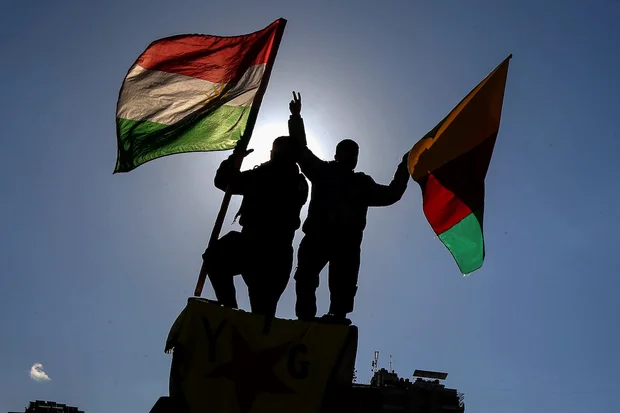
Forces of the Syrian interim government and the Kurdish Syrian Democratic Forces (SDF) faced off in intense clashes in northeastern Syria on Tuesday, after a ceasefire deal struck on Sunday collapsed overnight.
Kurdish officials have decried the “betrayal” by the U.S. and other allies, appealing to the international community for help as the Syrian government forces advanced on Tuesday on several prison camps holding former ISIS terrorists, which could cause the release of thousands of hardened extremists after a decade in jail.
The lightning offensive has severed the SDF-held territory into two surrounded enclaves centered on the cities of Kobane and Hasakah, threatening to destroy the decade-long Kurdish autonomy in Syria’s northeastern corner.
MORE | SDF Collapse and Risks for the US Counter-ISIS Mission: The risk that fighting in the northeast will significantly imperil the US mission to combat ISIS remains high unless negotiations or Kurdish operations can slow the pace of government advance towards Kurdish-majority… https://t.co/dDCpC3TsK7 pic.twitter.com/PJL8j969x8
— Institute for the Study of War (@TheStudyofWar) January 20, 2026
The Syrian government, led by former internationally designated terrorist Ahmed al-Sharaa (al-Jolani), had begun an offensive against majority-Kurdish neighborhoods in the northern city of Aleppo last week.
Syrian forces captured the neighborhoods while thousands of Kurds fled north toward the territory held by the SDF, which had managed to gain control over most of the territory to the east of the Euphrates River during the civil war in 2012.
For over a decade, this area was controlled by the Democratic Autonomous Administration of North and East Syria (DAANES), also known as Rojava, mostly controlled by troops loyal to the Kurdish Democratic Union Party (PYD), as well as allied Arab tribes mostly living in the countryside around majority-Kurdish towns.
Since the mostly Islamist rebel alliance led by al-Sharaa toppled the Assad regime at the end of 2024, SDF leader Mazloum Abdi and al-Sharaa have been in negotiations to integrate Rojava into the Syrian state. An agreement reached in March last year was never implemented.
Our forces foiled an attempt by Damascus factions to advance on the village of “Tal Baroud” along the Abyad road, south of Hasakah, inflicting heavy losses on their ranks and seizing a number of armored vehicles and weapons. pic.twitter.com/OiQC2lV0WU
— Syrian Democratic Forces (@SDF_Syria) January 20, 2026
Over the weekend, Syrian troops continued to sweep northward after capturing Aleppo, reaching the outskirts of the provincial capital Raqqa, and capturing the strategic city of Tabqa, as well as crucial oil fields in the Deir az-Zour region.
Many of the Arab tribes defected from the SDF to join the government, as footage of atrocities allegedly committed by Islamist government troops against captured Kurdish fighters circulated online.
By Sunday, Abdi was forced to agree to a deal with al-Sharaa that was much worse than the agreement struck in March. SDF troops would have to join the Syrian army as individuals, not as complete battalions, and the Kurds would lose control over border crossings and oil fields.
But on Monday, new clashes erupted as both sides accused each other of breaking the ceasefire. The SDF declared that the agreement had collapsed and issued a general call to arms in the evening, recalling the Kurds' heroic stand against ISIS that gave them control over the northeastern corner of Syria.
#Syria: #SDF-#YPG fighters are also using Grad rockets and suicide drones to target Government forces in #Hasakah province. https://t.co/UtuHVI8cMb https://t.co/nO7S0aiwza pic.twitter.com/sbRvt0M95d
— Qalaat Al Mudiq (@QalaatAlMudiq) January 20, 2026
“Just as our comrades in 2014 forged a historic resistance in Kobani and turned it into a graveyard for [the Islamic State group]… today we affirm with the same resolve that we will turn our cities… into a graveyard for the new [ISIS]-minded people who are directed by Turkey,” the SDF said.
On Tuesday, the Syrian government claimed to have captured 81 of the 120 ISIS prisoners it said had managed to escape from Shaddadi Prison during the clashes.
The SDF had accused government forces, among whom there are many former Islamist terrorists, of freeing the prisoners, claiming that the true number of escapees was around 1,500.
There were over a dozen prisons holding former ISIS terrorists in the territory controlled by the SDF, and these are estimated to hold some 9,000 hardened terrorists, including some believed to have carried out the group’s infamous atrocities during its reign of terror over large swathes of eastern Syria and western Iraq.
Hundreds of SDF elements reportedly fled the town of Al-Hol in the countryside of Al-Hasakah, according to local sources, as units of the Syrian army entered the area. pic.twitter.com/pUtTOrWGE2
— Levant24 (@Levant_24_) January 20, 2026
On Tuesday afternoon, SDF said the government was attacking al-Aqtan prison north of Raqqa, while troops were forced to withdraw from the al-Hol Camp, housing thousands of ISIS terrorists and their families.
The Kurdish forces blamed “the international indifference toward the issue of the ISIS terrorist organization and the failure of the international community to assume its responsibilities in addressing this serious matter,” adding that its troops would “redeploy in the vicinity of cities in northern Syria that are facing increasing risks and threats.”
Kurdish officials have specifically blamed Israel and the U.S. for their lack of support amid the ongoing advance of Syrian government forces.
The U.S. “left the Kurds, their allies, between the fists of ISIS and Al Qaeda,” said SDF spokesman Siyamend Ali, referring to al-Sharaa’s previous affiliation with Al Qaeda.
A U.S. official told the New York Times that the Trump administration is working to de-escalate the tensions between the sides, both of which are ostensibly allied with the U.S.
Special Envoy Tom Barrack reportedly was closely involved in the negotiations and praised the ceasefire and integration agreement over the weekend.
If Syrian government forces continue to advance in the north toward Raqqa, I will push for reimposing Caesar Act sanctions on steroids.
— Lindsey Graham (@LindseyGrahamSC) January 19, 2026
Apparently no one in Syria is listening to me or other U.S. government officials. If this continues, not only will there be bone-crushing…
However, there appear to be differences of opinion among Trump’s closest supporters, as Sen. Lindsey Graham wrote on Monday that “You cannot unite Syria by the use of military force as Syrian government leader Ahmed Al-Sharaa is trying to do.”
In another post on 𝕏, Graham wrote, “In the strongest terms possible, it is my core belief that America should defend the prisons in Syria that house the worst of the worst ISIS members. There are thousands of these lunatics in prisons, and if they get out, all hell will break loose. I’ve been saying this for years. To the Syrian government: be on notice that an ISIS jailbreak is a disaster for the U.S., Syria and the region.”
The day before, Graham had threatened the Syrian government with “reimposing Caesar Act sanctions on steroids” as well as “bone-crushing sanctions.” A continued advance would “permanently damage relationships between the U.S. and the new Syrian government,” he said.
Nevertheless, al-Sharaa and Trump spoke on the phone on Monday, with al-Sharaa’s office saying the leaders “affirmed the importance of preserving the unity and independence of Syrian territory” and “the need to guarantee the rights and protection of the Kurdish people.”
Israel’s Prime Minister Benjamin Netanyahu has not addressed the developments in Syria so far.
A Kurdish official told AFP on Tuesday that “Israeli figures are communicating with us and we expect any form of support.”
Popular article:
interview Easter message of resurrection hope amid war at Jerusalem's Garden Tomb
biblical commentary Let my people go: a Passover message for today
4 IDF soldiers killed, 2 wounded in fighting in southern Lebanon, as Israel eliminates dozens of Hezbollah terrorists

Receive latest news & updates
A message from All Israel News
Help us educate Christians on a daily basis about what is happening in Israel & the Middle East and why it matters.
For as little as $10, you can support ALL ISRAEL NEWS, a non-profit media organization that is supported by readers like you.
Latest articles:
North American Jewish organizations to recruit 100 professionals to combat antisemitism
‘No need’ for pre-election Iran strike, IDF chief says as gov’t, opposition trade blame for potential escalation – report
terror attack 2 Israeli soldiers killed, 2 terrorists eliminated in Hebron shooting; IDF says much larger attack was prevented
analysis A people dwelling securely? Israel’s strategic standing, 3 years after Oct 7
Hamas on wheels: What I found in Dearborn reveals a troubling history and a battle over Israel