Republicans have hammered Democrats over antisemitism; now one of their own has some explaining to do
Republicans in the United States have spent the last few years hammering Democrats over antisemitism in their ranks. They’ve demanded Democrats condemn anti-Israel rhetoric from progressive members of Congress. They’ve blasted Democratic Socialist candidates who embrace the Boycott, Divestment and Sanctions (BDS) movement. They’ve argued that Democratic leaders have been far too reluctant to confront antisemitism when it comes from their own political coalition.
All true. But what about the other side of the aisle – and I’m not talking about TUCKER CARLSON, Nick Fuentes and their ilk. Republicans may be facing an antisemitism test of their own that’s taking place in one of the most important Senate races in America.
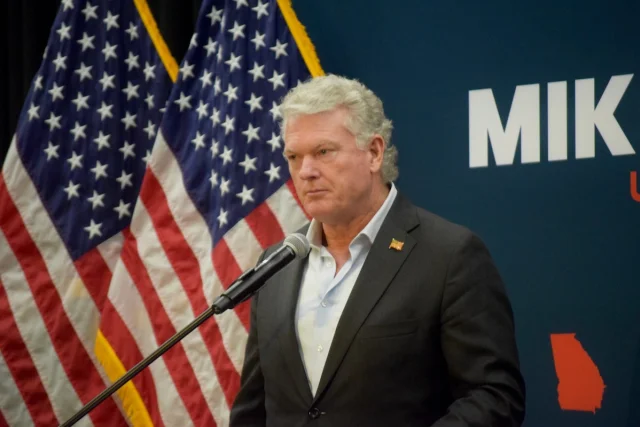
Republican Congressman Mike Collins is trying to unseat Democratic Senator Jon Ossoff in Georgia this November. Collins is a staunch conservative, Trump-backed and, overall, a strong supporter of Israel. But he also has some explaining to do.
The most serious issue involving Collins personally dates back to March 2024. An 𝕏 account called “Garbage Human,” which had a history of posting racist and antisemitic material, shared an article criticizing Washington Post reporter Maura Judkis and then wrote the following: “In case you were wondering, yes she is.”
What exactly was “she”? Jewish. Collins responded: “Never was a second thought.” The person behind the account later confirmed that the reference was indeed to Judkis being Jewish. That’s a problem.
Collins insisted people were misunderstanding him. He said he wasn’t commenting on Judkis being Jewish. Instead, he argued that he was agreeing that she was a “garbage human” because of her views about America being built on “stolen land.”
“I guess pointing out that a Washington Post journo excusing crime because she believes USA is on ‘stolen land’ makes her a garbage human is anti-Semitic?” Collins wrote. “Y’all just see stuff that ain’t there.”
Maybe Collins genuinely misunderstood the original post. But here’s where his explanation becomes harder to accept. After the person behind the account made clear that the reference was to Judkis being Jewish, Collins still didn’t say anything about misunderstanding the post and the characterization of the journalist.
Georgia state Rep. Esther Panitch, a Jewish Democrat, called Collins out. “It’s one thing to mistakenly respond to an anti-Semitic account,” Panitch said. “It’s another thing to double down on it and gaslight us like it never happened.”
That episode doesn’t prove Mike Collins hates Jews or subscribes to an antisemitic ideology. But fast-forward to 2026, and the story gets meatier.
A CNN investigation uncovered a disturbing collection of antisemitic material from Collins’s son-in-law, David Alan Scheer II – a social-media influencer with a massive following. We’re not talking about criticism of Prime Minister Benjamin Netanyahu or disagreement with Israeli policy. After all, that’s not antisemitic. CNN found that Scheer was promoting antisemitic conspiracy theories, Nazi imagery and material connected to Patriot Front, long considered to be a white-supremacist organization.
In one video highlighted by CNN, Scheer invoked the antisemitic “Jewish Bolsheviks” conspiracy theory, an idea that embraces the idea that communism is one big Jewish plot. Scheer complained about Americans being taught that Adolf Hitler was evil and sarcastically referenced the enormous attention paid to the Holocaust.
CNN also found that Scheer recently asked his followers whether he should produce a video about “why Gen Z doesn’t hate Hitler.” The poll was later deleted, but CNN preserved it. In another recording aired by CNN, Scheer rattled off a series of conspiracy theories blaming Jews for everything from pornography and banking to the JFK assassination, 9/11 and the influence of AIPAC and J Street.
If Scheer were simply an estranged relative whom Collins rarely saw, dragging Collins into his son-in-law’s ideology would be unfair, but that’s apparently not the situation. CNN found Scheer appearing in family photographs posted on Collins’s campaign website and social media. He attended Collins’s Republican Senate primary victory party in June.
Voter and property records reviewed by CNN also showed Scheer registered to vote since 2024 at a Collins-owned house adjacent to the congressman’s estate in Georgia. Additionally, CNN found evidence indicating Scheer had produced promotional material for Collins’s trucking company. He appeared to narrate company promotional videos.
CNN asked campaign officials whether Scheer had worked for Collins’s company, whether he had performed campaign work and whether his content had been filmed on Collins’s property. However, the campaign didn’t answer those specific questions. Instead, it pointed to Collins’s record of supporting Israel.
“Rep. Collins’ lifelong support for Israel is unquestioned and backed by his consistent record in Congress of standing up for Israel and her people,” his campaign said.
Eventually, Collins addressed the controversy involving his son-in-law, saying, “He has had no role in my campaign whatsoever and I don’t believe or support those views, and I have always condemned racism and antisemitism regardless of the source.”
Collins deserves credit for making his position clear, which helps to answer, at least for now, part of this controversy. It doesn’t, however, answer everything.
For starters, CNN reported evidence suggesting Scheer had produced promotional material for Collins’s trucking company and appeared to narrate company videos. Collins saying Scheer had “no role in my campaign whatsoever” answers the campaign question. It doesn’t necessarily answer what, if any, professional relationship existed between Scheer and Collins’s business.
While Collins has been a strong supporter of Israel, there remains that other lingering question: why did Collins respond approvingly to a social-media post whose author says it was targeting a journalist for being Jewish and why didn’t he unequivocally retract that response once its meaning was made clear?
If this were a Democrat in Georgia, you can be sure Republicans would certainly make this an issue. Republicans love to argue that Democrats shouldn’t be allowed to change the subject when charges of antisemitism appear on the left. Well then, what about when the appearance is on the right?
Ultimately, there’s a larger lesson here. Antisemitism doesn’t belong exclusively to the left or the right.
On the far left, it can emerge through demonization of Zionism, conspiratorial claims about Israeli influence and rhetoric that crosses the line from criticizing Israel into attacking Jews collectively. On the far right, it can emerge through overt hateful white nationalist groups and those linked to them, Holocaust minimization and conspiracy theories about Jewish control of government, banking and the media.
They may be different ideological roads, but it’s the same ancient hatred.
You might also like to read this: