‘No decisive outcomes’: Fmr top security official slams gov’t war policy, urges more strategic thinking


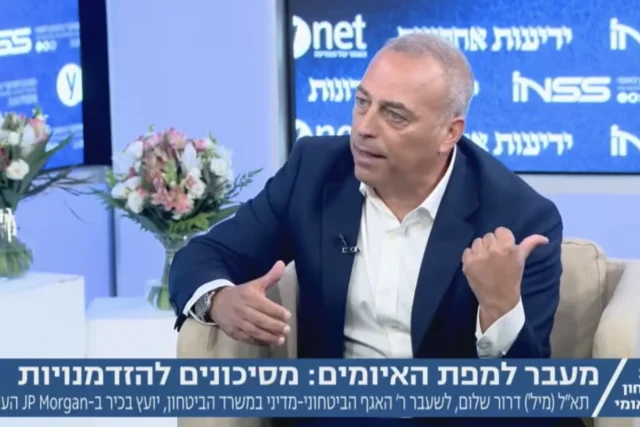
An outgoing senior Defense Ministry official strongly criticized the government’s achievements over the three years of war so far, warning that a lack of strategic vision squandered military achievements.
Brig. Gen. (ret.) Dror Shalom gave a first-ever on-camera interview at the INSS National Security Conference on Monday, after he recently left his post as head of the Defense Ministry’s Political-Military Bureau, which he led for most of the war.
Shalom spent decades in the center of Israel’s security apparatus, serving as a senior military intelligence officer and as national security adviser to the cabinet in previous positions.
“From a strategic standpoint, the war is a resounding failure,” Shalom declared. “At the strategic level, we failed to achieve a decisive outcome in any of the arenas.”
“Our hands are tied when it comes to strategic thinking,” he said. “The next government in Israel, whatever it is… needs to initiate. Military ability is impressive. It’s not enough. You need to initiate and improve Israel’s position in the world.”
Summing up his criticism, he said: “Hamas is still standing, Hezbollah is far from being disarmed, Iran—we did push its nuclear program back somewhat, but it still exists, and Israel's international standing is at an unprecedented low, while relations with the United States are also not at their best."
Despite this, Shalom noted that he supported some of the government’s decisions, like Operation Rising Lion against Iran.
“I thought it was the right timing, in coordination with the Americans and given the IDF's operational readiness. The strike was justified, even though there wasn't a bomb that was about to explode. We rolled back the weapons group because we dealt with the scientists—that is the most important thing, and it is very significant; there is a major achievement here.”
However, Shalom stressed that it is “troubling” that the enriched nuclear material remains in Iran, even if it is buried under the rubble for now.
But looking at the larger picture, he mocked the idea that the regime could be destroyed through airstrikes and the reportedly planned invasion by Iraqi Kurdish militias— “it's a delusion, simply a delusion. That is part of the weakening of the strategic tier.”
The retired general said that as head of the IDF intelligence Research Division in 2018 he had already warned that a plan for an “endgame” vis-à-vis the regime was needed, after U.S. President Donald Trump withdrew from the nuclear agreement with Iran.
“When we heard that Trump was leaving the nuclear agreement, it was clear that from that moment Iran would begin violating the agreement, and I wondered what our endgame—and the Americans' endgame—was. I think I was right back then.”
Regarding the Gaza front, Shalom noted the achievement of returning the hostages, though he credited the anti-government demonstrations for pressuring the U.S. to exert its influence.
“The hostages could have been brought back earlier—and more of them. Decisions could have been made sooner,” he said.
In general, Shalom lamented the lack of serious political outreach to translate military achievements into stable, long-term political agreements.
“Israel's entire strategic tier is weak today—or more accurately, weakened." Critics have long highlighted the turmoil within the Foreign Ministry, as well as the weakening of the role of the National Security Council as sources for a lack of long-term thinking and goal setting within the political leadership.
At the end of May, Shmuel Ben Ezra was appointed as the new national security adviser and head of the National Security Council, after it had been led by a temporary placeholder following the firing of Tzachi Hanegbi last October.
"The next government must take the initiative and improve Israel's standing in the world. A diplomatic initiative is required—to create an alternative to Hamas,” Shalom urged.
However, he also noted that Israel must “hunt down” every Hamas member.
On the northern front with Syria and Lebanon, Shalom praised ongoing negotiations with the governments in Damascus and Beirut as a “historic opportunity.”
“It is possible to reach political understandings with Syria's president and arrive at a peace agreement in Lebanon,” he assessed.
Shalom also warned that the government is “neglecting” ties with Israel’s neighbors Egypt and Jordan, with whom relations have worsened during the war. “The country's leaders don't even meet with them,” he said.
Summing up his remarks, Shalom urged the creation of a state commission of inquiry to analyze the country’s policies in Gaza, Iran, as well as the Palestinian issue, vowing to be “be the first to appear before it.”
You might also like to read this: