New UK gov’t led by PM Burnham, FM Miliband expected to take even tougher stance toward Israel
Burnham also vowed to look at 'further sanctions' against Israel




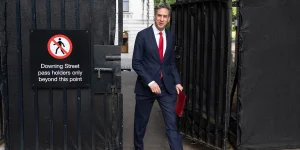
Andy Burnham became Great Britain’s new prime minister on Monday, succeeding Keir Starmer and pledging a series of reforms that include what is expected to be a tougher stance toward Israel. He underscored that direction with the appointment of Ed Miliband as the new foreign secretary.
While his predecessor, Starmer, was already seen as relatively cool toward Israel, Burnham has vowed to take an even more critical approach, telling The Guardian last week that “We’ve got to do more to put pressure on the Israeli government.” Under Starmer, the British government sought to cut off some arms sales, sanctioned Israeli ministers and joined the recognition of a Palestinian state, cratering relations with Jerusalem.
Burnham declined to characterize Israel’s actions in the Gaza Strip as a “genocide” while adding, “There’s increasing evidence that war crimes appear to have been committed.” Burnham also vowed to look “at further sanctions, both on those involved in violence in Gaza, but also looking at steps to ban trade in goods with illegal settlements.”
Upon his ascension to office, Gideon Falter, chief of the British Jewish Campaign Against Antisemitism (CAA), wrote Burnham an open letter, urging him make combating the rampant antisemitism in the UK a central priority.
“It was disheartening to British Jewry,” he wrote, “that you recently found time to announce specific policy measures relating to a foreign policy matter over which Britain has very little influence, but managed only a passing reference to antisemitism without mentioning a single policy.”
“Jews have been murdered at synagogue, stabbed in their neighborhoods, and attacked when they dare venture farther afield,” Falter noted, referring to the 2025 Yom Kippur terror attack at Heaton Park Synagogue in Manchester. As the then-mayor of Greater Manchester, Burnham “saw the effect firsthand,” Falter said.
“Now, as prime minister, you have an opportunity to do what your predecessors did not: You can do something about it.”
While Burnham did not mention Israel in his speech at Downing Street, one of his first moves was to appoint the former Labour party leader Ed Miliband, who is Jewish and has a long track record of strained relations with Israel.
During his time leading the party in 2014, amid Israel’s Operation Protective Edge against Hamas in Gaza, Miliband joined a symbolic call to unilaterally recognize a Palestinian state and criticized then-Prime Minister David Cameron for his “silence on the killing of innocent Palestinian civilians caused by Israel’s military action.”
Jewish leaders in the United Kingdom have strongly criticized Miliband’s nomination. Stephen Pollard, former editor of The Jewish Chronicle, called it the “most nauseating political appointment of my lifetime,” focusing on Miliband’s opposition to military action against the Assad regime in Syria, after it used chemical weapons on its own population.
“Not only was it a day of shame for Britain, it had global impact,” argued Pollard, “Obama feared a repeat in Congress and so backed away. Assad was thus sent a clear signal: butcher your own people with chemical weapons and the West will look the other way. It also sent a signal to Putin that the West was weak, and he soon after invaded Crimea.”
Edmund Fitton-Brown, a senior fellow with the Foundation for Defense of Democracies (FDD), told the Jewish Insider he believes Miliband “is much less rabid than Jeremy Corbyn,” the former Labour leader who once called members of Hamas and Hezbollah “friends” and faced persistent accusations of antisemitism, “but more anti-Israel than either of his predecessors.”
In his first statement as foreign secretary, Miliband said that “pursuing our interests and values means … playing our part to seek to end the conflict in Iran and fully reopen the Strait of Hormuz. It must also mean working tirelessly to seek a sustainable peace in Palestine and Israel, including an end to the terrible suffering of the people of Gaza and security for the people of Israel.”
You might also like to read this: