Lebanese President Aoun says he hopes to reach security deal with Israel as ‘prelude to peace agreement’
Next round of talks delayed until October, as Aoun seeks support for international force in southern Lebanon


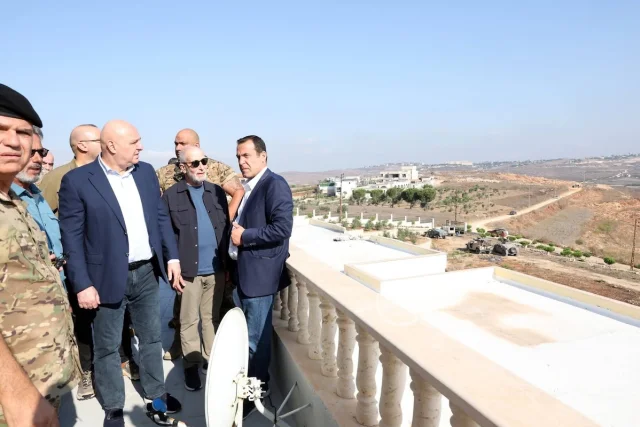
Lebanese President Joseph Aoun said he hopes to reach a security deal with Israel as a prelude to a peace agreement.
In an exclusive interview with Agence France-Presse ahead of his upcoming visit to Paris, Aoun said he would like to reach a security agreement with Israel, once the Jewish State withdraws from southern Lebanon.
Aoun said he hopes to achieve an agreement “primarily to end the state of hostility and the deployment of the army on the border. This could be a prelude to a later peace agreement, but we cannot jump directly to a peace agreement.”
“We have no choice but negotiations, because the alternative is war, which would be very costly for us,” Aoun added.
Aoun said Lebanon is also hoping to secure a new force to replace the UN Interim Force in Lebanon (UNIFIL), whose mandate expires at the end of this year.
Both France and Lebanon have sought to renew that mandate. Israel remains opposed to an extension, citing a history of UNIFIL forces failing to disarm Hezbollah, or even prevent attacks by the terror organization on Israeli territory.
While in Paris, Aoun will meet with President Emmanuel Macron and King Abdullah II of Jordan to build international support for the Lebanese Armed Forces (LAF).
“Our Arab and European partners, as well as the United States and our friends, must share with us the responsibility of supporting the army and strengthening the Lebanese state,” Aoun said.
The LAF has been tasked with disarming Hezbollah as part of a government pledge; however, LAF commander Rodolph Haykal has refrained from confronting Hezbollah, citing the risk of civil war.
While Aoun reiterated the Lebanese government’s determination to disarm Hezbollah, saying the decision is “neither negotiable nor open to discussion,” he also acknowledged the problematic nature of the task.
“The objective is not a confrontation,” Aoun said. “We are determined to resolve this issue peacefully.”
Over the weekend, Aoun, along with LAF commander Gen Rodolph Haykal, visited the southern Lebanese city of Nabatieh, in a surprise visit apparently aimed at demonstrating state sovereignty.
Nabatieh is center of support for the Hezbollah terror organization, which has suffered significant losses to the IDF in recent years.
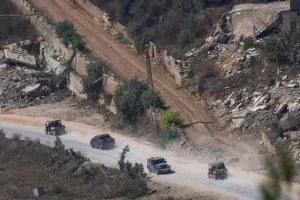
The town sits under the observation of the Ali Taher Ridge, where Israel had demolished an extensive Hezbollah tunnel system just hours before Aoun’s visit.
The explosives used in the demolition were enough to trigger a magnitude 4.1 tremor.
During his visit in Nabatieh, Aoun said that “no new negotiations with Israel are taking place at the moment.”
While the Lebanese government is reportedly upset at the failure of the IDF to withdraw from additional areas of southern Lebanon, as agreed to in the U.S.-led negotiations, the Israeli government points to the LAF’s refusal to begin disarming Hezbollah as of the reason.
According to the agreement, the LAF was supposed to ensure the destruction of all Hezbollah infrastructure in the areas from which it withdrew, and to prevent Hezbollah operatives from returning.
Israel’s Alma Research & Education Center questioned why the LAF, which was deployed to Nabatieh last week in order to “protect the city,” had not begun to dismantle Hezbollah infrastructure in the city.
Lebanese Army Deployment in Nabatieh: Reasserting State Sovereignty or Shielding Hezbollah?
— Israel-Alma (@Israel_Alma_org) September 9, 2026
On September 8, it was reported that the Lebanese Armed Forces (LAF) had reinforced their deployment and activity in Nabatieh, against the backdrop of Israeli strikes in the city and its… pic.twitter.com/j0IfNqYjrR
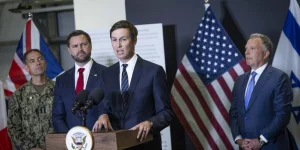
Israel’s Ambassador to the U.S. Yechiel Leiter met in Washington with Lebanese Ambassador to the U.S. Nada Hamadeh Moawad Tuesday night, Al-Arabiya reported.
The two discussed the next round of talks between the nations, which have currently been postponed until October, due to Israeli elections.
You might also like to read this: