Israel’s High Court strikes down law protecting Haredi draft dodgers from arrest





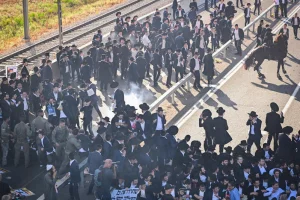
Israel’s High Court of Justice in Jerusalem struck down a controversial law on Thursday that protected from arrest Haredi (ultra-Orthodox) yeshiva students who refuse to enlist in the military.
The ruling came after Supreme Court Justice Ofer Grosskopf froze the law on July 15, just one day after it was passed. The court found that the Knesset had used defective legislative procedures to advance the measure, while eight of the nine justices also ruled that the law was unconstitutional and discriminatory because it granted Haredi men preferential treatment over other Israelis subject to mandatory military service.
Deputy Supreme Court President Noam Sohlberg stressed that the decision did not come “like a bolt from the blue,” noting that the Knesset’s legal advisers had warned lawmakers “once, twice, and three times” that the proposed legislation was problematic.
Prime Minister Benjamin Netanyahu’s coalition relies on the political support of the country’s two main Haredi parties – Shas and United Torah Judaism – which oppose mandatory military service for most ultra-Orthodox men.
However, there are signs of growing support within the Haredi community for military service. Last month, a new ultra-Orthodox party, Charedi Public, was launched with the stated goal of promoting Haredi enlistment.
The High Court’s ruling followed opposition to the law from the Knesset’s own legal team and Attorney-General Gali Baharav-Miara, who supported legal action against it.
Pressure for greater equality in military service has intensified since Oct. 7, 2023. The IDF has repeatedly warned of a personnel shortage amid the prolonged fighting against the Hamas terror group in the Gaza Strip.
IDF Chief of Staff Lt. Gen. Eyal Zamir, who has supported Haredi enlistment, told lawmakers that the legislation was “clearly and unequivocally inconsistent with the IDF’s needs.”
In late August, about 500 Haredi recruits joined the IDF. The military has established frameworks allowing ultra-Orthodox men to serve while maintaining a strictly observant lifestyle.
Some ultra-Orthodox leaders have nevertheless claimed that the government and IDF are seeking to undermine Torah study by forcing yeshiva students to enlist.
Sohlberg rejected that argument in his ruling.
“The enforcement proceedings against members of the haredi public in this context are conducted because they evaded their military-service obligation - not, heaven forbid, because they study Torah,” he wrote.
Israeli authorities estimate that 73,664 Haredi men are currently considered draft evaders. Only 219, or 0.3%, have so far been arrested.
The ultra-Orthodox Shas party condemned the High Court’s decision, calling the judges “the greatest generators of chaos in the country” and arguing that the ruling would not encourage Haredi enlistment but would instead deepen divisions within Israeli society.
Shas chairman Aryeh Deri separately claimed in a Thursday interview with Kol Barama radio that the IDF preferred “a secular army” and did not genuinely want more Haredi soldiers. Meanwhile, attorney Natan Rosenblatt, who represented an ultra-Orthodox organization, argued that Torah study prevented enlistment under the current circumstances.
You might also like to read this: