Israel’s High Court orders PM Netanyahu to justify keeping Ben Gvir as nat'l security minister
Court order looks set to revive national debate of Judicial Reforms, could lead to a ‘constitutional crisis’




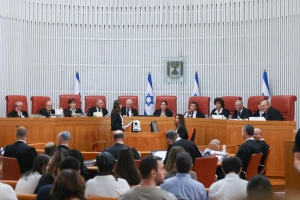
The High Court of Justice issued a conditional order on Wednesday requiring Prime Minister Benjamin Netanyahu to explain why he has not removed National Security Minister Itamar Ben Gvir from his position, in accordance with the legal recommendation of Attorney General Gali Baharav-Miara.
Last month, Baharav-Miara published a recommendation based on petitions calling for Ben Gvir’s removal from his ministry position. In it, she wrote, “A conditional order is required that will require the Prime Minister to explain why he is not removing the Minister of National Security, MK Ben Gvir, from his position. The minister is abusing his position and violating basic democratic principles. The dangers inherent in this situation are increasing as time goes by – it is possible that this is irreversible damage.”
To many in the coalition government, the situation where the attorney general, who is also legal advisor to the government, is asking the High Court to order Netanyahu to dismiss Ben Gvir is an example of the need for the Judicial Reforms, which the coalition began initiating in 2023, before the Oct. 7 Gaza War.
In announcing the conditional order, the High Court gave Netanyahu and Ben Gvir until March 10 to submit their responses, and it also noted that the composition of the panel hearing the case will be expanded to nine judges.
These two details of the order demonstrate “the nature and the gravity” of the case from the court’s perspective: the calling of an expanded panel of nine judges for the continuation of the hearing, and a fixed deadline for Netanyahu to respond – by March 10 – demonstrate that the court is seeking a full explanation and takes the concerns expressed by Baharav-Miara seriously.
Even before the High Court issued the conditional order, the coalition government began preparing for this scenario, and is reportedly considering advancing an already proposed amendment to a Basic Law, which would prohibit the High Court of Justice from interfering in a prime minister's decision regarding the appointment of ministers, to a second and third reading in the parliament.
The proposed amendment would repeal the so-called Deri-Pinchasi rule established by the High Court in 1993, in which the Israeli Supreme Court prohibited Shas leader Aryeh Deri from serving as Interior Minister due to his involvement in a corruption scandal, using the “reasonableness standard.” The High Court struck down a law by the coalition government aimed at limiting the court’s ability to use the reasonableness standard against Knesset Laws in early 2024.
By law, a minister who is accused of crimes can still continue to serve in his position. The Deri-Pinhasi ruling stated that the prime minister must exercise his discretion as to whether it is right not to dismiss a minister in such a case, but if the court finds that the discretion is unreasonable, it can overrule the prime minister and order the minister to be dismissed.
The ruling was a landmark event in Israeli political history and set the stage for the current legal battle over the court’s authority and the balance of power inside the Israeli government. The proposed amendment is another attack on the “reasonableness standard” that the court granted itself.
Many in the coalition government argue that the fact that Baharav-Miara is calling for Ben Gvir’s dismissal, even though he has not even been indicted, or become the subject of a criminal investigation, is proof that the judicial branch has acquired too much power without a clear legal basis.
The court order has the potential to provoke a so-called “constitutional crisis,” as it again brings focus to the lack of legal specificity regarding the full authority of the various branches of the Israeli government. The court order and the deadline will likely lead to further conflict between the coalition government and the judicial branch.
The order drew immediate reactions from Israeli politicians. Ben-Gvir himself attacked the move on his 𝕏 account, writing, "You have no authority. There will be no coup.”
Communications Minister Shlomo Karhi responded sharply, saying, “Not even 90 judges can appoint or dismiss a minister in Israel. The prime minister's response should be: It's none of your business, as prime minister of Israel, the sole authority is mine.”
Opposition MK Gilad Kariv (The Democrats) reacted positively to the court order, saying, “In a reformed and life-loving state, Netanyahu would have personally dismissed a failed and incompetent minister who is responsible for the collapse of personal security, in homes, on the streets and on the roads – but with Netanyahu, cynical political considerations prevail over any national considerations."
He went on to say the High Court judges did well when "they decided to oblige Netanyahu to address Ben Gvir's ongoing violation of the law and the complete trampling of the independence of the police and its statehood.”
Want to help more people find our reporting from Israel? Leave a quick Google review of our website HERE .
You might also like to read this: