Israeli transportation ministry under fire as flydubai hijacking attempt reveals gaps in security screening for foreign flight crews


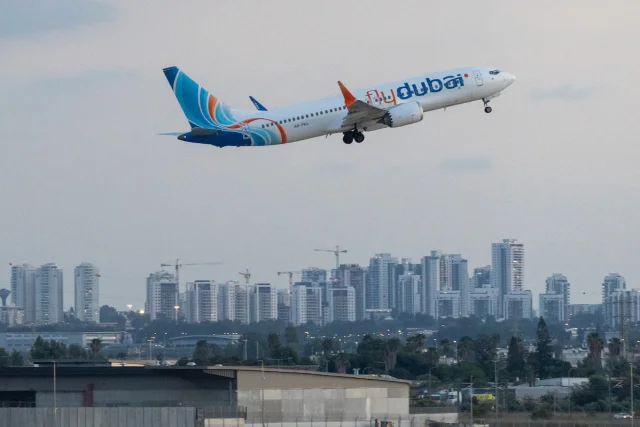
Israeli authorities are facing questions over whether security agencies failed to identify warning signs about the pilot accused of attempting to hijack flydubai flight 1073, despite information that had reportedly been available about his previous employment and alleged extremist views.
Army Radio reported Sunday morning that the Shin Bet security agency attempted in 2021 to transfer responsibility for security checks of foreign airline crews to the Transportation Ministry (MOT). According to the report, however, the ministry did not implement several recommended measures that could have helped identify potential security threats among foreign airline crews.
Mohammed Hammam al-Hammami, who has reportedly admitted to UAE authorities that he intended to crash flydubai flight 1073 and kill its nearly 180 passengers, was dismissed by Oman Air in 2025 following an internal investigation, according to reports.
The investigation reportedly found that al-Hammami frequently browsed extremist websites and expressed support for the Islamic State (IS) terrorist group. He also reportedly spoke regularly about jihad and expressed hatred and contempt for non-Muslims in private conversations with colleagues.
Additionally, his private diary has reportedly been examined by authorities and found to contain entries praising archterrorists Osama bin Laden, Abu Bakr al-Baghdadi, and Maulana Masood Azhar.
Despite the information reportedly gathered by Oman Air, al-Hammami was hired by flydubai in late 2025. He had apparently served as a member of the cockpit crew on several previous flights between Dubai and Tel Aviv without raising suspicions.
The Israeli Ministry of Transportation's Security Division said in mid-2025 that it did not have the resources to take over responsibility for conducting background checks on pilots employed by foreign airlines flying to and from Israel. However, according to Army Radio, the ministry did not formally request assistance from other security agencies to conduct the checks.
A classified State Comptroller report issued in May 2024 reportedly flagged the issue, although it remains under a court-imposed gag order. That same month, the Security Cabinet ordered the National Security Council to establish a team with representatives from the Transportation Ministry, Civil Aviation Authority, Shin Bet, Mossad and Finance Ministry to examine the issue.
The Army Radio report said MOT officials and elsewhere had told Transportation Minister Miri Regev and others that it did not have the capacity to assume responsibility for the task.
On Sunday, the Transportation Ministry rejected responsibility for conducting background checks on foreign airline pilots.
"The Security Division carries out a security assessment of aviation to Israel with the airline and local authorities,” Tamir Uri, a senior official in the Transportation Ministry's Security and Cyber Division, told the Israeli media portal Walla. “We request a declaration that all pilots have undergone a security background check. We are not an intelligence agency that conducts intelligence background checks. We have 120 airlines flying here. We are not the Shin Bet, and we don't have people abroad.”
The National Passenger Data Analysis Center, which operates under the Israel Tax Authority, had allegedly received information about the crew of flight 1073 and distributed it to the relevant government agencies, including the Shin Bet, Mossad and Israel Police. However, Uri insisted that "the names (of the pilots on flydubai flight 1073) were not passed on to us beforehand. Our procedures do not even include a threat of this kind, in which a pilot would carry out a terrorist attack. We believe there have been no such cases in the past, in which pilots with this kind of background arrived in Israel. Our working assumption is that this has not happened."
Records show that al-Hammami had been part of the flight crew on several flights to Israel and had last landed at Tel Aviv's Ben Gurion Airport one week before the attempted hijacking.
Other government agencies have said they were unaware that al-Hammami had been fired by Oman Air, the reason for his dismissal, or that he was known to have undergone a process of religious radicalization.
"There is [no such thing as 100% security]. That would mean stopping aviation to Israel," Uri told Walla. "Israeli airlines carry out security screening using Israeli teams. That is not the case with foreign airlines."
Shmuel Zakai, head of the Civil Aviation Authority, said, "Under a government decision, the Civil Aviation Authority has no responsibility whatsoever for security matters. We are responsible for safety. All security matters are the responsibility of other bodies."
"If an Omani citizen does not have a visa or an entry permit for Israel, he is not supposed to board a flight there. The airline knows that it was not permitted to operate this aircraft with a pilot holding an Omani passport who is barred from entering Israel,” he added. "Flydubai stopped its flights to Israel for two reasons: The authorities instructed the company to stop the flights to Israel until the investigation is completed, in order to make sure there is no additional breach and that this was a lone attacker. A fundamental rule is that the country from which the aircraft departs is responsible for security."
On Saturday evening, Transportation Minister Regev told Kan 11 News, "Aviation security is a very complex issue. The entire intelligence issue is divided between the Mossad and the Shin Bet. The Shin Bet is responsible for Israeli flights, and the Mossad is responsible for foreign companies. Flydubai is a foreign company. It is not connected to the Shin Bet but to the Mossad.” She emphasized, "The list did not come to us, because the body that is supposed to identify the crew is an intelligence body. We are not an intelligence body.”
Regev also warned that the incident was unlikely to be the last time an aircraft pilot posed a security threat, and that governments worldwide would need to find ways to address the issue going forward.
You might also like to read this: