Israeli Jews volunteer during Sukkot to protect Christians in Jerusalem’s Old City



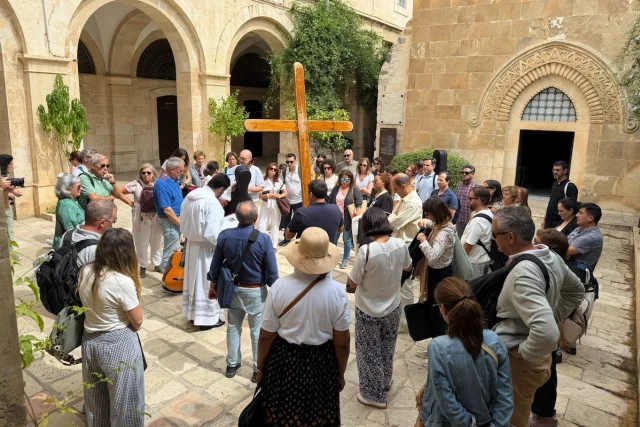
More than 140 Jewish Israeli volunteers gave up part of their Sukkot holiday this year to serve as a “protective presence” for Christian clergy and visitors walking through Jerusalem’s Old City.
Sukkot, or the Feast of Tabernacles, is one of Judaism’s three major pilgrimage festivals, bringing thousands of Jewish worshippers to Jerusalem. At the same time, Christian priests, nuns, monks and visiting pilgrims are also making their way through the narrow streets of the Old City to churches and other holy sites.
Most of the time, those paths cross peacefully. But in recent years, Christian clergy have been spat at and harassed, crosses and Christian signs have been defaced and stickers have been placed over signage pointing to churches.
The people behind these incidents represent a small radical fringe, but Jewish scholar and Christian-Jewish relations expert Yisca Harani believes that condemning the behavior from a distance was not enough.
She organized volunteers to walk the streets alongside Christian clergy and visitors, scattering themselves throughout the Old City to deter incidents, document them when they occur and report them to authorities.
In an exclusive interview with ALL ISRAEL NEWS, Harani said she began focusing more closely on the phenomenon of spitting several years ago.
“We’re on Via Dolorosa Street, and this is a very sacred street for Christians,” she said. “It has been many years that there’s a problem with spittings, but in the last three years, I’ve decided that this has got to be registered and introduced to the authorities as a phenomenon, not as a marginal thing.”
Why spitting?
Spitting at or near Christian clergy and symbols has a long history in Jerusalem. Some Jews use it as a gesture of contempt or rejection of Christianity. It is not required by Jewish law, however, and Jewish leaders have even condemned the practice.
In medieval and early modern Europe, some Ashkenazi Jews developed a custom of spitting when reciting the word “emptiness” in the Aleinu prayer, as a symbolic rejection of what they viewed as the idolatrous beliefs of the Christian majority persecuting them.
The custom reflects a Hebrew wordplay: rok (רוק), meaning “spittle,” sounds similar to reik (ריק), meaning “empty.” Rok comes from the ancient biblical Hebrew verb raqaq (רקק), meaning “to spit,” which is also the root of the modern verb lirok (לירוק), “to spit.” The link between rok and reik is based on sound and association rather than a shared linguistic root.
A volunteer’s view
One of those volunteers is Nardy Grun, a secular humanistic rabbi and certified guide who regularly leads tours in the Old City.
Grun said he has seen the problem firsthand and believes it requires a response.
“Because the Christians in the Old City of Jerusalem, especially in the Old City, are attacked,” Grun said. “The churches are attacked. They are, most of all, the main thing is that they spit in front of churches.”
He pointed to a recent incident involving a 9-year-old boy from the Armenian community who was pepper-sprayed while riding his bicycle because he was wearing a cross.
“So for me, as a secular humanistic rabbi, this cannot go without a response,” Grun said.
He joined the protective presence effort in order to “maybe deter, maybe stop, maybe to show that there are people in Jerusalem, in the Old City, that do not condone this type of action.”
Grun said he has personally witnessed relatively few incidents while volunteering, but has seen numerous videos online showing people spitting and cursing Christians. During one shift, however, he saw a 10-year-old boy spit on the ground and confronted him.
For Grun, the goal is ultimately bigger than preventing individual incidents. “Because we want a free country,” he said. “We want everybody to worship as they believe in.” People should be able to walk through the Old City without fear, he added, regardless of their denomination, religion or culture.
“It should be harmonious, without fear, cooperation,” he said.

A Christian perspective
For Erast Amuli, a Christian from the Democratic Republic of Congo who is studying theology in Jerusalem as part of his formation to become a priest, the volunteers’ presence represents something much larger than security.
“The volunteer work is very important as the aim is really to bring people together,” Amuli said. “To understand one another, though there are differences, at least people can respect one another.”
“Christians can practice their religion in freedom as it is promoted,” he said. “Also, the Jews, they can practice their religion in freedom and respect.”
Amuli said the relationships formed between Jews and Christians in Jerusalem have already produced tangible results, including shared celebrations and opportunities to learn about each other's traditions.
He said the volunteers’ work can help address misunderstandings and eventually allow people from different religious backgrounds “to learn even from one another and to live together.”
A city of guests
For Harani, their work has been particularly meaningful during Sukkot.
“I have a huge sukkah,” Harani said, referring to the temporary shelters built by Jewish families as part of the holiday tradition, recalling Israel’s years in the wilderness.
“It is so beautifully decorated that it really breaks my heart that I’m not in the sukkah.” She continued, “But you know what? In a way, I’m saying, OK, Jerusalem is like a big sukkah where everybody is a guest. And we treat them as if they were in my own sukkah.”
Harani said that is the message the volunteers are trying to embody: Christians should be able to walk through Jerusalem’s streets as welcome guests rather than people who have to fear harassment.
When asked about her vision for Jerusalem, she answered: “My hope is that the energy and the motivation of civil society will never stop. This is a city that is a magnet to everybody. It’s a magnet to lunatics, to radicals, and also to people of goodwill. And we’re not going to let that magnet-metal connection be removed.”
“I don’t know if I’m a full optimist, but the optimistic message is that when there are people who care, the duty, the mission will not stop. Amen.”
You might also like to read this: