Israeli agricultural non-profit offers helping hand to Tanzania’s expanding wine industry



CultivAid, an Israeli agricultural non-profit organization, is helping modernize Tanzania's growing wine industry by bringing Israeli expertise in irrigation, viticulture and sustainable farming to local growers, as the East African country seeks to improve grape quality, increase production and expand exports.
Wine production in Tanzania dates back to the 1960s, when Catholic missionaries introduced modern viticulture to the central region of Dodoma, now considered the country's wine capital.
Today, CultivAid is working with growers, agricultural professionals and researchers in Tanzania, Kenya and Zambia to introduce innovative Israeli cultivation techniques that aim to improve yields, sustainability and grape quality while creating new opportunities for exports and wine tourism.
Speaking to The Media Line, Tanzanian viticulturist Jacob Timothy Mwavika explained why Israel has become a source of inspiration for farmers and wine producers across Africa.
"I have followed Israeli agriculture for many years because of its innovation and technology, especially irrigation techniques, desert agriculture and greenhouse technology," Mwavika said.
"Israel also stands out because of the amount of agricultural research and development it invests in," he added.
Despite his familiarity with Israeli agricultural innovation, Mwavika admitted that he knew little about Israeli winemaking before partnering with CultivAid.
"To be honest, I had heard very little about Israeli wine compared to what I knew about table grape production," he said.
Like Israel, Tanzania's main wine-growing region has a semi-arid climate, making Israeli expertise particularly relevant. Israel has become a global leader in cultivating grapes and producing wine under challenging conditions with limited natural water resources.
"We saw that there was a lot to do," Dr. Tomer Malchi, co-founder and CEO of CultivAid, recalled when his organization first assessed Tanzania's wine industry.
"There are many difficulties. They have low crop outputs, low quality, and pesticide issues. We have a lot of know-how and agronomy that can jump-start the crops," he explained.
Malchi believes Tanzanian vineyards have the potential to double their crop yields as modern farming practices become more widely adopted.
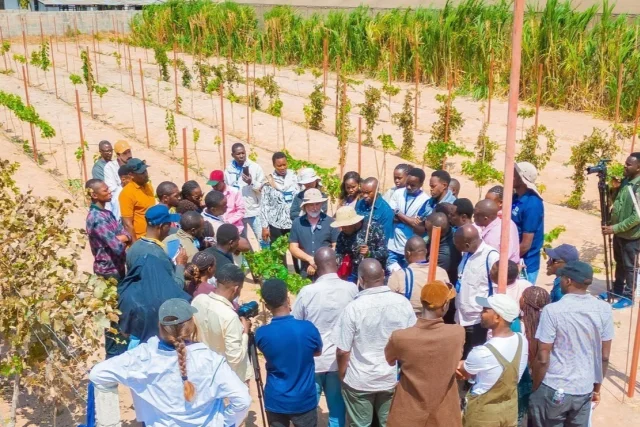
The cooperation is centered on a six-acre demonstration farm in Dodoma established by CultivAid.
"We are training local residents to be the best agronomists in Tanzania," Malchi said.
The organization recently held a vineyard management course for 60 local participants as part of a long-term program aimed at transforming Tanzania's wine industry.
"It has always been my dream to raise a new generation of grape specialists," Mwavika explained. "The challenge was that there was no platform to train them. CultivAid has provided that solution, and now they are helping develop young professionals with specialized skills in viticulture."
Mwavika said the partnership has given him access to practical expertise that was previously unavailable.
"CultivAid introduced me to many experts and gave me the opportunity to physically see and practice methods that I had only learned about through reading," the Tanzanian viticulturist said.
While Tanzania's wine industry remains relatively young, Mwavika believes it has substantial room for growth.
"The Tanzanian wine industry has significant opportunities for growth because there is still land suitable for grape production," Mwavika assessed. "We also have a strong tourism market, where wine consumption is high, and with improvements in quality, Tanzania can become much more competitive."
Malchi said the partnership has already delivered measurable results.
"When we began our activity, the local wine industry was producing between 4 million and 5 million liters a year, and now we are at 20 million liters," he recalled.
Even so, he believes the industry has yet to realize its full potential.
"There is still limited innovation and technology in the industry," he revealed.
"Modern equipment and improved techniques can transform both production and wine quality," Malchi explained.
Israel's own wine industry has undergone a dramatic transformation over the past four decades. Once known primarily for inexpensive kosher wines used in religious ceremonies, the country is now home to more than 300 commercial wineries producing internationally recognized wines exported around the world.
Despite challenging geography and limited water resources, vineyards now stretch from the Golan Heights and the Galilee in the north to the Judean Hills near Jerusalem, and even in the Negev Desert in the south.
In 2024, Israeli wine exports totaled about $66 million, with the United States serving as the largest export market. In May, the Negev Desert gained international recognition as a global wine-producing region.
For Mwavika, the partnership has also changed how he views Israel.
"I have learned that Israelis have a genuine willingness to help transform agriculture through practical training, working directly with farmers and openly sharing the results of their research," he stated. "I have not yet visited Israel, but it is something I very much hope to do."
Ayelet Levin-Karp, CEO of SID Israel, Israel's humanitarian aid and international development community, said organizations such as CultivAid demonstrate another dimension of Israel's engagement overseas.
"Projects like CultivAid reflect a different side of Israel's engagement with the world, one built on partnership, knowledge-sharing and long-term economic development," Levin-Karp explained.
"At a time when Israel faces significant international challenges, the work of Israeli development organizations across Africa demonstrates that Israeli expertise continues to be valued because it delivers measurable results and creates lasting opportunities for local communities,” she concluded.
You might also like to read this: