








Israel won’t stop striking Hezbollah despite talks with Lebanon, wants group’s disarmament by start of 2026 – report
Israel will give talks a chance but sets deadline for disarmament
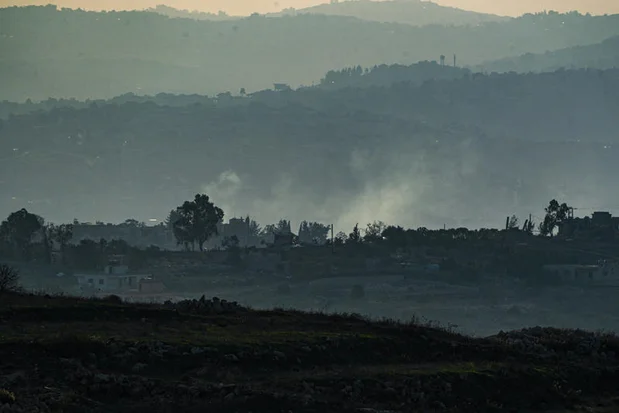
Israel conveyed to the Lebanese government that it won’t stop striking Hezbollah despite the recent first civilian-level meeting between the countries’ representatives, the Lebanese newspaper Ad-Diyar reported on Monday.
After Israel escalated strikes and signaling it was preparing for a potential new ground operation in recent weeks, the U.S. pressured Beirut and Jerusalem to send civilian representatives for the first non-military talks between the two sides in decades.
Despite this, Israel emphasized this won’t mean a stop to the airstrikes, most of which were aimed at preventing Hezbollah from rearming.
While Jerusalem reportedly showed itself ready to give negotiations a chance, the report added that senior Lebanese officials were told that the deadline for deciding the fate of Hezbollah’s weapons north of the Litani River would come at the beginning of next year.
If the Lebanese government has not resolved the issue by that time, Israel “will have a green light to continue the process of eliminating Hezbollah’s military wing,” according to Ad-Diyar.
After the weakening of Hezbollah at the hands of the IDF last year, the U.S. tied support for reconstruction to a demand to disarm the terror group. The Lebanese government instructed its military to establish a monopoly on weapons in the country, which would include disarming the terror group.
However, the Lebanese Armed Forces (LAF) have so far focused on the area south of the Litani River, leaving the Iran-backed group’s strategic weapon depots in Beirut and the Bekaa Valley virtually untouched.
Israel has warned that some officers in the LAF are cooperating with Hezbollah, and that the group is rearming faster than the military is able to confiscate its weapons.
The Lebanese government, meanwhile, has said it will complete the LAF’s deployment south of the Litani by the end of the year and has demanded, as a condition for continuing efforts to disarm Hezbollah, that Israel withdraw from the five outposts it still holds on Lebanese territory.
Nabih Berri, the powerful Speaker of the Lebanese Parliament and Shiite ally of Hezbollah, told the newspaper Al-Akhbar that the mission of Lebanon’s civilian envoy Simon Karam, who negotiated with Israel last week, “is supposed to yield clear results within weeks.”
“The United States must take an initiative that will convince Israel to abide by the agreement through stopping the strikes, releasing prisoners, and withdrawing from the occupied areas. If these things are not achieved, the negotiations will be meaningless,” Berri said.
According to a report by the Lebanese newspaper Nidaa Al-Watan, Berri recently requested a fatwa – an Islamic religious ruling – from Iran’s Supreme Leader, Ali Khamenei, to allow Hezbollah to hand over its strategic weaponry, including precision-guided missiles and drones.
On Monday, the leader of Lebanon’s Druze community, Walid Jumblatt, rejected the call for permanent peace that Israel’s U.S. Ambassador, Yechiel Leiter, made in an interview with a Lebanese outlet recently.
“Absolutely not. We are committed to the ceasefire, and afterwards we will return to the principles of the Arab summit held in Beirut in 2002, in which the leaders of the Arab states spoke – and continue to speak to this day – about ‘land for peace,'” Jumblatt said after a meeting with Berri.
He added that negotiations with Israel are being handled under the motto, “Withdrawal, ceasefire, consolidation and stabilization of the ceasefire, and the return of the residents of southern Lebanon to their villages.”
Despite the rejection of normalizing ties with Israel, Jumblatt expressed his general support for the government’s plan to deploy the military first in southern Lebanon, and then, throughout the country.
Jumblatt has long navigated between the different sides in the divided political landscape of Lebanon.
One of Hezbollah’s most vocal opponents in the country is Samir Geagea, the leader of the Christian “Lebanese Forces” party.
He said there is currently no reason for delaying the dismantling of Hezbollah’s military apparatus, while disagreeing with warnings that this could lead to a new civil war.
“We are not talking about disagreements between two parties or between two civilian groups; we are talking about a legitimate state that has consciously made decisions,” he said, claiming that everyone agrees that dismantling Hezbollah’s military is the prerequisite for resolving the current situation, given that it is a heavy burden on the Lebanese state.
Popular article:
interview Easter message of resurrection hope amid war at Jerusalem's Garden Tomb

biblical commentary Let my people go: a Passover message for today
4 IDF soldiers killed, 2 wounded in fighting in southern Lebanon, as Israel eliminates dozens of Hezbollah terrorists

Receive latest news & updates
A message from All Israel News
Help us educate Christians on a daily basis about what is happening in Israel & the Middle East and why it matters.
For as little as $10, you can support ALL ISRAEL NEWS, a non-profit media organization that is supported by readers like you.
Latest articles:
North American Jewish organizations to recruit 100 professionals to combat antisemitism
‘No need’ for pre-election Iran strike, IDF chief says as gov’t, opposition trade blame for potential escalation – report
terror attack 2 Israelis critically wounded, 2 terrorists killed in Hebron shooting; IDF says larger attack was prevented
analysis A people dwelling securely? Israel’s strategic standing, 3 years after Oct 7
Hamas on wheels: What I found in Dearborn reveals a troubling history and a battle over Israel