





Israel urged Qatar to continue sending funds to Hamas even weeks ahead of Oct 7 - report
TIME report says Qatar arrangement gave Israel leverage, measure of control over dispersal of funds


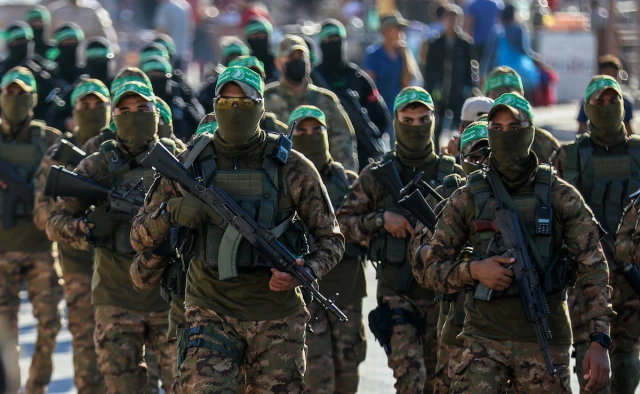
A new report by TIME revealed letters and documents shedding new light on the payment program organized by the Israeli government and Qatar to fund the Hamas-run government for several years ahead of Oct. 7, 2023.
The system has come under increased scrutiny in Israel as part of investigations into the failures that led to the Oct. 7 catastrophe. It has also featured prominently in conspiracy theories claiming that Israel created or aided Hamas or that the massacre was a false flag attack carried out by Israel itself.
The new documents illustrate that the government, as well as then-Mossad Director Yossi Cohen, wanted the funding to continue despite increasing internal criticism in Israel.
The program was launched in 2012, five years after Hamas violently took over the Gaza Strip. It also came after the 2008 Gaza War known as “Operation Cast Lead” in Israel and weeks of escalating strikes in early 2012.
The Qatari government had been sending money to Gaza since the Hamas takeover. But in 2012, the Netanyahu government set up a program to systematize and control Qatari funds, with the goal of gaining leverage by creating dependence, preventing catastrophic humanitarian situations that could explode in Israel’s face, as well as essentially bribing the terror group to keep quiet.
For example, Prime Minister Benjamin Netanyahu ordered the suspension of Qatari payments in 2019 to force Hamas to stop rocket fire against Israel.
At the time, the security system, as well as Netanyahu, were increasingly focused on the growing threat posed by Iran and its proxy network and welcomed the supposed quiet on the southern border.
In a 2020 letter cited by TIME, Mossad director Cohen wrote to Qatar’s Emir Tamim bin Hamad Al Thani: “It is indeed a great opportunity to express our gratitude and appreciation for the humanitarian aid efforts that the State of Qatar has provided the last few years to the Gaza Strip… Undoubtedly, these humanitarian efforts have played a crucial role in improving the humanitarian situation within the Gaza Strip, and ensuring stability and safety in the region.”
Israel’s security system and most politicians generally agreed that the strategy was effective, while only a few right-wing leaders, like Avigdor Liberman (Yisrael Beitenu) or Naftali Bennett, criticized it.
According to TIME, documents show that through cooperation with Qatar, Israel gained a measure of control over determining which families qualified for financial aid and disbursing the funds.
Several statements Netanyahu reportedly made over the years—though he denied some of the reports—indicate the Israeli government also saw propping up the Hamas government in Gaza, or at least preventing the strip from descending into chaos, as a tool to prevent it from coming under the control of the Palestinian Authority again, thus keeping Gaza and Judea and Samaria separated and weak.
In 2024, Netanyahu told TIME, “The reason that successive governments agreed to that is that we wanted to make sure that Gaza has a functioning civilian administration to avoid humanitarian collapse,” he said.
Five years into the program, some $1.1 billion had been transferred into the Gaza Strip, according to the Israeli newspaper Haaretz. Ostensibly, the funds were meant for humanitarian assistance, fuel, and government salaries; however, Israeli media reported that security officials already at that time knew Hamas was using the funds for its military as well.
Qatar has categorically denied these claims, portraying them as an attempt to smear the emirate’s image in Israel.
Last month, Israeli newspaper Yedioth Ahronoth reported that internal intelligence documents and testimony from senior officials show that Netanyahu was informed that funds were being diverted to Hamas’ military wing.
A senior Military Intelligence officer reportedly told the State Comptroller that Hamas was diverting around $4 million a month from Qatari funds to its terror army between at least 2019 and 2021, constituting roughly half of its entire military budget.
After increasing public criticism of the arrangement, Qatar began demanding formal documentation of the system in 2018.
A 2020 letter cited by TIME and authored by R. L. “Maoz”, a member of Netanyahu’s National Security Council, appealed to Qatar to continue the funds despite mounting public criticism.
“We reiterate the importance of continuing to transfer the Qatari humanitarian financial assistance through the existing mechanism,” Maoz wrote. “We greatly appreciate your cooperation and open discourse to safeguard stability and security in the region and to bring our countries and peoples closer together.”
A former defense official told the outlet that support for the payment program crossed political lines. Even former critic Naftali Bennett continued the practice after taking office in 2021. “It was a policy failure on our part born of good intentions that multiple prime ministers kept going,” the official said.
“But Netanyahu was unquestionably at the center of it. He was the one who championed and accelerated the program, his government was in charge of the way it was run, and now we know as a society that we can never afford to make a mistake like that again,” he added.
A new agreement in August 2021 committed Qatar to sending $40 million to a cash assistance program that handed out $100 per month to 100,000 Palestinian households for four months, and similar arrangements followed.
The emirate also reportedly paid Israel for fuel and electricity deliveries, with Jerusalem keeping control over recipients and the distribution mechanism for monthly $100 payments to poor families.
The system continued into 2023, with then-Mossad director David Barnea flying to Doha just two weeks before Oct. 7 to request a renewal of the payments, according to a New York Times report.
Today, the program is generally seen among Israelis as one decisive factor that allowed Hamas to build its strength and gain the ability to conduct the Oct. 7 massacre.
In his 2024 interview with TIME, Netanyahu defended himself by arguing that it “didn't prevent me from conducting three full-fledged military campaigns against Hamas in which we killed thousands of terrorists, eliminated some of their top military leadership and sought to prevent them from having the capacity to attack us."
One thing we didn't do was we didn't come out to eradicate Hamas completely, because that would require a full-scale ground invasion for which we had no internal legitimacy or international legitimacy,” he continued.
Asked if the whole arrangement to let Qatar transfer funds into Gaza was a mistake, Netanyahu answered: “I don't think it made that big a difference, because the main issue was the transfer of weapons and ammunition from the Sinai into Gaza. That's what made them—it wasn't so much a question of money.”
In September, Netanyahu reiterated his stance that the Qatari money wasn’t a decisive factor at all, telling i24 News that it amounted to just “two per cent of all the money that entered the Strip”.
You might also like to read this: