





Obama’s ‘stolen land’ claim ignores the legal and historical record
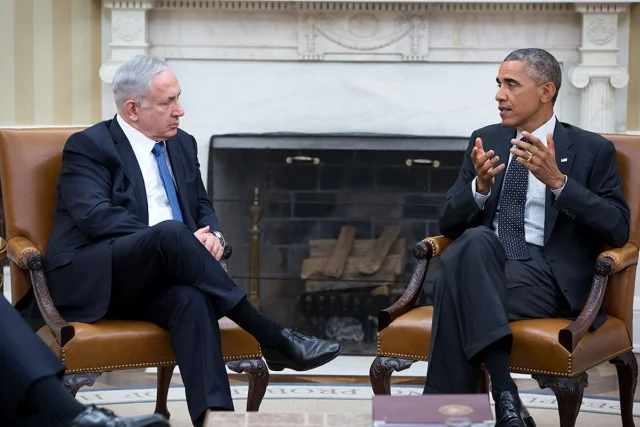
Former U.S. President Barack Obama’s recent remarks in Belfast—claiming that Israel “took land off people” during its establishment—are not merely ahistorical; they ignore the documented legal, diplomatic, and historical record. A careful reading of that record, including declassified archives and the foundational documents of international law, shows that the Jewish claim to the land is rooted in law and history, not theft.
The Historical Record: Flight, Not Only Expulsion
Obama’s framing presumes a one-sided narrative of expulsion. Yet the historical evidence reveals a far more complex reality. While there were indeed cases of expulsion—such as al-Bassa, Iqrit, Kafr Bir’im, and al-Qubayba—there is also extensive documentation of Arab evacuation orders and advice. In Haifa, a contemporary document from the Arab Emergency Committee dated April 23, 1948, confirms that the transfer of the Arab population was “voluntary and came at our request.” The memoirs of former Syrian Prime Minister Khalid al-Azm acknowledge that Arab governments called on the Palestinian population to leave, stating, “Since 1948 we have been demanding the return of the refugees… when we ourselves were the ones who induced them to leave.”
Fear also played a documented role. The Deir Yassin battle spread terror, and leaflets and loudspeaker broadcasts in Arab Jerusalem warned, “Unless you leave your home, the fate of Deir Yassin will be your fate.” A Palmach testimony acknowledges, “What happened in Deir Yassin helped us greatly in the other villages.” The weight of historical evidence shows that displacement resulted from the war itself—a combination of military actions, expulsions, and paralyzing fear—not a simple tale of land theft.
The Legal Record: Purchases Under Ottoman Law
Obama’s claim also ignores the meticulously legal process by which Jewish individuals and organizations acquired land in Ottoman and Mandatory Palestine. This was not a colonial imposition but an adaptive use of the laws of a weakening empire. The Ottoman Land Code of 1858 and the 1867 Law of Foreign Ownership permitted foreign nationals to own land outright, and Jewish purchasers—often holding British, French, or German passports—operated within a dual legal framework of Ottoman land law and consular protections under the Capitulations.
Key transactions, such as the Sursock family’s sale of the Jezreel Valley, were negotiated within Ottoman legal frameworks. Philanthropic organizations like Baron Edmond de Rothschild’s PICA and the Jewish Colonization Association worked through Ottoman-approved land registries, transforming barren or malaria-ridden plots into productive colonies. Figures like Haim Amzalak, the British vice-consul in Jaffa, and Joseph Navon Bey, an Ottoman Jewish entrepreneur, mediated deals through diplomatic channels. The Jewish National Fund, established in 1901, institutionalized these strategies. As the historical analysis concludes, “Jewish land acquisition in Ottoman Palestine was neither clandestine nor extralegal. It was a legally astute response to an evolving imperial system.”
The International Legal Record: The Mandate for Palestine
Most decisively, Obama’s claim ignores the League of Nations Mandate for Palestine (1922), which explicitly recognized “the historical connection of the Jewish people with Palestine” as “the ground for reconstituting their national home in that country.” The territory assigned for this purpose at San Remo (1920) and formalized in the Mandate included what is today Israel, Judea, Samaria, Gaza, and Jordan.
As Prime Minister Menachem Begin argued in 1981, “There is no such thing as annexation because one does not annex one’s own country. You annex foreign land. You do not annex your own country.” Begin anchored this status not solely in ancient scripture but in concrete modern international law. The Mandate was binding international law, creating specific rights for the Jewish people within defined territory. No subsequent legal instrument has legitimately extinguished these rights.
The Heartland: Judea, Samaria, and Gaza
If Begin’s logic holds for the Golan, it holds with exponentially greater force for Judea and Samaria—the geographical and spiritual epicenter of Jewish history for over 3,000 years. This is the land of the Patriarchs, where Joshua led the Israelites, where the Tabernacle rested in Shiloh, and where the United Kingdom under David and Solomon had its capital in Jerusalem. The Mandate explicitly included Judea and Samaria entirely. Jordan’s occupation from 1948 to 1967 was illegal and recognized only by Britain and Pakistan; it did not extinguish the underlying Jewish right affirmed by the League of Nations.
Even Gaza fits within this framework. It features prominently in Jewish history, was allotted to the Tribe of Judah, and was included in the Mandate. Egypt’s occupation from 1948 to 1967 was illegal and never conferred legitimate sovereign title. Asserting Israeli sovereignty over these territories is not “annexation”—it is the “application of Israeli law… to a part of our country that was liberated” from an illegal occupier.
Deir Yassin: Myth and Reality
Obama’s narrative leans heavily on the charge of massacre and ethnic cleansing, with Deir Yassin as its centerpiece. But virtually nothing in the popular account of Deir Yassin is correct. It was a military campaign, not a massacre. Deir Yassin was strategically situated on a hill overlooking the main highway entering Jerusalem, and by March 1948 about 150 soldiers from Syria and mainly Iraq had taken up posts there. Arab soldiers disguised as villagers launched a series of attacks on Jewish convoys to Jerusalem, and the Arabs regularly shelled Jewish convoys and parts of West Jerusalem from the village. Jewish military leadership decided in April that year that they must take over Deir Yassin for obvious strategic reasons.
As the Jews approached the village, they were led by a truck with a loudspeaker that warned civilians to flee via the rear of the village, which the Jews kept open during the entire battle—“and more than 200 residents left unharmed.” If the intent was to perpetrate a massacre, no one would have been warned or allowed to leave. Before the battle, the Arabs had fortified the houses and placed Iraqi soldiers in them; the homes had iron doors. Because the houses were fortified, the Jews had to dynamite open most of the doors, which caused a higher than expected number of casualties among the Arabs and accounts for most of the civilians who were injured or killed. After the remaining Arabs feigned surrender and then fired on the Jewish troops, some Jews killed Arab soldiers and civilians indiscriminately. Some Arab soldiers dressed up like women with veils that covered their faces. One of the people being checked realized he had been caught, took out a pistol and shot the Jewish commander; his friends, crazed with anger, shot in all directions and killed the Arabs in the area. The Irgun suffered 41 casualties, including four dead. Instead of 250, the current consensus of both Arab and Israeli investigation agrees that Arab casualties were 107 killed and 12 wounded. Contrary to claims from Arab propagandists at the time and some since, no evidence has ever been produced that any women were raped; on the contrary, every villager ever interviewed has denied these allegations.
There is no evidence to support the notion that a few of the remaining survivors of the so-called “massacre” were taken to other Arab villages causing them to flee. Instead, those captured were taken to Jerusalem and later released. Initial news reports, like one in the New York Times, simply reported about the battle with no hint of a massacre. The day after the battle, the Irgun escorted a representative of the Red Cross through the town and held a press conference. There was no hint of a massacre; that myth was developed later. What did come just a few days after the battle of Deir Yassin was an Arab ambush of a Jewish convoy on the way to Hadassah Hospital, killing 77 Jews, including doctors, nurses, patients, and the director of the hospital; another 23 people were injured. This massacre attracted little attention and is never mentioned by those who are quick to bring up Deir Yassin. Moreover, despite attacks such as this against the Jewish community in Palestine, in which more than 500 Jews were killed in the first four months after the partition decision alone, Jews did not flee—they had nowhere to go.
It is true that upon occasion there were a few Jews who committed some atrocities against Arabs during Israel’s War for Independence, which can be classified as war crimes. However, they were few and far between and were not indicative of the leadership of the new Jewish state. According to a research report by the Arab-sponsored Institute for Palestine Studies in Beirut, “the majority” of the Arab refugees in 1948 were not expelled, and “68%” left without seeing an Israeli soldier. While Arabs had the option of fleeing to many different Arab nations, most of the 800,000 Jewish refugees expelled from Arab nations in the late 40s had nowhere to go but Israel.
Conclusion
Obama’s characterization of Israel as having “taken land off people” is a profound historical and semantic error. The documentary record—from Ottoman land registries to the League of Nations Mandate—demonstrates that Jewish land acquisition was legally conducted, that displacement resulted from a complex war rather than simple theft, and that the Jewish people’s claim to Judea, Samaria, and Gaza is recognized by international law. To call it theft is to ignore the foundational legal document that paved the way for Israel’s rebirth and the undeniable, millennia-deep roots of the Jewish nation in its ancestral heartland.
You might also like to read this: