Israel ramps up domestic artillery shell production to meet wartime demand amid supply shortage, regional tensions
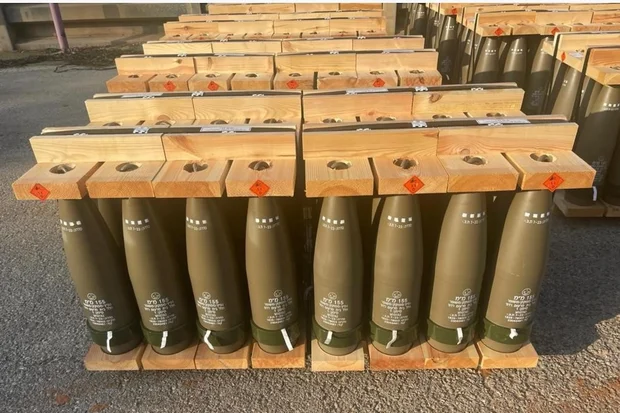
Israel is ramping up its domestic weapons production, signing a NIS 150 million ($48 million) contract with Elbit Systems, a leading Israeli defense electronics and weapons manufacturer, for tens of thousands of 155mm artillery shells. Thousands of workers across dozens of factories are producing the components, with the Ministry of Defense authorizing three shifts to meet the urgent demand.
According to a Defense Ministry statement, “The deal forms part of a broader IMOD strategy, driven by Defense Minister Israel Katz and Director General Maj.-Gen. (Res.) Amir Baram, to reduce reliance on external munitions sources and grow Israel’s domestic defense production base.”
Over the last two and a half years of the Iron Swords War, ammunition supplies have been a major concern for Israel’s national security planners. Israel has a robust domestic defense industry, anchored by Elbit, Israeli Aerospace Industries, Rafael Industries, and nearly 150 other companies, and it has consistently ranked among the top 10 global defense exporters.
At the same time, Israel imports large amounts of defense equipment, primarily from the United States, which stores stockpiles in Israel for emergencies. The global supply of weapons and ammunition is limited, and Russia's invasion of Ukraine in 2022 exposed the gap between the pace of modern warfare and the pace of arms production. Some of the weapons and ammunition stored in Israel was sent to Ukraine in late 2022, further straining stockpiles.
The Oct. 7, 2023, attack on Israel intensified the demand for munitions. American stocks are reportedly low amid ongoing operations against Iran and preparations for potential contingencies in Taiwan, and public support in the U.S. for supplying Israel has declined.
Analysts note that increasing domestic production alone cannot fully eliminate Israel’s strategic vulnerabilities. Complex systems like fighter jets require industrial capacity beyond Israel’s capabilities, and many high-tech components rely on semiconductors produced primarily in Taiwan. Even relatively simple weapons, like artillery shells, depend on global supply chains for steel, explosives, and other inputs.
Israel also remains dependent on imported crude oil, mostly from Azerbaijan via the Baku-Tbilisi-Ceyhan pipeline in Turkey, a supply made more uncertain by Turkey’s increasingly hostile stance toward Israel.
The push to expand domestic production underscores Israel’s determination to strengthen its defense self-reliance amid ongoing regional conflicts and global supply uncertainties.
Popular article:

interview Easter message of resurrection hope amid war at Jerusalem's Garden Tomb

biblical commentary Let my people go: a Passover message for today

4 IDF soldiers killed, 2 wounded in fighting in southern Lebanon, as Israel eliminates dozens of Hezbollah terrorists

Receive latest news & updates
A message from All Israel News
Help us educate Christians on a daily basis about what is happening in Israel & the Middle East and why it matters.
For as little as $10, you can support ALL ISRAEL NEWS, a non-profit media organization that is supported by readers like you.
Latest articles:

Change Bloc divided over coalition with Arab or ultra-Orthodox parties after week of negotiations

Huckabee fires back as Senate Democrats target US-Israel intelligence ties: 'Shocking!'

Israeli blood test detects early breast cancer with 95% accuracy, assesses recurrence risk

Injured son of ambassador Leiter still unconscious but out of life-threatening danger, moved to rehabilitation

Jim Jordan takes GOP reins: What it means for Israel as Democrats take US Congress