Israel can’t let Syria policy be set by Oct 7, security talks are 90% complete, says al-Sharaa
Damascus will insist on Golan Heights sovereignty, Sharaa asserts


Syrian President Ahmed al-Sharaa offered several insights into his approach to Israel on Tuesday, arguing that Jerusalem should not allow the events of Oct. 7, 2023, to dictate its policy toward Syria
Speaking on the sidelines of the UN General Assembly (UNGA) at an Atlantic Council panel, the former terror leader turned self-declared president described the current geopolitical situation as a “historic moment that could achieve benefits for all parties.
Addressing Israeli leaders, al-Sharaa said, “If you want to protect your own security, you need to respect the security of others.”
“I understand what happened on October 7 to some of the innocent people. But at the same time, it is not possible that all policies are set based on an incident that happened in history,” al-Sharaa said, noting, "at the same time we need to understand what happened in Gaza," including women and children who were killed.
“So it is not appropriate that what happened on October 7 sets the policy for Syria,” al-Sharaa emphasized. “This is not logical, and this brings more security threats.”
Israel’s efforts to maintain security are instead “creating problems” around its borders, he added. He urged Israel to focus on “mutual respect and good economic and trade relations.”
👀 @BarakRavid’s @Axios question to Syrian President Ahmed al-Sharaa 👇👇: pic.twitter.com/DZnHwaNv2N
— ToniMrad (@murat_toni) September 22, 2026
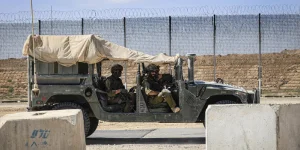
The Israeli military continues to hold a buffer zone within Syrian territory, mainly composed of the former demilitarized zone per the 1974 Disengagement Agreement, as well as the peak of Mount Hermon. This includes several Syrian villages, where the IDF has sporadically arrested suspects, leading to clashes with the residents.
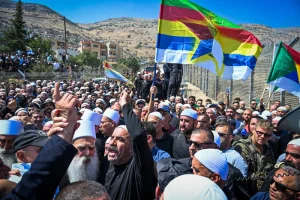
On the other hand, the IDF has also struggled to prevent activists of the extremist “Pioneers of Bashan” movement, which wants to settle the Syrian territories, from crossing over the border. On Tuesday, fourteen activists crossed the border before being arrested and returned to Israel, the IDF stated.
Likely referring to this situation, as well as the Israeli intervention to defend the southern Syrian Druze last year, al-Sharaa asked, “Why has Syria been bombed for two years, every day?”
“There are indiscriminate arrests taking place in Syria. Even the presidential palaces have been bombed twice by the Israeli army. Our airports are being bombed, as well as all the military airports that we have. Will that bring security to the Israeli citizen?”
Syrian President Ahmad Al Shara arrives at the US-GCC meeting on the sidelines of UNGA in New York. pic.twitter.com/FjWsEwHoTV
— The National (@TheNationalNews) September 22, 2026
In contrast, he pointed to improving relations with the U.S., Britain, Gulf states, and others: “Those relations are successful... So I believe the problem is with Israel, not with Syria.”
The United States has been trying to broker a security arrangement between Damascus and Jerusalem, though al-Sharaa accused Israel of pulling back every time the sides approached an agreement.
“There were several sessions of negotiations with Israel, and we almost reached 90% of agreements… We are still engaging in this track.”
While emphasizing that a full peace agreement remains far off and that Syria has not relinquished its claim to sovereignty over the Golan Heights, where part of his family is from, al-Sharaa argued that a phased approach could succeed.
“We need to protect the security and the rights of Syrians before we can talk about peace… We demand that Israel withdraw to the areas it occupied under the 1974 arrangements before discussing security arrangements,” the president said. “If the security arrangements succeed, it will be possible to move on to discussing a permanent peace.”
During his time as an internationally wanted terror leader, al-Sharaa was known as “al-Jolani,” a reference to his family’s ties to the strategically located plateau from which Syrian forces shelled Israeli towns for decades before Israel captured much of the territory during the 1967 Six-Day War.
“The Golan is Syrian land according to United Nations resolutions, and there is no room for discussion regarding its status,” al-Sharaa said.
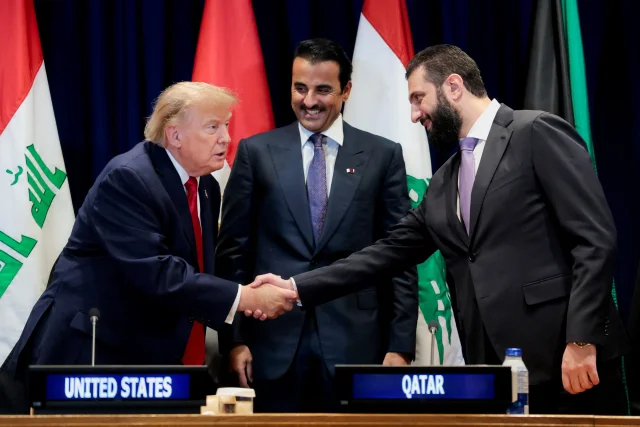
He recounted that he joked about the issue during his White House meeting with U.S. President Donald Trump, who recognized Israeli sovereignty over the Golan Heights.
“I said, 'Why don't you give New Jersey to the Israelis? You don't own the Golan Heights to give it to them, but you own New Jersey, and I believe New Jersey is full of Democrats, and they are not voting for Trump. So it will be good to give it to the Israelis.'”
“Regardless of this joke, the Golan Heights belong to their own people,” he reiterated. “It is neither the Syrian president nor the American president nor any other person who can abandon them or give them up to others.”
"If this task needs me to be there ... I will not be humble."
— The National (@TheNationalNews) September 22, 2026
Syrian President Ahmad Al Shara tells The National he is open to running in future elections in the country. pic.twitter.com/1w1xoNN8Mv
In addition to Israel, al-Sharaa addressed several other issues during his talk during the Atlantic Council panel. He claimed that his overall goal remains to guide Syria through a transitional period toward the adoption of a new constitution.
Asked whether he would stand for re-election afterward, he said he hadn't thought about it. “Right now, we are focusing on serving people... If I believe that I need to remain in power, I will stay there."
“What we are trying to instill now in Syria is respect for the law,” he said, “in order to make sure that authority is an institution and not an individual that is ruling the country.”
A key part of his rule so far has been the reconstruction of the country’s security services, including police and army forces. Israel is following these efforts closely, as the counterterror operations are harming some of Israel’s enemies, but the strengthening of the Syrian military could also threaten Israel in the future.
Al-Sharaa’s interior security forces have battled with the Lebanese Hezbollah trying to shut down the smuggling of weapons and drugs over the border, as well as conducted a campaign against the remnants of the terror group ISIS in the country.
Last week, the Syrian Interior Ministry said that five wanted suspects were arrested and weapons and ammunition were found in al-Sanamayn, in southern Syria, as part of anti-ISIS operations. The town is located some 30 km (18 miles) from the Israeli border.
Over the past month, a series of explosions at weapons and ammunition sites across northern Syria has killed dozens of people. Most experts have pointed to a lack of care and professional infrastructure, highlighting the difficulties in rebuilding the Syrian military.
The latest explosion wounded at least four people south of Aleppo on Monday. According to Reuters, at least 16 similar explosions were registered at arms storage facilities since the fall of the regime of Bashar al-Assad in December 2024.
You might also like to read this: