Israel, Abraham Accords partners convene in NYC to expand regional cooperation




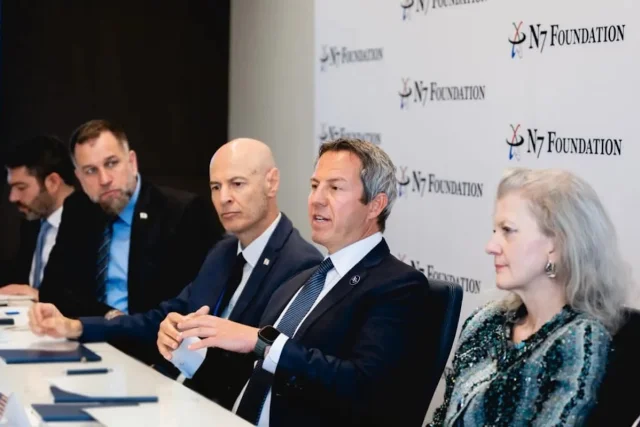
Senior Israeli, Arab and U.S. officials convened in New York on Thursday for the first official multilateral meeting of Abraham Accords countries since January 2023, with Kazakhstan participating for the first time as officials discussed ways to deepen regional cooperation.
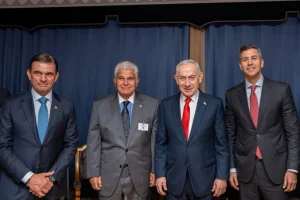
The high-level roundtable, hosted by N7 Foundation founder and chairman Jeffrey Talpins, brought together U.S. Under Secretary of State Allison Hooker and senior officials from Israel, Morocco, the United Arab Emirates, Bahrain and Kazakhstan.
The meeting was also the first official gathering of the Accords countries since the Hamas-led Oct. 7, 2023, attack and the subsequent Gaza war.
“The Abraham Accords have demonstrated what is possible when countries come together around shared interests with a common vision for a more integrated and prosperous region,” Talpins stated.
“The next phase is about deepening the relationships that already exist and identifying practical opportunities for countries to work together,” he added.
The participants reaffirmed the principles of the Abraham Accords and discussed potential areas for practical cooperation, including trade, investment, technology, water and food security, energy, regional stability and security. Officials also welcomed Kazakhstan’s forthcoming accession to the Accords.
“The Abraham Accords have created a foundation for a more connected region, and their full potential will be realized through the practical cooperation they make possible,” N7 president Oren Eisner explained.
“Today’s discussion focused on the work ahead: strengthening existing relationships, welcoming new partners, and advancing initiatives that deliver tangible benefits to people and economies across the region,” he added.
Kazakhstan’s participation could open the door for greater involvement by other non-Arab, Muslim-majority countries in Central Asia. Kazakhstan has welcomed the Abraham Accords framework while continuing to support a peaceful two-state solution to the Israeli-Palestinian conflict.
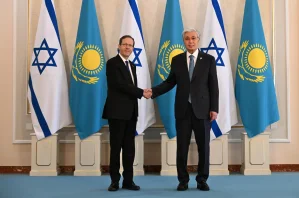
In April, Israeli President Isaac Herzog visited Kazakhstan on an official state visit, where he was hosted by Kazakhstan’s President Kassym-Jomart Tokayev. The visit highlighted growing strategic ties and cooperation between the two countries, including their longstanding Jewish connection.
“I am moved to be here as the President of the State of Israel. The Jewish story of Kazakhstan spans hundreds of years, which today translates into a modern and developing relationship,” Herzog stated. “I thank President Tokayev for inviting me on this state visit, and I was delighted to meet him, the senior leadership, and the flourishing and thriving Jewish community,” the Israeli president added.
The Abraham Accords were brokered by U.S. President Donald Trump in 2020 and initially established normalized relations between Israel, the United Arab Emirates and Bahrain, with Morocco later joining the framework. Sudan also agreed to normalize relations with Israel, although its accession to the Accords has not progressed in the same manner because of the country’s subsequent internal conflict.
The Trump administration has continued to promote the Abraham Accords as a framework for expanding diplomatic and economic ties between Israel and Arab and Muslim-majority countries. Washington has sought to encourage countries including Saudi Arabia and Indonesia to join the framework.
In September 2023, just weeks before the Hamas Oct. 7 attack, Saudi Crown Prince Mohammed bin Salman revealed in an exclusive Fox News interview that peace with Israel was getting “closer every day.”
However, following the Hamas attack and the Gaza war, Saudi Arabia informed Washington that it had decided to freeze normalization talks with Israel for the duration of the war. Normalization with Saudi Arabia is further complicated by Riyadh’s position that diplomatic relations with Israel should be linked to implementation of a two-state solution.
You might also like to read this: