The Messiah who would not come down
Islam, the Cross, and the victory Yeshua chose


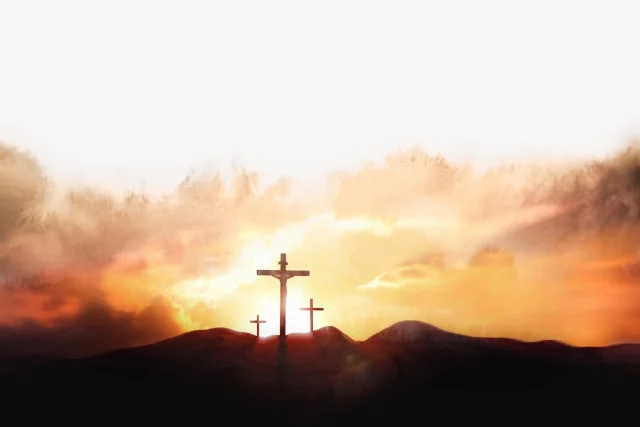
There is a sentence shouted at Yeshua from beneath the Cross that may be more important than it first appears:
“If You are the Son of God, come down from the cross” (Matthew 27:40).
Matthew has heard those words before.
At the beginning of Yeshua’s ministry, the tempter says, “If You are the Son of God…” (Matthew 4:3, 6). At the end, the challenge returns: If You are really God’s Son, prove it by escaping suffering.
But Yeshua does not come down.
That is where the Christian Gospel and Islam collide—not first over whether God had the power to rescue Jesus, but over what divine victory actually looks like.
Islam honors Jesus. The Qur’an calls him Messiah, speaks of his miraculous birth, and says that God raised him. Yet Qur’an 4:157 also declares that Jesus was not killed or crucified by his enemies. Classical Muslim interpretation often explained this by saying another person was made to resemble him, although Muslim interpretations differ over exactly what occurred.
The intention is understandable: Surely God would not allow His chosen Messiah to be publicly humiliated and killed by wicked men.
Christianity answers with a startling claim:
That apparent humiliation was not the defeat of Yeshua. It was the means of His victory.
The temptation was always “Messiah without the Cross”
This pattern runs through the Gospels.
In the wilderness, Satan offers Yeshua power without the Father's appointed path.
Later, when Yeshua tells His disciples that He must go to Jerusalem, suffer, be killed and rise again, Peter protests: “This shall never happen to You.”
Yeshua replies, “Get behind Me, Satan” (Matthew 16:22–23).
Peter loved Yeshua. Yet the logic behind his protest resembled the logic Yeshua had rejected in the wilderness: You can be Messiah without suffering. You can have glory without the Cross.
Then, at Golgotha, the temptation reaches its final form:
Come down.
This is why the Islamic denial of the crucifixion raises such a profound Christian question. Islam does not teach that Jesus obeyed Satan. But narratively it gives Jesus precisely the outcome the Gospel repeatedly presents as the rejected alternative: Messiahship separated from the Cross.
That does not prove Islam is satanic. It does mean the parallel deserves serious examination.
Why would Messiah need to die?
For a Muslim reader, this may be the decisive question.
Christianity does not teach that Jesus was helplessly overpowered. Yeshua says of His life:
“No one takes it from Me, but I lay it down of Myself” (John 10:18).
The Cross is therefore not God failing to rescue Yeshua.
It is Yeshua willingly giving Himself.
And this is not a late Gentile idea imposed upon a Jewish Messiah. The pattern is woven through Israel’s Scriptures.
Isaiah 53 describes the Servant of the LORD as rejected, pierced, bearing the sins of others, “cut off from the land of the living,” and yet afterward vindicated.
Psalm 22 depicts a righteous sufferer mocked by enemies whose suffering ultimately ends with the nations turning to the God of Israel.
Daniel 9 speaks of an Anointed One—Messiah—being “cut off.”
The Torah itself establishes the grammar of sacrifice, blood, Passover and atonement.
Then Yeshua says after His resurrection:
“Was it not necessary that the Messiah should suffer these things and enter into His glory?” (Luke 24:26).
Notice the order:
Suffering, then glory.
Not glory instead of suffering.
The historical problem cannot simply be ignored
There is also a historical difficulty for the Islamic view.
The crucifixion is not an obscure detail that appeared centuries later in Christian tradition. It is embedded in Christianity’s earliest testimony.
Paul’s letters were written within the first generation after Yeshua’s death. In 1 Corinthians 15, Paul passes on a tradition he had already received: Messiah died for our sins, was buried and was raised.
The sequence is ancient, concise and central.
The Cross is also reported by all four canonical Gospels and reflected in non-Christian Roman testimony concerning Jesus’ execution under Pontius Pilate.
Islam’s denial appears roughly six centuries later.
A Muslim may still believe the Qur’an corrects the earlier record. But then the question becomes unavoidable:
Why should a later denial overturn the earlier, multiply attested testimony—especially when that death stands at the center of the earliest apostolic proclamation and fits the messianic pattern of Israel’s Scriptures?
The Christian claim is greater than rescue
Here lies the deepest difference.
Islamic theology seeks to vindicate Jesus by denying that His enemies finally succeeded in killing Him.
The Gospel says something far more astonishing:
They did kill Him—and still they did not win.
Resurrection is greater than escape from death because resurrection means death itself has been conquered.
God does not merely keep Messiah from entering the grave.
Messiah enters the grave and comes out the other side.
That is why Paul says that through the Cross Messiah “disarmed the rulers and authorities” (Colossians 2:15). Hebrews says that through death He broke the power of the one who held the power of death (Hebrews 2:14).
The Cross was not an interruption of God’s plan.
It was the trap into which evil walked.
The powers thought killing Yeshua would end His mission. Instead, His death became the means by which sin was atoned for, death was defeated and the dominion of the powers was broken.
This illuminates Paul’s extraordinary statement that if “the rulers of this age” had understood God’s wisdom, “they would not have crucified the Lord of glory” (1 Corinthians 2:8).
They did not understand what the Cross would accomplish until it was too late.
What constitutes the greater victory?
So the central question for a Muslim is not:
Could God have saved Jesus from crucifixion?
Of course He could.
The question is:
What if God chose something greater?
What if divine power is revealed not merely by preventing suffering, but by transforming suffering into redemption?
What if God’s victory was not keeping Messiah from death, but defeating death through Messiah?
What if the very event that appears dishonorable to human eyes is where God reveals His deepest wisdom?
That is precisely the apostolic claim.
Philippians 2 says Yeshua humbled Himself and became obedient “to the point of death, even death on a cross. Therefore God also has highly exalted Him.”
Again, the order matters.
Not exaltation instead of death.
Exaltation through obedient death.
He stayed
This brings us back to the mockers at Golgotha.
“If You are the Son of God, come down.”
Yeshua could have.
He did not.
Not because Rome was stronger.
Not because His enemies had defeated Him.
Not because the Father had abandoned His plan.
He stayed because the Cross was the plan.
Had He saved Himself from death, He would not have saved us through His death.
Had the Lamb escaped the sacrifice, there would have been no atonement.
Had Messiah never died, there could be no resurrection from the dead.
Islam says Jesus did not die there.
The apostles proclaimed something radically different:
He stayed.
He died.
He was buried.
And God raised Him from the dead.
For the follower of Yeshua, that is not the story of a defeated prophet.
It is the story of Israel’s Messiah accomplishing redemption precisely where the world thought He had lost.
The Cross was not the failure from which God rescued Yeshua.
It was the battlefield on which Yeshua won.
You might also like to read this: