Is Lebanon ready to abolish its 1955 ban on contact with Israelis?
Lebanese banker’s dinner with Netanyahu sparks legal row – but underscores a growing debate over engaging Israelis



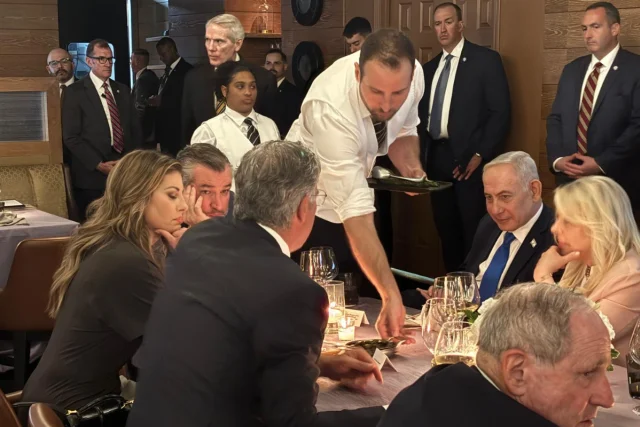
A dinner photo showing a prominent Lebanese banker with Israeli Prime Minister Benjamin Netanyahu in Washington, D.C., sparked controversy in Lebanon this week. While Western media focused on the backlash and legal action, reactions inside Lebanon revealed a broader debate over growing willingness to engage with Israel.
Antoun Sehnaoui co-hosted the dinner with former U.S. Envoy Morgan Ortagus in honor of the late Sen. Lindsey Graham, Axios News reported. A photograph from the event showed Netanyahu and his wife Sara seated across from Sehnaoui, alongside U.S. Senator Ted Cruz.
A group of Lebanese lawyers reportedly invoked Lebanon’s 1955 Israel boycott law, prompting Public Prosecutor Judge Rami al-Hajj to issue a search-and-investigation notice. Though administered through the Ministry of Economy’s Israel Boycott Office, the law broadly prohibits contact with Israeli entities and individuals, with penalties of fines, hard labor, or imprisonment.
Last night, Sara and I joined Lindsey Graham’s family and friends in Washington to honor his memory.
— Benjamin Netanyahu - בנימין נתניהו (@netanyahu) July 28, 2026
America lost a great patriot. Israel lost one of its greatest friends. And I lost a dear friend.
Lindsey’s courage, friendship and commitment to our alliance will never be… pic.twitter.com/lvfoiixKxl
But some Lebanese analysts have downplayed the significance of the legal move.
“It was not an indictment or a criminal charge,” said Tony Abi Najm, editor-in-chief of IMLebanon. “The notice was issued because the prosecutor wanted to determine Antoun Sehnaoui’s whereabouts and was informed that he was outside Lebanon.”
“What Antoun Sehnaoui did was for Lebanon – not for Netanyahu, not for Trump, and not for Iran. He did it because Lebanon needs to move forward,” he said in an interview with El Siyasa.
A Christian businessman from a prominent Lebanese banking family, Sehnaoui has long been associated with pro-Western circles. In April, his donation to the U.S. Holocaust Memorial Museum became another point of tension after Ortagus, his partner, praised his family’s ties to Christian Zionism during the ceremony.
Today is Yom HaShoah, Holocaust Remembrance Day.
— Antoun Sehnaoui (@SehnaouiAntoun) April 14, 2026
Morgan and I had the honor of attending the United States Holocaust Memorial Museum’s Days of Remembrance ceremony in Washington, D.C., where our inscription on the Donors Wall was unveiled.
This year, and every year, we are… pic.twitter.com/JoK8KHU5Z7
Sehnaoui chairs the board of Société Générale de Banque au Liban (SGBL), which was recently named in a pending U.S. civil lawsuit concerning alleged Hezbollah-linked financial networks.
However, beyond Sehnaoui, the controversy reflects a wider political struggle over engagement with Israel and the possibility of future relations. Abi Najm argued that some of Sehnaoui’s critics are the same figures who previously accused Lebanese President Joseph Aoun of betrayal for entering negotiations with Israel.
Citing Lebanon’s signed agreement with Israel, he said, “Article 12 states that, immediately after signing this framework, the two countries will establish working groups to prepare a comprehensive peace and security agreement. What does that mean? It means representatives from both countries will sit together and negotiate. How do you reach a peace agreement without communicating with the other side?”
Former Lebanese Parliament member Hadi Hobeiche questioned whether Lebanon’s legal framework reflects the country’s current political realities.
“Look, the law is one thing. But today, the national interest is, in my opinion, stronger than laws. When you have matters of national interest, all these details become secondary,” Hobeiche said in an interview with Al Jadeed. “If the law prevents me from sitting with Israelis, but sitting with Israelis leads to stopping attacks and stopping the killing of my people, then yes, I will sit with them regardless of what the legal texts say.”
“The legal texts themselves need to be reviewed and amended, because when these laws were created, we were in a certain situation. Today, we are in a different situation.”
Abi Najm noted that Lebanese journalists have interviewed former IDF Spokesman Avichay Adraee and that Ali Hamdan, advisor to Parliament Speaker Nabih Berri, has communicated with Israeli journalist Barak Ravid of Axios – without resulting in prosecutions.
“There happened to be a dinner attended by senior officials. Let's stop being trapped by outdated thinking. If we want peace, we have to move beyond these complexes,” he said.
Critics disagreed. Hasan Illaik, a veteran journalist with Hezbollah-affiliated Al Akhbar, accused Sehnaoui of being a "result" of the current Lebanese government.
“It is unacceptable for Anton Sehnaoui to do what he has done, only for his bank to continue operating normally in the country the very next day, alongside his financial companies, media outlets, and affiliated production firms,” Illaik said.
Abi Najm argued that the real betrayal lay elsewhere.
“The real betrayal is destroying the country for Ali Khamenei – forcing one and a half million people from their homes and devastating seventy villages. That's the real treason.”
Pointing to Egypt and Jordan's peace treaties with Israel, he added, “No one should frighten us with these old narratives anymore.”
Help more people find our reporting from Israel! Leave a quick Google review of our website HERE .
You might also like to read this: