Iranian foreign minister says country ‘waiting for US response’ to latest proposal to open Hormuz, end war
Iranian official says country will not budge on nuclear rights, Trump considers renewed bombing campaign



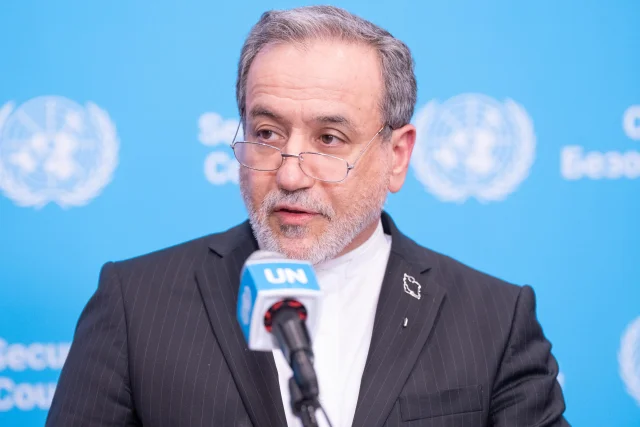
Despite President Donald Trump’s public rejection of an Iranian proposal to reopen the Strait of Hormuz and end the state of conflict between the United States and Iran, the Iranian regime insists it is pursuing a diplomatic solution.
Iranian Foreign Minister Abbas Araghchi was asked about the U.S. response to the Iranian plan following Trump’s stated rejection.
Araghchi said Trump has “made many contradictory statements” in the past.
The Iranian foreign minister said the proposals had been “conveyed to the American side through intermediaries.”
“We are waiting for the mediators to convey the definitive views to us, and we will make a decision based on them," Araghchi said in a video posted on social media by Al Jazeera.
Araghchi has reportedly remained in New York to continue talks with the U.S. administration through mediators.
While in New York, Araghchi reportedly met with Robert Malley, a former Obama and Biden administration official who helped negotiate the Joint Comprehensive Plan of Action (JCPOA) nuclear agreement in 2015, from which Trump withdrew the United States in 2018.
Malley was dismissed from his government position over the handling of classified documents. He has also faced scrutiny over alleged ties to a regime-aligned influence network known as the “Iran Experts Initiative,” whose existence was reported by Iran International and Semafor in September 2023.
According to Israel Hayom, Malley is believed to be advising Araghchi on negotiations with the United States.
Iranian President Masoud Pezeshkian appeared on the CBS program “Face the Nation” over the weekend, where he said that Iran is ready to open the Strait of Hormuz the day the U.S. accepts its proposal.
However, when asked about the terms, Pezeshkian did not clarify whether Iran would seek control of the strait or require payments for use of the waterway, as it has previously demanded.
The Iranian president also accused Trump of capriciousness, claiming that Iran was honoring its agreement under the JCPOA until Trump withdrew. He also said, “We sat down and resumed talks with them. In the middle of the negotiations, they attacked us.”
Pezeshkian accused the United States of abiding by previous agreements, saying the Iranian government has lost trust in Washington.
“Put yourself in our position. Imagine someone came and martyred your Supreme Leader. And then, not abide by everything you had agreed upon. What would be your reaction? It's not something that can be resolved that simply.”
The Iranian leader also told Al Jazeera that his country has "lost faith" in Washington.
“We no longer have faith in Washington after the attacks and sanctions that have followed all negotiations,” Pezeshkian said. “Qatar and Pakistan are currently mediating between Iran and the US and are conveying our messages to Washington.”
Pezeshkian was in the U.S. for the UN General Assembly, after Washington granted him permission to enter for the second year.
While Pezeshkian told CBS that Iran would allow nuclear inspectors to resume their work in the country, a senior Iranian official told Reuters on Friday that Tehran would make no concessions or show any flexibility regarding its nuclear program.
Meanwhile, amid reports of explosions in vessels seeking to traverse the Hormuz Strait on Sunday morning, the commander-in-chief of the Iranian army, Amir Hatam, said Iran would not allow any vessels to use the strait until it is able to do so itself.
“If Iran cannot trade, if Iran cannot live, no one will be able to trade or live,” Hatam said in statements carried by regime-affiliated media.
🔴🇮🇷🇺🇸UPDATE: More explosions are being heard right now off the coast of Bandar Abbas.
— BeamTracker | Military OSINT (@BeamTracker_) September 26, 2026
Third wave of powerful blasts tonight, it‘s likely that US forces might be attempting to escort a large convoy through the Omani route.
Source: @hey_itsmyturn https://t.co/wuPslxoLvx pic.twitter.com/0vnwTvVPjj
At the same time, Anwar Gargash, a senior diplomatic advisor to the president of the United Arab Emirates, Mohamed bin Zayed, said in an interview over the weekend that the current “situation of neither war nor peace” could continue for several months.
Speaking to Foreign Affairs, Gargash said that any agreement with Iran must deliver lasting peace, rather than a break in hostilities.
“We do need peace, but I think also we need peace that will last,” Gargash told Foreign Affairs. “We don’t need, you know, sort of a patch-up job where suddenly within three months, four months, five months, we have another outbreak.”
“I think we need something with more permanency,” he added, saying he believes that input from the Gulf states is necessary to reach a lasting peace deal between the two sides.
“The American-Iranian level is one important level. But I think also from our vantage point in the Gulf, these discussions at the Gulf or individual Gulf countries or the Gulf as a group with Iran is extremely important.”
Meanwhile, The Wall Street Journal reported that President Trump is considering a renewed bombing campaign aimed at convincing the regime to accept U.S. demands after the midterm elections.
You might also like to read this: