How The Art of the Deal explains Trump's latest Israel controversy

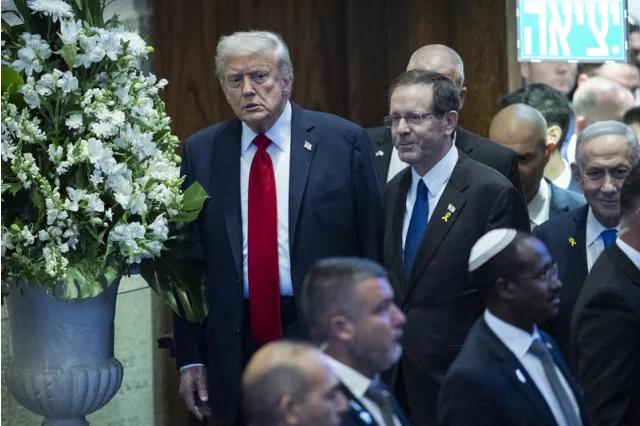
U.S. President Donald Trump has once again stirred up controversy with comments about Israel that immediately lit up social media and cable news. Speaking on Monday, Trump suggested that Israel would be in grave danger – or perhaps not even exist as it does today – had he not personally gotten involved.
It was a classic Trump formulation: remove him from the equation and the outcome becomes dramatically worse.
President Trump has arguably done more for Israel than any modern U.S. president. His claim that Israel would not exist without him, however, is best viewed as an example of his characteristic hyperbole and ego rather than a statement with biblical support, particularly given biblical passages that describe Israel existing in the last days.
But it’s not just ego. There’s more to the story and we’ll touch on that in a moment. First, let’s point out the pattern at play here and what’s behind it. It stretches far beyond Israel.
Trump has been making versions of the same argument for years. The wording changes but structure rarely does.
Regarding Russia’s invasion of Ukraine, Trump has repeatedly insisted: “This would never have happened if I were president.”
On NATO, remember this one? “If it weren’t for me, NATO wouldn’t even exist.”
How about the economy: “Without me, you’d have had a depression.”
Even when it comes to doom-and-gloom scenarios, Trump talks about saving the day: “We’re heading toward World War III… Only I can stop it,” Trump has exclaimed.
The common thread is unmistakable. Trump consistently presents himself as the decisive variable.
It would be easy to chalk all of this up to egocentric or narcissistic behavior. There’s little doubt that Trump has a healthy ego. He enjoys taking credit. He likes being the center of attention. But when you step back and examine the totality of how Trump has communicated over the last forty years, another explanation begins to emerge.
His comments aren’t random. They’re remarkably consistent with the public relations philosophy he laid out decades ago in "The Art of the Deal."
Let’s take a deeper dive.
Perhaps the most revealing passage comes when Trump introduces what he calls “truthful hyperbole.” He describes it as “an innocent form of exaggeration” and then comes the key line: “People want to believe that something is the biggest and the greatest and the most spectacular.” You see the connection?
So instead of saying he helped Israel, Trump says Israel might not exist without him. Instead of saying he strengthened NATO, he says he saved NATO. Instead of arguing his policies reduced the chances of war, he says only he can stop World War III. It all fits almost perfectly within the communications strategy that Trump himself described nearly four decades ago.
Another famous line from "The Art of the Deal" may be even more revealing. He wrote, “I like thinking big.” Trump rarely frames issues as incremental improvements. Instead, the stakes are almost always existential. Countries either survive or disappear. Economies boom or collapse.
Throughout the book, Trump repeatedly casts successful negotiations through the eyes of the dealmaker. And of course, Trump is the ultimate dealmaker. What ends up happening is that the emphasis isn’t on the project as much as it’s on the person who made it happen. So that helps explain why Trump so often says “I” rather than “my administration” or “the United States.”
Put another way: Trump’s leadership produced the success, and in branding terms, that’s enormously powerful. The dealmaker becomes inseparable from the deal itself.
However, when Trump made those comments about Israel Monday, the initial reaction understandably would rub Israelis and American Pro-Israel Supporters the wrong way.
After all, history shows that Israel survived its War of Independence in 1948 despite receiving no direct U.S. military assistance and nearly two decades later, Israel stunned the world by defeating Egypt, Jordan and Syria during the Six-Day War of 1967 through the capabilities of the Israel Defense Forces – not through direct American military intervention.
Additionally, Evangelical Christians will be the first to remind everyone that God has a special plan for the nation of Israel and the Bible makes clear Israel will exist in the end days.
Despite all that, it’s important to remember that in the end, perhaps the old observation still holds true. When it comes to Donald Trump, it may be wise to take him seriously – but not always literally. That mindset may help to more easily digest some of the over-the-top rhetoric that can be on display more frequently than not.
You might also like to read this: