'Disgusting': Opposition to UN convention for women’s rights intensifies in Judea and Samaria



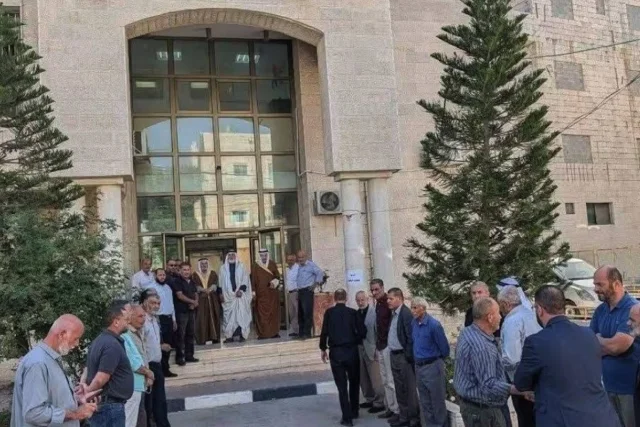
A Palestinian Christian and human rights advocate has slammed protests against a UN anti-discrimination convention protecting women’s rights as “disgusting,” criticizing recent attacks against a Christian school for banning the hijab.
Opposition to the UN Convention is not new but the movement campaigning against it has gained momentum over the past several years, asserting that it contravenes Islamic Sharia Law.
The Convention on the Elimination of All Forms of Discrimination against Women (CEDAW) was passed in the UN by 189 states in 1979 but despite the fact that President Mahmoud Abbas symbolically signed up to the convention in 2009, its implementation has been fiercely contested within the Palestinian Authority.
In his post yesterday, Ihab Hassan highlighted recent attempts by the “Popular Movement to Bring Down CEDAW” to incite the public against a Christian school.
He warned against the movement, saying, “It opposes women’s rights and equality.”
“Inciting against the school is terrifying and is extending to incitement outside the school,” Hassan added. “The matter is horrifying and needs a real stand.”
Member states who accepted CEDAW pledged to eliminate the exclusion and restriction of women, and any drawing a distinction between men and women in a way that negatively impairs women’s rights and freedoms.
Signatories are committed to ending discriminatory legislation, establishing tribunals and frameworks for protecting women’s rights, and eliminating all acts of discrimination against women such as inheritance practices that favor sons over daughters, requirements for male guardianship, the elimination of polygamy and so on.
According to Hassan, the movement opposing this Convention guarding women’s rights has accused the Christian school of “overstepping Islamic religious rulings related to the Islamic faith.”
There is a disgusting Islamist movement in the West Bank called the “Popular Movement to Bring Down CEDAW.” It opposes women’s rights and equality. It is now inciting the public against a Christian school over its ban on the hijab. In its statement, the movement accused the school of “overstepping Islamic religious rulings related to the Islamic faith.”
— Ihab Hassan (@IhabHassane) October 5, 2026
The Al-Tahrir Party (Hizb ut-Tahrir), which means the “Liberation” party, is a fundamentalist pan-Arab organization at the forefront of the movement opposing CEDAW. According to Hassan, they argue that some articles contradict the principles of Islamic jurisprudence.
Following the formal adoption of the Convention by the Palestinian Authority in 2014, Schmidt College for Girls, a German Catholic school located near the Damascus Gate in East Jerusalem, also saw protests against its ban on the hijab.
Having prevented one girl from entering the graduation ceremony wearing the Muslim head covering, the school had help from Palestinian Authority security in quelling the protests that followed.
In the same year, the Rosary Sisters School in Beit Hanina extended the ban to all items of clothing or jewelry pertaining to religious or political affiliations, leading to protests and community tensions, including threats of serious violence, according to Haaretz.
“Wise people from both sides are trying to calm the waters and limit the topic to the school campuses,” executive secretary of the Jerusalem Inter-Church Center, Yusef Daher, told the Israeli outlet at the time, saying that he hoped they would succeed.
Five years later, in 2021, the Grand Mufti of Jerusalem and the Palestinian Territories, Sheikh Mohammed Hussein, issued a ruling on the matter. “It is not possible to ratify under any circumstance any law that does not comply with the provisions of Islamic sharia that are in force in the Palestinian territories.”
“The decision of the Jurisprudence Council reaffirms that anything that contradicts with and does not go in agreement with the Islamic sharia is completely rejected,” he stated, “whether it is CEDAW or any other agreement that does not comply with the spirit of sharia… there are personal status laws derived from the provisions of Islamic sharia, they are laws that completely align with the spirit of sharia and ensure everyone’s rights.”
Sheikh Hussein has clarified that while there are articles within the Convention that align with Islamic teaching, there are “other issues that are disagreed upon,” for example on abortion, inheritance, homosexuality and other matters.
According to the Mediterranean Network for Feminist Information (Medfeminiswiya), the Palestinian Authority's top Sharia judge, Mahmoud al-Habash, also said, “Islamic sharia is above the law, and above any political commitment or commitment to international laws and conventions.”
“We will not accept any contradiction with what God has prescribed,” he added.
While feminist groups are urging the authorities to abide by the convention, leading clerics and political movements such as Al-Tahrir, along with tribes from Hebron, Jerusalem and Gaza, have all expressed their opposition to its implementation.
In 2018, the Palestinian Constitutional Court issued a decision stating that “anything in the agreement that contradicts… the national identity does not have to be implemented.”
Similarly, the Palestinian Bar Association also rejected implementing and publishing CEDAW in its current form, according to Medfeminiswiya.
However, Rima Nazzal, the General Union of Palestinian Women secretariat, said assertions that it contravenes Islamic sharia and contradicts society’s values were spurious, and that Palestinian basic law “stipulates equality between all citizens and gives women their full rights.”
“We do not see that this delay is justified or [that the convention] contradicts with the orientation of the state of Palestine and its basic laws.”
Nazzal attributed the rejection of CEDAW to the rise of extremist and fundamentalist Salafi movements, saying, “The [Palestinian] authority sadly did not work on confronting these segments that have limited freedoms, threatened human rights defenders and accused them of betrayal. The policy of silence towards this behavior allowed for the growth of this current in society.”
Meanwhile, Hassan drew attention to the aspect of hostility towards Christian communities living under the Palestinian Authority.
“Hizb ut-Tahrir and its remnants have an explicit enmity towards Christianity. And they always exploit societal events to spread their venom towards Christians,” he wrote on 𝕏.
Palestinian Christian commentator Jack Nassar, replying to Hassan’s post, said the largest gathering of the opposition protesters was in Hebron, but that they were also in Jerusalem, Nablus, Tulkarm, Ramallah and other locations.
You might also like to read this: